
Enterprise Applicant Tracking System: A Complete Guide for 2026
Recruit
Enterprise ATS
9 min read
Key Highlights
Enterprise hiring involves more applicants, teams, locations, and approvals than a standard ATS is typically designed to manage.
An enterprise ATS centralizes requisitions, candidate pipelines, approvals, and collaboration, while providing controls such as role-based access and audit trails.
Essential capabilities include high-volume recruiting, customizable approval workflows, HR system integrations, advanced reporting, and support for multi-location hiring.
The blog compares platforms such as Greenhouse, SmartRecruiters, Workday, Lever, and iCIMS, highlighting the different enterprise needs each serves.
Choosing the right ATS means assessing how well it fits current hiring processes and can scale with future growth, including implementation, migration, security, and vendor support.
Introduction
Enterprise hiring is far more complex than hiring for a small or growing business. As organizations expand across departments, locations, and teams, managing recruitment becomes increasingly difficult without the right systems in place.
Standard applicant tracking systems may work for straightforward hiring, but they often struggle to support high application volumes, complex approval processes, and collaboration across multiple stakeholders. This is where enterprise-focused recruitment software becomes essential.
This guide explains what an enterprise applicant tracking system is, how it differs from standard ATS, the key features to look for, how to evaluate enterprise solutions, and the leading platforms for large-scale hiring.
What is an Enterprise Applicant Tracking System?
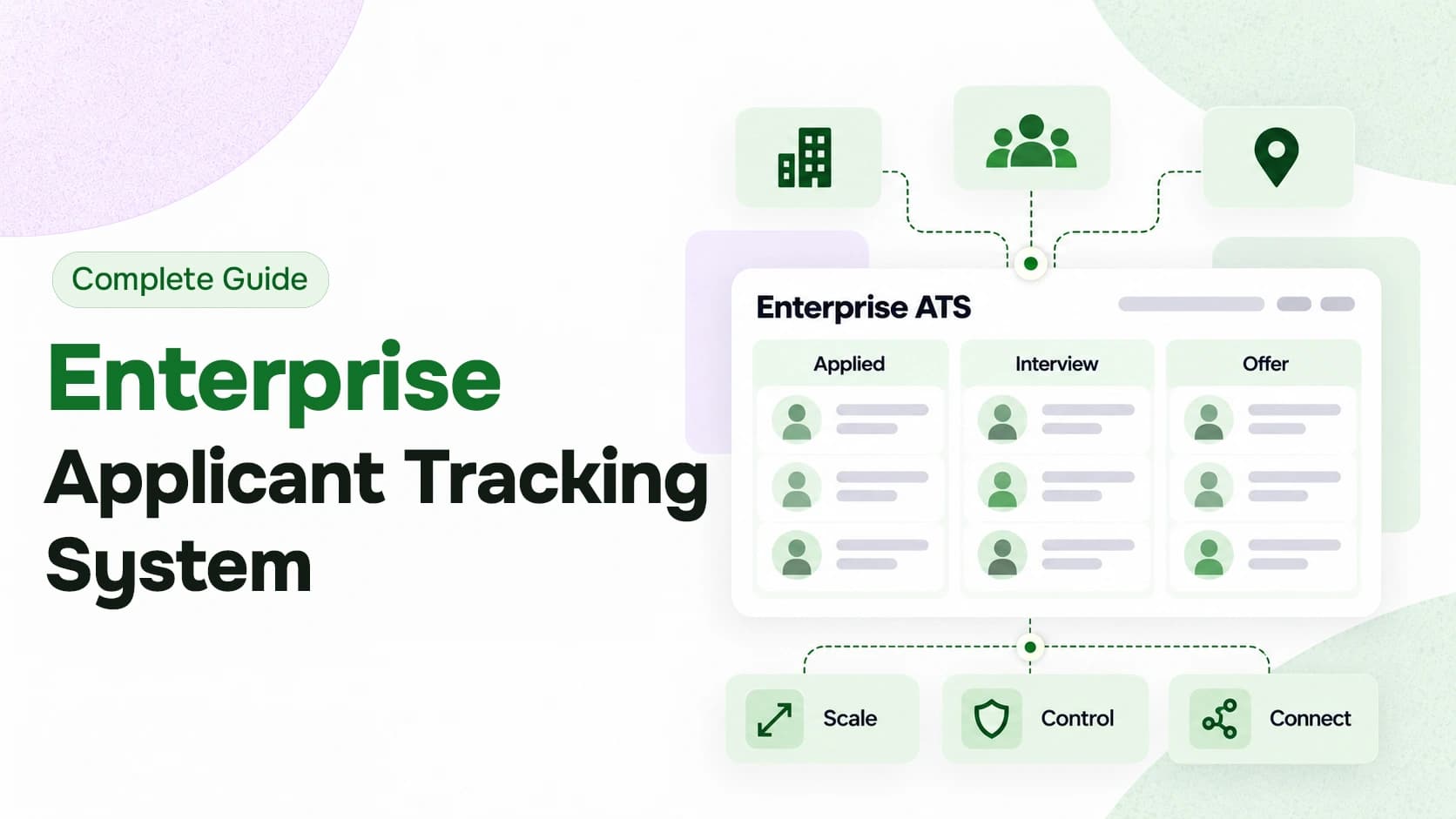
An enterprise applicant tracking system is recruitment software designed for large organizations that handle complex, high-volume hiring. It is built to support structured recruitment across multiple teams, departments, and locations, which is why it serves as the large company applicant tracking solution of choice.
Instead of managing hiring through disconnected tools, an enterprise ATS centralizes job requisitions, candidate pipelines, approvals, and recruiter collaboration in a single system. This gives hiring teams greater visibility, consistency, and control throughout the recruitment process.
Enterprise ATS platforms also provide governance features such as role-based access control, workflow automation, audit trails, and advanced reporting to support secure, compliant, and efficient hiring at scale.
Enterprise Applicant Tracking System vs Standard ATS
While both systems help organizations manage recruitment, they are designed for different hiring environments. A standard ATS suits small to mid-sized businesses with straightforward hiring, while an enterprise ATS is built for large organizations hiring across multiple teams, locations, or countries, with a focus on scale, governance, and integration.
Features | Standard ATS | Enterprise ATS |
Hiring Volume | Moderate hiring activity | High-volume recruiting across multiple teams |
User Management | Limited user roles | Advanced role-based access control |
Workflow Complexity | Basic hiring workflows | Multi-level approval workflows and custom processes |
Integrations | Limited integrations | Enterprise-grade API integrations with HR systems |
Reporting | Standard reports | Advanced analytics and enterprise reporting |
Compliance | Basic compliance support | Detailed audit trail and governance controls |
Geographic Reach | Single locations or region | Multi-location and global hiring support |
Scalability | Suitable for growing teams | Built for large-scale hiring operations |
Still Scaling Toward Enterprise?
If you’re not managing multi-region approvals yet, Mercury Recruit gives growing teams the structure without the overhead.
Key Features to Look for in an Enterprise Applicant Tracking System
Not every ATS is built for enterprise hiring. Large organizations need systems that can handle complex recruitment processes, high application volumes, and collaboration across multiple teams and locations.
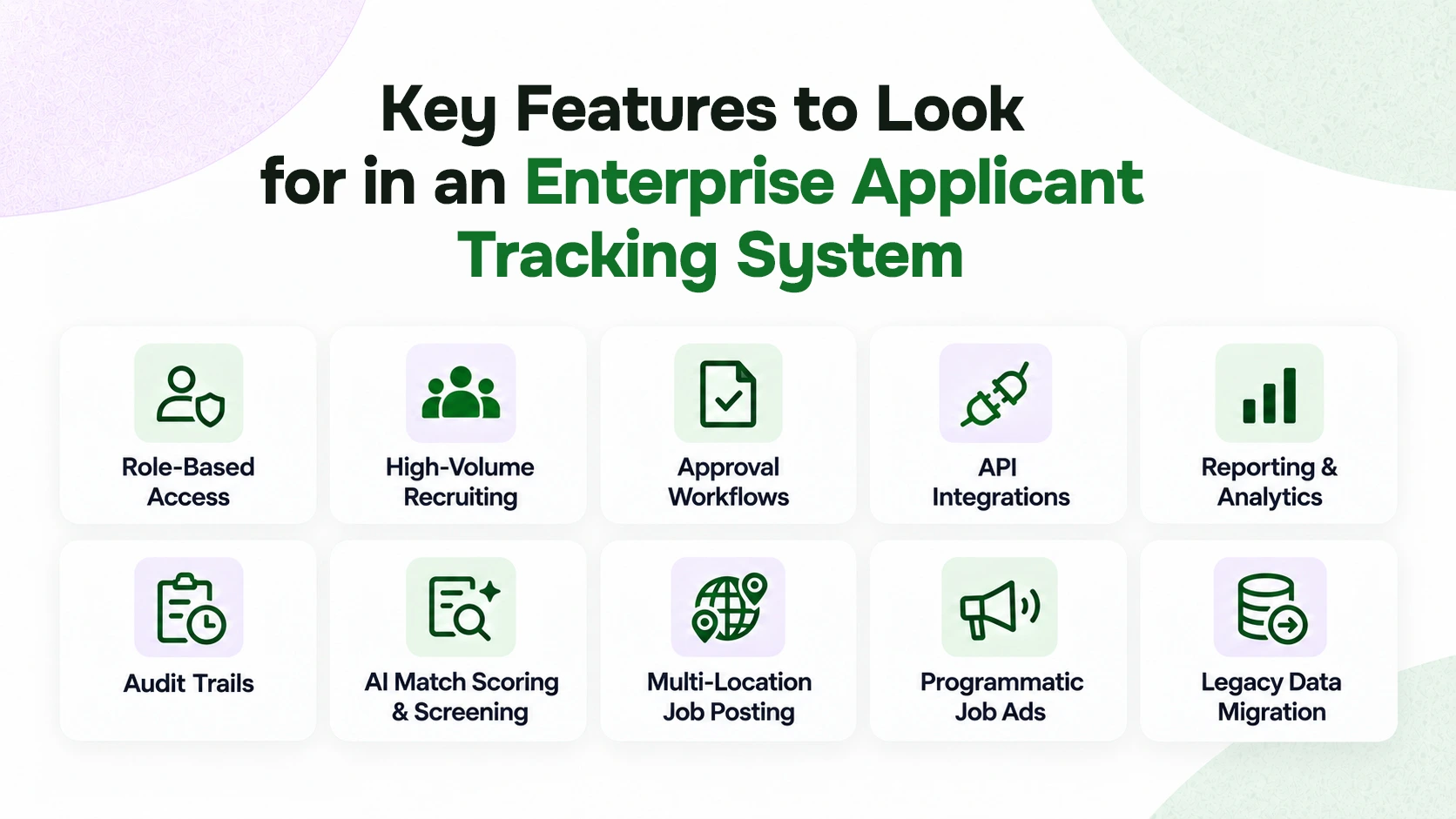
When evaluating an enterprise applicant tracking system, the following features are often the most important.
Role-Based Access Control: Enterprise recruitment involves multiple stakeholders, including recruiters, hiring managers, department heads, and leadership teams. Role-based access control allows organizations to assign permissions based on responsibilities, so people only see what is relevant to their role.
High-Volume Recruiting Support: Enterprise hiring often means managing hundreds or even thousands of applications across multiple positions. According to SHRM's Recruiting Benchmarking report, recruiters in extra-large organizations managed a median of 100 requisitions each in 2026. An ATS should be able to process these high candidate volumes efficiently without slowing down workflows or creating administrative bottlenecks.
Multi-Level Approval Workflows: Many organizations require approvals before a job is posted, an offer is extended, or a hiring decision is finalized. For example, a new job opening may need approval from the hiring manager, department head, and HR before it can be published. Multi-level approval workflows help standardize these processes and maintain consistency across departments.
Enterprise-Grade API Integrations: Recruitment is only one part of the broader HR ecosystem. Enterprise ATS software should integrate with HRIS platforms, payroll systems, onboarding, assessment, and background screening services. Enterprise-grade APIs keep data flowing between systems and cut down on manual entry.
Advanced Reporting and Analytics: Hiring decisions rely on accurate data. Enterprise ATS platforms should provide detailed reporting on metrics such as time-to-hire, source effectiveness, recruiter performance, and pipeline conversion rates. These numbers help organizations spot bottlenecks and improve.
Audit Trail and Compliance Controls: For regulated industries or multiple-region hiring, compliance is a critical consideration. Audit trail records the action taken in the system, which supports transparency and both internal and external compliance requirements.
AI Match Scoring and Autonomous Screening: Many modern enterprise ATS platforms use AI to manage large candidate pools efficiently. AI match scoring ranks candidates based on job requirements, while autonomous screening filters applications against predefined criteria. LinkedIn's Future of Recruiting 2025 report found that talent acquisition professionals using generative AI reported a 20% reduction in workload, highlighting AI’s potential to reduce manual recruiting tasks.
Multi-Location Job Syndication: Large organizations often recruit across multiple offices, regions, or countries. Multi-location job syndication allows employers to distribute job openings across various job boards and career sites while maintaining centralized management.
Programmatic Job Advertising: Programmatic job advertising helps organizations automatically allocate recruitment advertising budgets to channels that are most likely to attract qualified candidates. This can improve recruitment efficiency and increase visibility for critical roles.
Legacy Data Migration Support: Organizations moving from an existing platform should consider how easily historical candidate records, hiring data, and workflows can be transferred into the new system. Strong legacy data migration capabilities reduce implementation challenges and preserve valuable recruitment data. This helps organizations retain historical candidate records and hiring data when switching ATS platforms.
Top Enterprise Applicant Tracking Systems in 2026
Large organizations often require ATS platforms that can support high-volume recruiting, complex workflows, enterprise integrations, and compliance requirements. While the best choice depends on specific business needs, several platforms are widely recognized in the enterprise recruitment market.
1. Greenhouse (Best for structured hiring)
Greenhouse is known for its structured hiring approach, helping enterprises standardize interviews, scorecards, and hiring workflows across multiple teams. This helps ensure consistent candidate evaluations as hiring scales. With over 500 HR and recruiting integrations, it also fits easily into existing HR systems.
2. SmartRecruiters (Best for multi-location hiring needs)
SmartRecruiters is built for enterprises hiring across multiple regions and business units. It offers AI-powered recruiting, multilingual career sites, and programmatic job advertising to help organizations manage global recruitment from a single platform. Its marketplace integrations also connect with a wide range of HR, payroll, and productivity tools.
Best for: Enterprises with global or multi-location hiring needs.
3. Workday (Best for Workday ecosystem)
Workday Recruiting is designed for organizations already using the Workday ecosystem. It connects recruitment with HR, payroll, workforce planning, and employee records in a single platform, reducing manual data transfer and improving visibility throughout the employee lifecycle.
4. Lever (Best for proactive recruiting and long-term talent engagement)
Lever combines an applicant tracking system with built-in candidate relationship management (CRM), allowing enterprises to manage active applicants while nurturing long-term talent pipelines. It also integrates with hundreds of recruiting and HR tools, making it easier to streamline sourcing, interviewing, and hiring workflows.
5. ICIMS Talent Cloud (Best high-volume hiring)
ICIMS Talent Cloud is built for enterprises that manage high-volume hiring across multiple teams and locations. It combines applicant tracking with AI-powered recruiting and integrates with hundreds of HR and business applications, making it easier to scale recruitment while working within existing enterprise systems.
You can also check out our listicle on the top applicant tracking system for small business to compare with enterprise systems.
How to Choose the Right Enterprise Applicant Tracking System
Selecting an enterprise applicant tracking system is a long-term decision that affects recruitment operations, user adoption, and scalability. While features are important, organizations should evaluate vendors based on how well the platform aligns with their hiring processes and future growth plans.
Scalability and Hiring Capacity: Consider whether the platform can support both your current hiring needs and future growth. Evaluate how it handles increasing application volumes, additional users, and expansion across departments or locations without requiring major system changes.
Integration Capabilities: Review how well the ATS integrates with your existing HR technology stack, including HRIS platforms, payroll systems, onboarding software, assessment tools, and communication platforms. Strong integration capabilities help reduce manual work, improve data accuracy, and create a more connected recruitment process.
Workflow Flexibility: Assess whether the platform allows you to configure hiring stages, approval workflows, and recruitment processes to match your organization's needs. A flexible system is easier to adapt as hiring requirements evolve without forcing teams to change established workflows.
Security and Compliance: Evaluate the platform’s security measures and compliance capabilities to ensure candidate data is protected throughout the recruitment process. Features such as role-based access control, audit trails, and support for relevant data protection regulations are essential for enterprise hiring.
Implementation and Data Migration: Consider the implementation timeline, onboarding support, and legacy data migration capabilities before selecting a vendor. A well-managed transition helps minimize disruption, preserves historical recruitment data, and enables faster adoption across hiring teams.
Vendor Support: Look beyond the software itself and evaluate the level of ongoing support the vendor provides. Training resources, technical assistance, regular updates, and dedicated account management can all contribute to the long-term success of your recruitment platform.
Recruiting Software for Growing Teams
Skip the enterprise complexity you don’t need yet. Mercury Recruit scales with you as you grow into it.
Book A DemoConclusion
An enterprise applicant tracking system brings structure, visibility, and consistency to complex hiring. As volumes increase and more teams get involved, it provides the workflows, integrations, governance controls, and scalability that keep recruitment organized and efficient.
The right platform isn’t the one with the most features; it’s the one that fits how your organization hires today and can grow with you tomorrow. Choosing your ATS with that intent turns it from a tool you will eventually replace into infrastructure that scales with the business.
FAQs
Frequently Asked Questions
Some of the most widely used enterprise applicant tracking systems include Greenhouse, SmartRecruiters, Workday Recruiting, Lever, and iCIMS Talent Cloud. Each has different strengths, from workflow automation and analytics to enterprise integrations and global hiring support. The right choice depends on your hiring volume, operational complexity, and long-term goals.