
Employer Branding vs. Recruitment Marketing: Key Differences
Recruit
Employer Branding
9 min read
Key Highlights
Employer branding defines why people should want to work for your organization.
Recruitment marketing communicates that value to specific candidate audiences.
Employer branding is continuous, while recruitment marketing often works through campaigns and nurture programs.
Brand and marketing teams use different metrics, but both contribute to talent attraction.
Most organizations need a credible employer brand before scaling recruitment marketing.
Introduction
Employer branding and recruitment marketing both help you attract candidates, but they solve different problems.
Employer branding builds your long-term reputation as a workplace, while recruitment marketing uses that reputation, targeted content and campaigns to generate interest in your organization and open roles.
When the difference is unclear, you can end up promoting an employer message that is not well defined or failing to share strong workplace stories with the right candidates.
This distinction matters because 75% of job seekers consider an employer’s brand before applying, according to LinkedIn’s employer-brand guidance.
Both activities support your wider recruitment process, but they operate at different levels.
Therefore, understanding how each activity contributes to hiring helps you build a clear employer message and promote it to the right candidates.
In this blog, you will learn the difference between employer branding and recruitment marketing, how they work together, and which one to prioritize first.
What Is Employer Branding?
Employer branding is how a company builds and manages its reputation as a place to work, based on its culture, employee experience, values, and what it offers employees.
The CIPD employer brand guidance explains that every organization already has an employer brand because people form opinions about employers whether the company actively manages those perceptions or not.
Your employer brand develops through the experiences and signals people associate with your workplace, including:
Company culture and values
Leadership and management
Career development
Compensation and benefits
Flexibility and working conditions
Employee reviews and advocacy
Your employee value proposition (EVP)
Employer branding also requires consistency over time rather than attention only when vacancies appear.
If your organization has not yet defined this foundation, start by clarifying what employer branding is and what you want candidates and employees to consistently associate with your workplace.
“Even during a hiring slowdown, you still need to maintain and reinforce your employer brand.”— Rachel Nevers, Senior Manager of Talent Attraction, LinkedIn
What Is Recruitment Marketing?
Recruitment marketing is the use of marketing methods to attract, engage, nurture, and convert potential candidates.
Common recruitment-marketing activities include:
Paid recruitment campaigns
Career-site content
Social media recruitment
Email campaigns
Employee stories and videos
Recruitment events
Audience segmentation
Campaign analytics
Recruitment marketing works across the candidate funnel instead of focusing only on candidates who are ready to apply today.
It also complements candidate sourcing, which targets specific prospects, while recruitment marketing builds awareness and engagement
“It’s really just marketing. People will click on jobs for companies they know and recognize that have a good reputation.”— Jordan Scheltgen, Founder and CEO, Cave
Promote Every Opening From One Place
Create, publish, and track job posts without juggling separate tools.
Employer Branding vs Recruitment Marketing: Key Differences
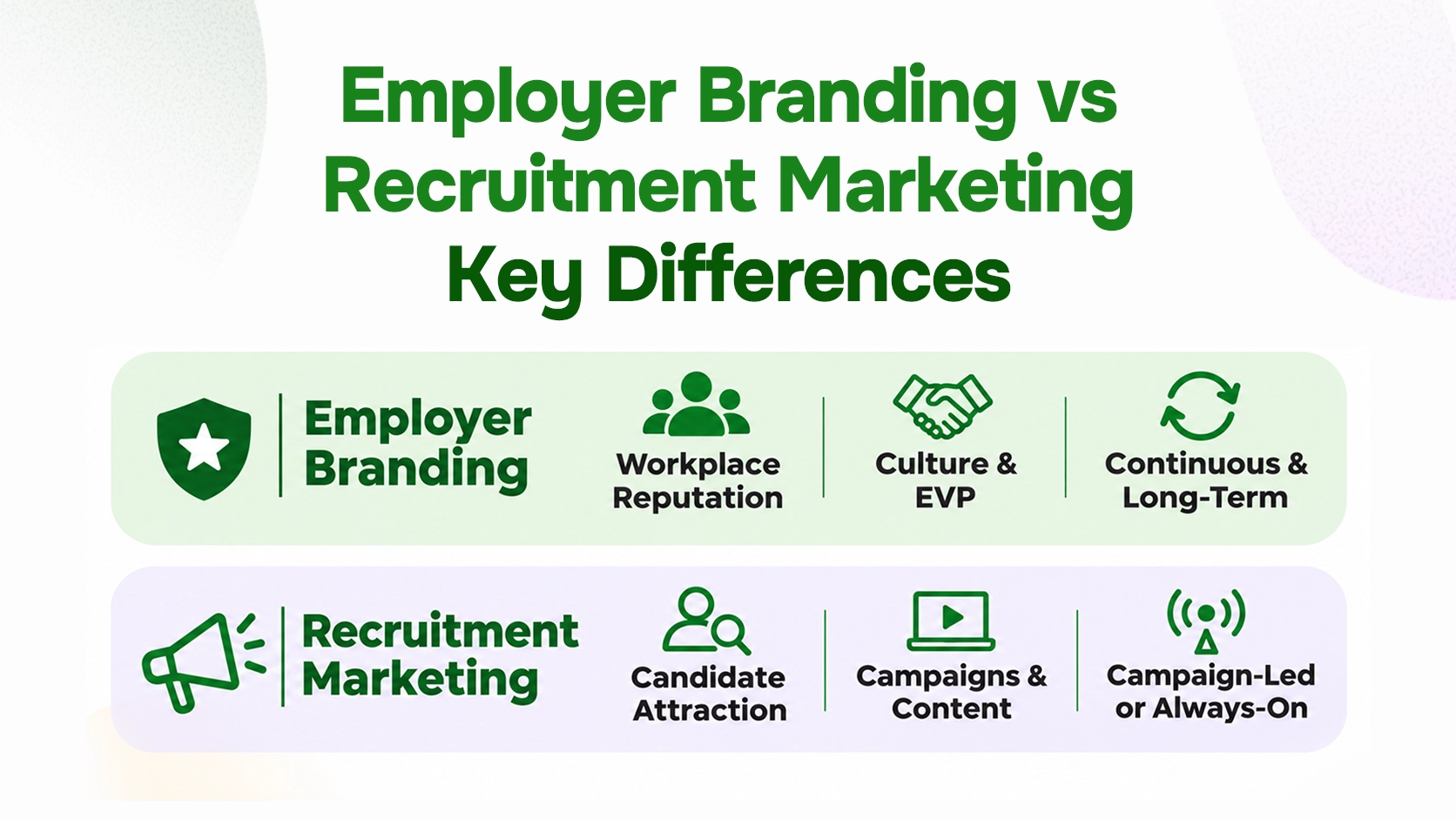
The main difference between employer branding and recruitment marketing is their purpose.
Employer branding establishes the workplace's reputation and promise; recruitment marketing activates that promise to attract and move relevant candidates toward a hiring action.
Employer Branding vs Recruitment Marketing Comparison Table
The table below shows the key difference between employer branding and recruitment marketing:
Comparison Area | Employer Branding | Recruitment Marketing |
Primary purpose | Shape workplace reputation | Attract and engage candidates |
Core question | Why should people want to work here? | How do we reach the right candidates? |
Foundation | Culture, EVP and employee experience | Employer-brand positioning and hiring goals |
Audience | Employees and wider talent market | Defined candidate segments |
Activities | EVP, employee stories, reputation management | Campaigns, content, job promotion and nurture |
Timeframe | Continuous and long-term | Campaign-led or always-on |
Primary outcome | Awareness, credibility and preference | Engagement, applications and candidate movement |
Ownership | Cross-functional | Usually talent acquisition-led |
How Their Focus and Scope Differ
Employer branding has a broader scope because it covers the overall relationship between your organization and the people who experience or evaluate it as an employer.
On the other hand, recruitment marketing focuses more directly on candidate-facing activities tied to talent attraction.
For example, your employer brand might establish career growth as part of your EVP. Recruitment marketing then decides how that promise appears in engineering content, graduate campaigns, social posts, emails, events, or job advertisements.
The message should stay recognizable while becoming relevant to each audience member.
This is why recruitment marketing should not simply distribute the same generic message everywhere; it should translate a consistent employer brand into content that speaks to specific talent groups.
“Personalized engagement is not just about showcasing our brand; it’s about creating a warm and inviting atmosphere for potential candidates.”— Adrina August, EMEA Content Marketing Manager, Greenhouse
How Employer Branding and Recruitment Marketing as Hiring Needs Change
Employer branding is continuous, while recruitment marketing is organized around measurable activities and campaigns.
However, recruitment marketing is not always short-term.
An urgent hiring campaign might last a few weeks, while an email nurture program, social content strategy, career-site program, or talent community might operate throughout the year.
A better distinction is that employer branding builds value over time, while recruitment marketing is launched, measured, adjusted, and repeated as hiring needs to change.
Know Which Channels Bring Qualified Candidates
Compare source performance and application conversion across roles.
Explore AnalyticsHow Their Goals, Metrics, and Ownership Compare
Employer branding and recruitment marketing need different metrics because they answer different business questions.
Employer-branding metrics often include:
Employer awareness
Candidate perception
Employee advocacy
Career-site engagement
Employer-review sentiment
Offer acceptance
Retention indicators
These measures help you understand whether the market recognizes and trusts the employer's proposition.
In contrast, recruitment-marketing metrics focus more directly on campaign and funnel performance:
Reach and impressions
Content engagement
Click-through rate
Cost per applicant
Application conversion
Source performance
Talent-community engagement
Qualified candidate volume
Ownership also differs. Employer branding commonly involves talent acquisition, HR, marketing, communications, leadership, and employee-experience teams because the brand must reflect the real workplace.
Meanwhile, recruitment marketing usually sits closer to talent acquisition or a dedicated recruitment-marketing function, with support from marketing, creative, operations, or analytics teams.
How Employer Branding and Recruitment Marketing Work Together
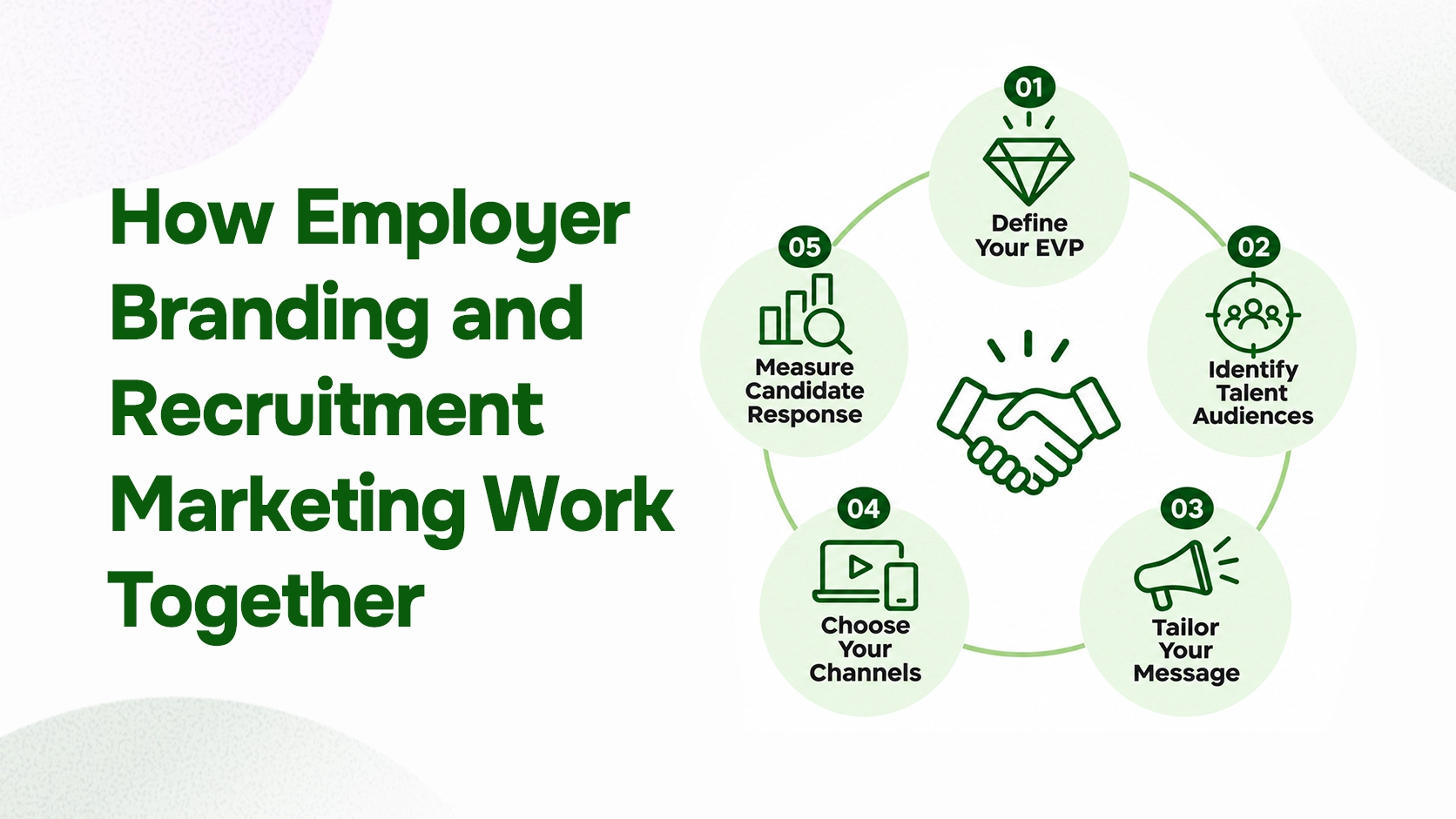
Employer branding creates the promise, and recruitment marketing gives that promise visibility and direction.
A practical workflow looks like this:
Define the employer proposition: Clarify the EVP, values, employee experience, and evidence behind your claims.
Identify candidate audiences: Determine which skills, roles, locations, or candidate groups you need to reach.
Translate the EVP into relevant messages: Emphasize the parts of your employer proposition that matter to each audience without changing the underlying promise.
Choose channels and campaigns: Distribute those messages through career content, social media, email, events, advertising, and other appropriate channels.
Measure candidate response: Use engagement and funnel data to identify which messages and channels are working.
The connection between branding and recruitment activity has been recognized for years by talent leaders.
This workflow only works when branding and recruitment marketing are treated as one continuous process, not two separate initiatives running in parallel.
Recruitment marketing can also maintain relationships when candidates are interested but not ready to apply.
Instead of losing those people after a campaign ends, you can organize them in a talent pool, continue relevant communication, and reconnect when a suitable role becomes available.
“There’s no point in having a branding team working on marketing and trying to attract people if it doesn't actually impact the recruitment process.”— Matthew Jeffery, VP Head of Global Sourcing & Employment Branding, SAP
Should You Focus on Employer Branding or Recruitment Marketing First?
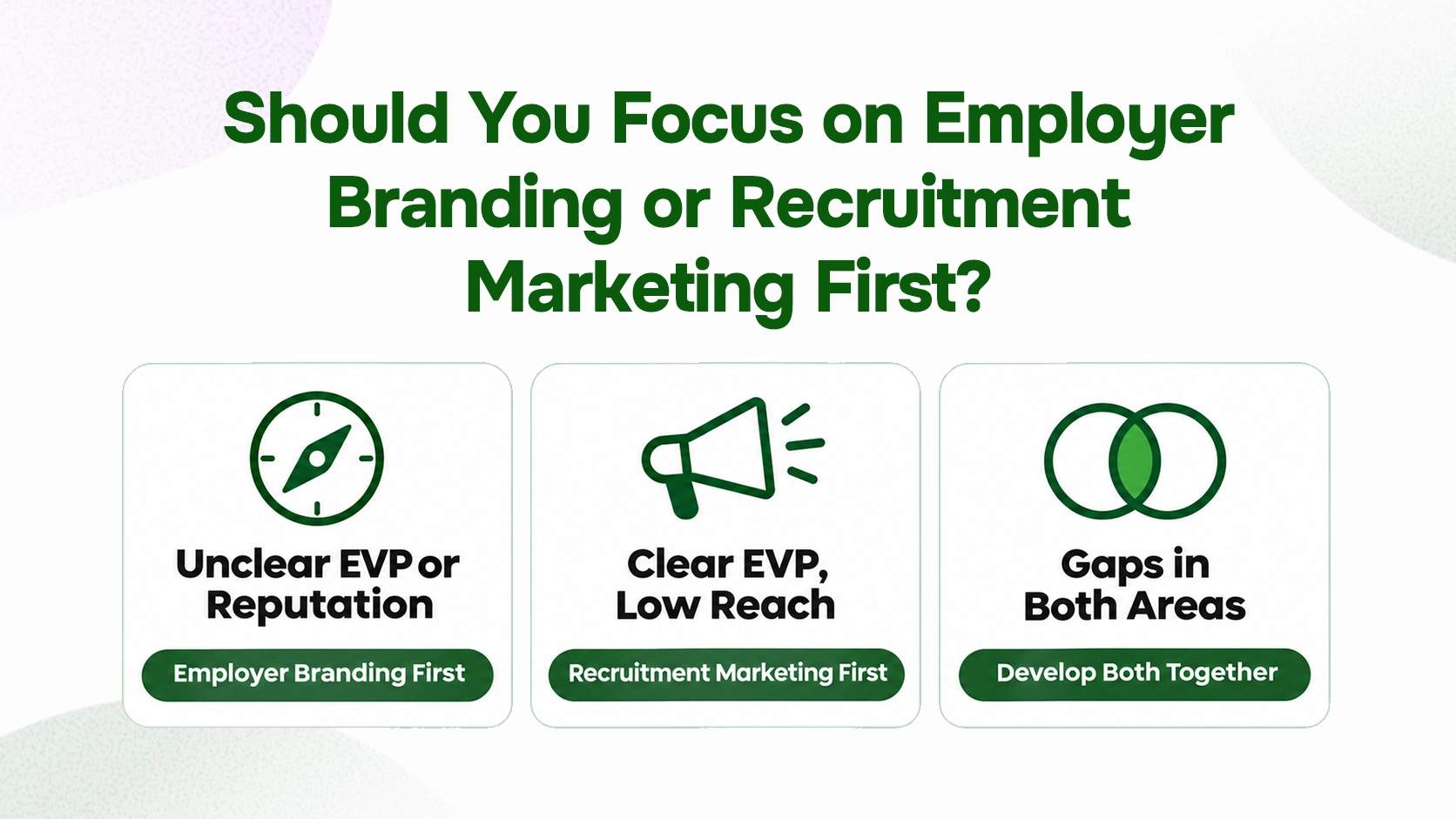
Prioritize employer branding first when your workplace proposition is unclear; prioritize recruitment marketing first when the proposition is strong, but the right candidates are not seeing or responding to it.
Focus on employer branding first when:
Your EVP is unclear or outdated.
Candidate messaging changes significantly between teams.
Employees do not recognize the workplace story you promote.
Your company lacks a clear talent-market position.
Reputation is limiting candidate interest.
In these situations, an employer branding strategy gives future campaigns a credible and consistent foundation.
Focus on recruitment marketing first when:
Your EVP is already clear.
You have credible employee stories and culture evidence.
Specific roles struggle to attract attention.
Candidate reach is too low.
Engagement is strong but applications are weak.
You need better audience targeting or campaign distribution.
However, some teams need both because their hiring challenges stem from a mix of unclear employer positioning and weak candidate outreach.
For example, high campaign traffic with poor candidate fit can indicate weak targeting, unclear messaging, or both, while strong awareness with little engagement suggests the brand exists but is not being effectively activated for current hiring needs.
The priority should therefore follow the constraint: fix the employer proposition when the message is weak and improve recruitment marketing when distribution or conversion is weak.
Keep Candidate Interest Organized Between Hiring Campaigns
Save promising candidates and follow up when the right role opens.
Book A DemoConclusion
Employer branding and recruitment marketing solve different parts of the same talent-attraction challenge.
Employer branding defines the reputation, EVP, culture, and employee experience that make your organization worth considering, while recruitment marketing turns those strengths into campaigns, content, channels, and candidate engagement.
Start by identifying what is limiting your hiring results today: strengthen employer positioning if your message lacks clarity or credibility and improve recruitment marketing if the right candidates are not discovering or responding to that message.
Then connect both disciplines to your wider recruitment process so the experience candidates receive after applying supports the promise that attracted them in the first place.
FAQs
Frequently Asked Questions
Employer branding shapes your long-term reputation as a workplace, while recruitment marketing uses targeted content, campaigns, and channels to attract and engage candidates.