
Candidate Sourcing: A Complete Guide to Finding & Engaging Top Talent
Recruit
Candidate Sourcing
14 min read
Key Highlights
Candidate sourcing enables recruiters to identify and engage qualified professionals before they enter the hiring process.
Successful candidate sourcing combines talent pipelines, personalized outreach, employer branding, and AI-powered sourcing tools.
Building relationships with qualified professionals before vacancies arise leads to faster and higher-quality hiring.
Active and passive sourcing strategies work together to expand your talent pool and improve recruitment outcomes.
Tracking sourcing metrics such as response rate, time to fill, and quality of hire helps optimize recruitment performance.
Introduction
The best candidates don't always apply for jobs. Around 70% of highly qualified professionals are already employed and aren't actively searching on job boards like LinkedIn, Indeed, or Glassdoor.
This is why candidate sourcing has become a core part of the modern recruitment process.
Instead of waiting for applications, recruiters identify and connect with qualified professionals before a position becomes difficult to fill.
Organizations that rely only on job posting often miss experienced talent with the right skills.
A structured sourcing process helps build stronger talent pipelines, reduce time to hire, and reach professionals who are rarely available through traditional hiring methods.
In this guide, you’ll learn the core difference between sourcing and recruiting, the step-by-step process to find top talent, and the best channels, tools, and metrics to build a high-performing talent pipeline.
What Is Candidate Sourcing?
Candidate sourcing is the process of proactively finding, attracting, and engaging potential candidates before the selection process begins.
Rather than waiting for applications to come in, recruiters actively focus on sourcing candidates through job boards, LinkedIn, employee referrals, talent databases, Boolean search, and direct outreach.
The goal is to build a strong candidate pipeline of qualified professionals who are a genuine fit for the role.
It focuses on creating a pool of qualified talent rather than filling an immediate vacancy through incoming applications.
Sourcing vs. Recruiting: What's the Difference?
Candidate sourcing focuses on finding and engaging qualified professionals before they apply, while recruitment covers the entire hiring process, from identifying a hiring need to onboarding a new employee.
Sourcing sits at the very top of the recruitment funnel and feeds every stage that follows.
It fills the pipeline; recruiting converts it. Without sourcing, recruiters are left with a small, weak pool of applicants to choose from.
On the other hand, without recruiting, sourced candidates sit in the pipeline and never move forward.
They are closely related and work together to create an effective hiring process, but they cover different stages of the hiring process.
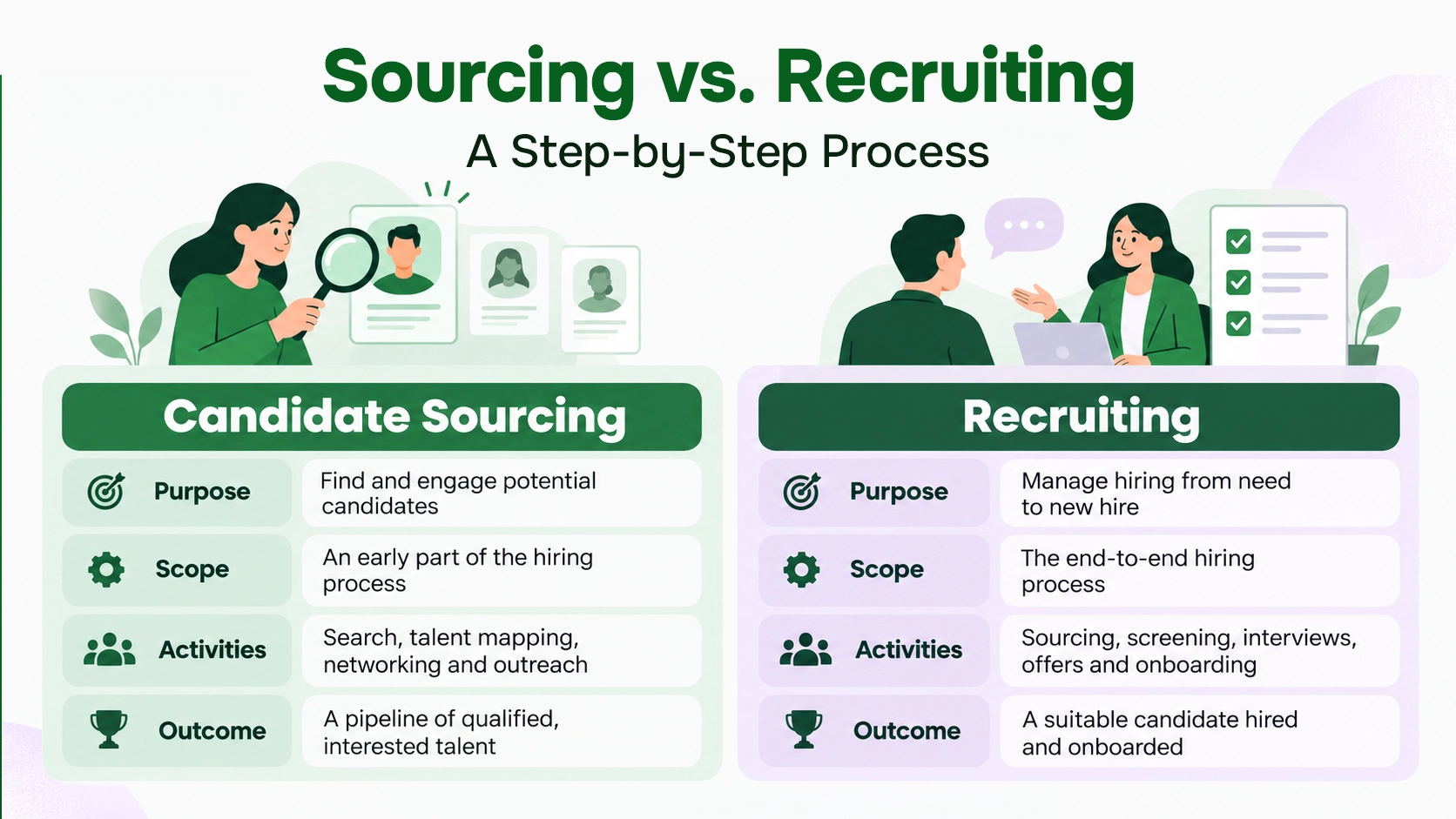
The table below shows how sourcing and recruiting differ by purpose, timing, activities, candidate type, and final goal.
Aspect | Candidate Sourcing | Recruitment |
Purpose | Identify and engage qualified candidates before they apply | Evaluate and hire the best person for the role |
Stage | Begins before the formal hiring process | Starts after candidates enter the recruitment process |
Focus | Building a qualified talent pipeline | Managing the end-to-end hiring process |
Key Activities | Candidate search, talent mapping, networking, outreach, referrals, and talent pool building | Resume screening, interviews, assessments, background checks, job offers, and onboarding |
Candidates | Active and passive | Applicants who have applied or entered the hiring process |
Goal | Build a strong pool of qualified talent | Fill open positions with the best-qualified professionals |
Why Candidate Sourcing Matters
Candidate sourcing helps organizations fill roles faster, improve hiring quality, and build stronger talent pipelines.
Reaches passive candidates: Finds qualified professionals who are not actively looking but are open to the right opportunity
Shortens time to hire: A pre-built pipeline means hiring starts ahead of the vacancy, not after
Improves quality of hire: Targeting specific profiles produces a stronger, more relevant shortlist
Reduces cost per hire: Fewer wasted interviews and faster decisions lower overall recruitment spend
Strengthens employer branding: Every outreach message builds your organization's presence in the talent market
Supports diversity hiring: Proactive sourcing lets teams deliberately target underrepresented talent pools
Builds a future-ready pipeline: Sourcing today fills the roles that open tomorrow
“Talent agility means having the right people, in the right roles, at the right time — ideally ahead of time — to meet the demands of business in a fast-changing world.”
— Glen Goodman, Chief Talent Officer at ChenMed
70% of Top Talent Isn’t Applying. Go Find Them.
Mercury Recruit helps lean hiring teams source, organize, and engage passive candidates before a role becomes hard to fill.
See How It WorksActive vs. Passive Candidate Sourcing
Active candidates are professionals who are actively looking for a new role.
On the other hand, passive candidates are professionals who are currently employed and not actively searching for a job.
The following table compares active and passive candidate sourcing across key aspects of the hiring process:
Aspect | Active Candidate Sourcing | Passive Candidate Sourcing |
Definition | Targets candidates who are actively looking for a job | Targets professionals who are not actively looking for a job but are open to new opportunities |
Where to Find Them | Job boards, company career pages, career fairs, and recruitment websites | Professional networks, employee referrals, talent pools, and industry communities |
Recruitment Approach | Recruiters identify active job seekers who are already looking for roles | Recruiters proactively identify, approach, and engage qualified talents |
Response Rate | Generally higher because candidates are already looking for jobs | Usually lower because candidates are not actively seeking new roles |
Hiring Speed | Faster for immediate hiring needs | Takes longer because it involves relationship building and personalized outreach |
Best For | Entry-level, high-volume, and frequently hired role | Senior, technical, leadership, and hard-to-fill positions |
How to Source Candidates (A Step-by-Step Process)
Here is a practical step-by-step process for sourcing qualified candidates:
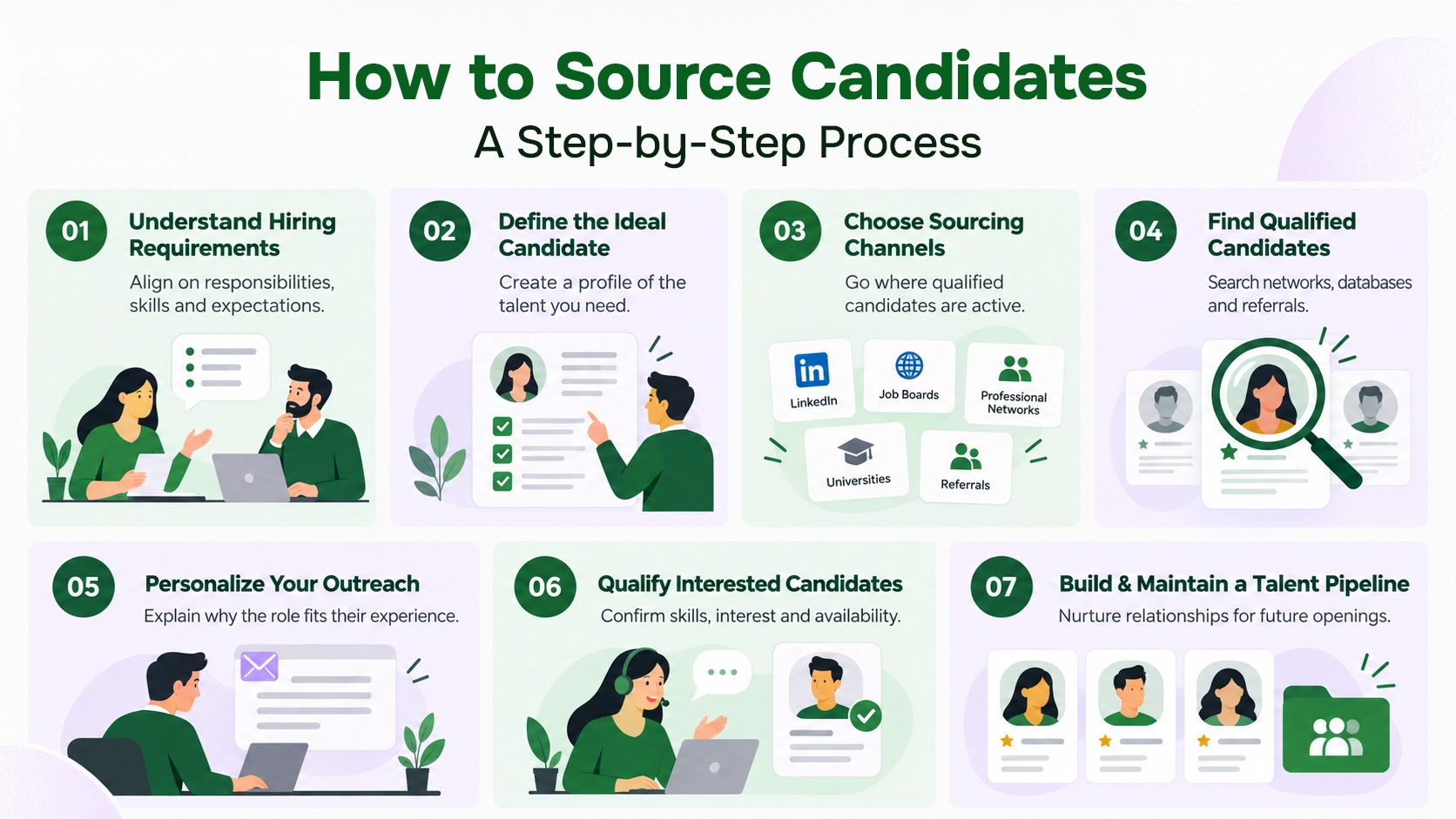
Step 1: Understand the Hiring Requirements
Every sourcing process starts with understanding the hiring requirements. Recruiters meet with the hiring manager to understand why the role is being filled, the responsibilities involved, the required skills, experience level, qualifications, and any specific expectations.
Having a clear understanding of the role helps recruiters focus their sourcing efforts and prevents time from being spent on candidates who are not a good fit.
Step 2: Define the Ideal Candidate Profile
Once the hiring requirements are clear, recruiters create an ideal candidate profile.
This profile describes the type of professional they want to target, including technical skills, industry experience, certifications, education, and other qualities that match the role.
For example, if a company is hiring a Senior Software Engineer, the ideal profile include experience with specific programming languages, cloud platforms, leadership experience, and previous work in SaaS companies.
A detailed candidate profile makes sourcing more targeted and consistent.
Step 3: Choose the Right Sourcing Channels
Different candidates use different platforms, so selecting the right sourcing channels is essential.
The best channel depends on the role and where qualified candidates are most likely to be found.
Using multiple sourcing channels increases visibility and helps build a more diverse candidate pipeline.
Step 4: Search and Identify Qualified Candidates
With the candidate profile and sourcing channels defined, recruiters begin searching for suitable candidates.
This involves using LinkedIn search filters, Boolean search techniques, resume databases, applicant tracking systems (ATS), professional communities, and employee referrals to identify people who match the role's requirements.
The objective is not simply to create a long list of names but to identify qualified professionals who closely match the ideal candidate profile.
Step 5: Craft Personalized Candidate Outreach
After identifying potential hires, recruiters reach out with personalized messages.
Instead of sending the same message to everyone, an effective outreach explains why the candidate was selected and how the opportunity matches their skills and experience.
A personalized approach increases response rates, builds trust, and creates a positive first impression of the organization.
For example: If you're contacting a software developer, reference a GitHub project or technical skill that aligns with the position.
Step 6: Qualify Interested Candidates
Candidates who respond positively go through an initial qualification stage.
Recruiters confirm whether the candidate meets the basic job requirements, is interested in the opportunity, and is available to move forward in the hiring process.
Candidates who qualify are then handed over to the recruitment team for formal screening, interviews, and further evaluation.
Step 7: Build and Maintain a Talent Pipeline
Candidate sourcing does not end when a position is filled. Strong recruiters continue building relationships with qualified professionals, even if they are not ready to change jobs immediately.
By maintaining an organized talent pipeline, recruiters create a ready-to-engage pool of candidates for future openings.
This reduces sourcing time, speeds up hiring, and supports long-term talent acquisition goals.
Build a Talent Pool You Can Hire From Tomorrow
Save sourced candidates, tag them by skill, and re-engage them the moment a role opens, all inside Mercury Recruit’s Talent Pool.
Explore Talent Pool FeaturesTop Candidate Sourcing Channels Recruiters Use
Candidate sourcing becomes more effective when recruiters use the right sourcing channel.
Here are the most effective ones:
1.Job Boards & Job Posting
Job boards are the most straightforward sourcing channel for active candidates.
Platforms like Indeed, Glassdoor, and industry-specific boards put job listings in front of professionals who are actively exploring new opportunities.
Well-written job postings with clear responsibilities, qualifications, and benefits help attract more relevant applicants and improve application quality.
2. LinkedIn & Social Recruiting
LinkedIn is one of the most effective platforms for candidate sourcing, especially for professional, technical, and leadership roles.
Recruiters use LinkedIn to search for candidates based on skills, experience, location, industry, and other filters.
As per the 2026 LinkedIn talent report, LinkedIn platform insights are derived from 1 billion members, 14 million jobs, and 5 million profile updates per minute.
This scale makes LinkedIn especially useful for sourcing professionals.
Beyond LinkedIn, platforms like Facebook, X (formerly Twitter), and professional communities also help organizations promote job opportunities, strengthen employer branding, and engage with potential candidates.
3. Employee Referrals
Employee referral remains one of the most valuable sourcing channel.
Employers’ Recruiter Nation Report found that employee referrals and career websites tied at 35% as candidate sources in 2024. Still, in 2026, referrals play a major role in talent acquisition.
This program encourage current employees to recommend qualified professionals from their network.
Since employees understand the company's culture and job requirements, referrals often result in candidates who are a better fit for the role.
4. Talent Pools & Databases
A talent pool is a collection of qualified candidates who have shown interest in the organization or have been sourced for previous opportunities.
These candidates may not have been hired initially, but they remain valuable for future vacancies.
Maintaining an updated talent pool allows recruiters to fill open positions faster without starting the sourcing process from scratch every time.
5. Boolean Search
While 20% of recruiting teams automate candidate searches using AI tools, many still rely on traditional sourcing methods such as Boolean search.
Boolean search is a technique recruiters use to find more relevant candidates on platforms like LinkedIn, Google, and resume databases.
It combines keywords with search operators such as AND, OR, NOT, and quotation marks to narrow search results.
For instance, during candidate sourcing for an experienced SaaS Product Manager, a Boolean search helps filter out unrelated profiles and quickly identify professionals who match the role requirements.
This makes candidate searches faster, more accurate, and more efficient.
“ Hiring is the most important people function you have, and most of us aren't as good at it as we think. Refocusing your resources on hiring better will have a higher return than almost any training program you can develop. “
— Laszlo Bock, Former Senior Vice President of People Operations, Google
Proven Candidate Sourcing Strategies & Techniques That Actually Work
Finding qualified talent through different sourcing channels is only part of the process.
Successful candidate sourcing also depends on using the right strategies such as:
Talent Pipeline Building: Build relationships with qualified professionals before hiring needs arise.
Personalized Outreach: Tailor every outreach message to the recipient's skills and experience.
Employer Branding: Build a strong employer brand to attract and engage qualified talent.
Candidate Rediscovery: Reconnect with qualified professionals from previous hiring processes.
Multi-Channel Sourcing: Use multiple sourcing channels to reach a broader pool of qualified professionals.
“The key for us, number one, has always been hiring very smart people.”
-Bill gates, Cofounder of Microsoft
If you want to learn sourcing strategies in detail, explore our complete guide on Candidate Sourcing Strategies.
Candidate Sourcing Tools to Speed Up Hiring
The right tools make sourcing faster, more organized, and more scalable. Here are some core platforms every sourcing team relies on:
1. Professional Networking Platforms
Professional networking platforms help recruiters identify and connect with qualified professionals across various industries.
For example, LinkedIn Recruiter provides advanced search filters, candidate recommendations, InMail messaging, project folders, and pipeline management.
It helps recruiters identify, organize, and engage qualified professionals more efficiently than the standard LinkedIn platform.
2. Applicant Tracking System (ATS)
An ATS stores and organizes candidate information in one place. Besides managing active applicants, many ATS platforms maintain searchable talent databases that recruiters can use when sourcing for future roles.
If your organization is looking for an ATS that supports structured recruitment and efficient candidate sourcing, Mercury Recruit provides features such as AI-powered candidate matching, resume parsing, talent pool management, and many more.
These features help recruiters source, organize, and track candidates more efficiently throughout the hiring process.
3. Technical Communities
Professional communities and industry-specific platforms are valuable sourcing channels for finding qualified talent across different industries.
Platforms such as GitHub, Stack Overflow, Behance, Dribbble, Kaggle, and industry forums allow recruiters to assess professionals based on their work, portfolios, contributions, and expertise before making contact.
4. Contact Discovery Tools
Tools like Hunter.io and Apollo.io help recruiters find professional email addresses and contact details for candidates they identify during sourcing.
These tools make personalized outreach faster and more efficient.
5. Recruitment CRM
A Recruitment CRM helps recruiters build and maintain relationships with passive candidates over time.
While an ATS manages active applicants, a CRM keeps potential candidates engaged through regular communication until the right opportunity becomes available.
6. AI-Powered Candidate Sourcing Tools
AI-powered candidate sourcing tools are becoming a normal part of recruitment in 2026. SHRM’s 2025 Talent Trends data shows that 51% of organizations use AI to support recruiting efforts.
The most common uses include screening resumes, used by 44% of organizations; automating candidate searches, used by 32%; and communicating with applicants, used by 29%.
For detailed AI-powered sourcing tools, explore our complete guide to Candidate Sourcing Tools.
Candidate Sourcing Metrics You Should Track
Tracking sourcing metrics helps recruiters understand which sourcing activities produce the best hiring results.
Here are some key metrics to monitor:
Sourcing channel effectiveness: Measures which sourcing channels generate the highest number of qualified candidates.
Outreach response rate: Tracks the percentage of candidates who respond to sourcing messages.
Candidate pipeline size: Monitors the number of qualified candidates available for current and future hiring needs.
Time to Fill: Measures the time required to fill an open position from the date it is posted.
Sourcing-to-hire ratio: Shows how many sourced candidates are needed to make one successful hire.
Diversity sourcing metrics: Track how effectively sourcing efforts attract candidates from diverse backgrounds.
Turn Sourcing Into a System, Not a Struggle
Run every step in this guide (profiling, outreach, pipeline building, and tracking) from one platform.
Try Mercury Recruit FreeConclusion
Candidate sourcing is not a supplementary recruiting activity. It is the step that makes every other part of the process work.
Organizations that invest in sourcing consistently build stronger teams, hire faster, and spend less time restarting the process from scratch.
However, those who skip it keep wondering why the right candidates never seem to show up.
You can start with a clear candidate profile, use the right sourcing channels, and send personalized outreach.
To add to that, keep the pipeline warm even when no roles are open. Do that consistently, and hiring becomes a system, not a struggle.