
12 Candidate Sourcing Strategies to Find & Hire Top Talent
Recruit
14 min read
Key Highlights
Candidate sourcing enables recruiters to identify and engage qualified professionals before they enter the hiring process.
Successful candidate sourcing combines talent pipelines, personalized outreach, employer branding, and AI-powered sourcing tools.
Building relationships with qualified professionals before vacancies arise leads to faster and higher-quality hiring.
Active and passive sourcing strategies work together to expand your talent pool and improve recruitment outcomes.
Tracking sourcing metrics such as response rate, time to fill, and quality of hire helps optimize recruitment performance.
Introduction
According to recent studies, 70% of the global workforce isn't actively looking for a new job right now. They're not updating resumes, browsing listings, or waiting for a recruiter's message. Most are busy succeeding where they already are.
That means a significant portion of qualified talent is unlikely to discover your job posting, no matter how well it's written.
If your recruitment process only reacts to inbound applications, you'll often struggle to reach the people you want to hire.
A perfect hire takes more than a job listing; it takes the right candidate sourcing strategies, built around proactive outreach, strong referral networks, and relationships that start well before a role ever opens.
So, this guide covers practical candidate sourcing strategies that help you find qualified talent, engage passive candidates, and improve sourcing results.
What Is Candidate Sourcing?

Candidate sourcing is the process of identifying, researching, and engaging potential candidates before they apply for a role.
Instead of posting a job description and waiting for applications to land in an inbox, sourcing means going out and finding the right people through LinkedIn, talent databases, referral networks, and direct outreach.
Today's hiring landscape has made candidate sourcing more important than ever. While 72% of employers say finding qualified candidates is one of their biggest hiring obstacles, 87% of professionals say they would still consider the right opportunity.
This gap between what employers can find and what candidates would consider is exactly why sourcing works. It bridges that gap by reaching qualified people before they ever apply.
“Sourcing and finding people is the most important. You can’t recruit, message, or network with someone you haven’t found.”
— Glen Cathey, Former SVP, Consulting Principal, Talent Advisory, Randstad Enterprise
87% of Professionals Would Consider the Right Offer
Most of them will never see your job post. Mercury Recruit helps you find, organize, and reach them first.
Explore how mercury recruit helps12 Candidate Sourcing Strategies That Work
Every strong sourcing effort starts with a clear understanding of who you are looking for.
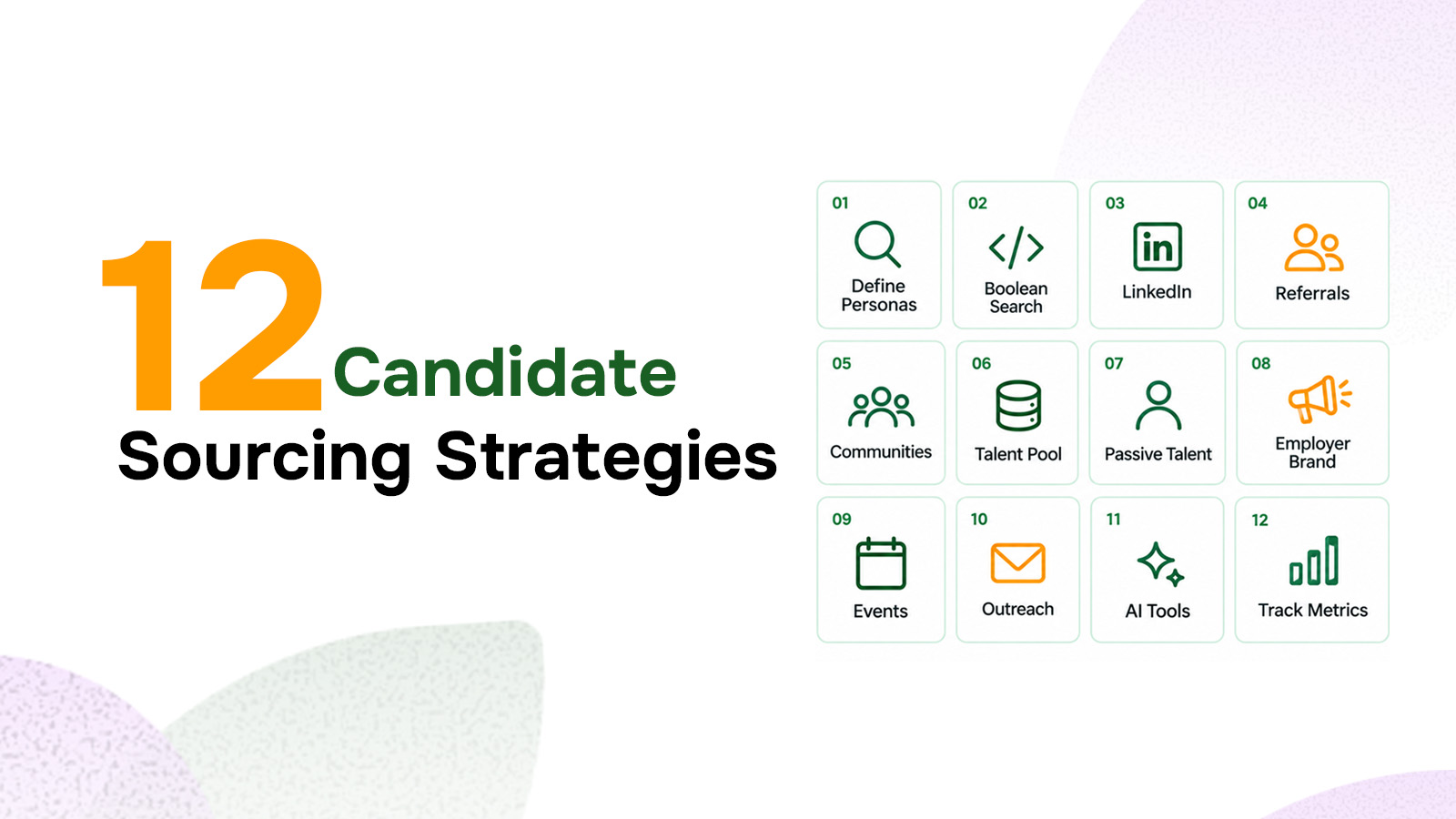
It is about choosing the right channels, reaching out the right way, and using tools that save time. Here are 12 candidate sourcing strategies:
1: Build Candidate Personas & Define Your Ideal Profile
A candidate persona is a detailed profile of the ideal candidate for a role, covering skills, experience, industry background, career stage, and even communication style.
Sourcing without a clear persona means searching blindly. Recruiters end up with a long list of loosely relevant names instead of a focused shortlist of people who genuinely fit.
Before any search begins, work with the hiring manager to define what a strong candidate actually looks like: the must-have skills, the nice-to-have qualifications, the experience level, and the type of company background that signals fit.
For example, sourcing a senior backend engineer for a fintech startup means targeting candidates with specific language expertise and experience in regulated industries, not just anyone with a "backend engineer" in their title.
[Image 1 (Clean candidate persona template highlighting key hiring criteria such as skills, experience, qualifications, industry background, certifications, salary expectations, and cultural fit), Image title: Candidate Persona Template for Effective Sourcing, Image alt text: candidate persona template for effective sourcing]]
2: Master Boolean Search
Boolean search uses operators like AND, OR, and NOT to narrow search results on professional networks, search engines, developer platforms, and resume databases to find more relevant candidates.
Operator | Purpose |
AND | Includes multiple required keywords |
OR | Searches alternative keywords |
NOT | Excludes unwanted terms |
" " | Searches exact phrases |
( ) | Groups search combinations |
Instead of searching for "software engineer" and reviewing thousands of profiles, recruiters use search strings such as "backend engineer" AND ("Python" OR "Go") AND "fintech" NOT "intern" to filter out irrelevant results and identify candidates who closely match the role.
Boolean search works on Job boards, Google, GitHub, most resume databases, and other talent platforms. It helps recruiters find qualified candidates faster while reducing the time spent reviewing unrelated profiles.
Another technique worth using is X-Ray search. It uses Google search with Boolean operators to search within a specific platform, such as LinkedIn.
3: Source on LinkedIn & Social Platforms
Social media has become one of the most effective candidate sourcing channels. Today, more than 80% of organizations use social media as part of their recruitment strategy.
Among them, LinkedIn remains the leading platform for sourcing professional and technical talent.
Its advanced search filters and InMail allow recruiters to identify and connect with candidates based on skills, experience, industry, and location.
Beyond LinkedIn, platforms like X and industry-specific communities help recruiters reach professionals who are more active in niche networks.
For example:
Role | Best Platform |
Software Developers | GitHub, Stack Overflow |
Designers | Behance, Dribbble |
Marketers | LinkedIn, X (Twitter) |
Researchers | Google Scholar, ResearchGate |
Data Professionals | Kaggle |
4: Build an Employee Referral Program
Employee referrals consistently produce some of the fastest and highest-quality hires.
According to Dimensional Search, employee referrals convert from application to interview at 40%, compared with 12% for other external sources, even though referrals represent only 1% to 5% of total applicants.
Since employees understand the role, the team, and the company culture, they're more likely to recommend qualified professionals who fit the position.
An effective referral program includes:
Clear referral guidelines
Attractive referral incentives
Fast feedback for referring employees
Simple submission process
Recognition for successful referrals
The most successful referral programs stay active throughout the year. Instead of promoting referrals only when a role opens, you must remind employees about referral opportunities and make the process quick and easy.
5: Tap into Talent Communities & Niche Platforms
General job boards reach a wide audience, but niche platforms reach the right audience for specialized roles.
Technical roles get strong results from platforms like:
GitHub for software developers
Stack Overflow for technical professionals
Dribbble and Behance for designers
Kaggle for data professionals
Reddit communities for industry professionals
Slack and Discord communities for specialized professionals
Industry-specific forums and associations for domain experts
These niche communities enable recruiters to evaluate real work before making a contract. This creates stronger hiring decisions while improving candidate quality
6: Re-engage Past Candidates (Silver Medalists) & Your Talent Pool
Recent data shows that nearly half of all sourced hires now come from candidates already saved in a company's CRM or ATS.
These candidates, often called silver medalists, reached the final stages of a previous hiring process but were not selected.
They have already been assessed, are familiar with the organization, and are often a strong fit for similar roles in the future.
Most ATS platforms automatically store candidate profiles and hiring history. Before starting a new sourcing campaign, review your existing talent pool first.
The right candidate may already be in your database, saving time and reducing sourcing effort.
Want to make better use of candidates already in your database? Try Talent Pool to keep qualified profiles organized, engaged, and ready for future openings.
Turn Silver Medalists Into Your Next Hire
Mercury Recruit’s Talent Pool keeps every qualified past candidate organized, searchable, and ready to re-engage.
Explore Talent Pool7: Source Passive Candidates
Passive candidates are not applying anywhere, not browsing job boards, but are open to the right opportunities.
Reaching them requires direct outreach like personalized LinkedIn messages, targeted emails, or warm introductions through mutual connections.
For example, a senior cybersecurity engineer who has spent five years at the same company may ignore a generic recruitment message. A personalized outreach highlighting a leadership role, larger security projects, and flexible work arrangements is far more likely to receive a response.
The real difference with passive candidate sourcing is not the channel; it is the pitch. Active candidates are already motivated to move, while passive candidates need a real reason to consider leaving a job.
While Passive sourcing takes more effort than posting a job and waiting, it brings in stronger candidates and produces better hires over time.
8: Use Employer Branding to Attract Inbound Talent
Strong employer branding makes every other sourcing strategy work better. When candidates already have a positive impression of an organization, they respond to outreach faster.
This is where recruitment marketing plays a direct role, giving candidates a reason to feel good about your organization before you ever send the first message.
The Employee stories and testimonials
Workplace culture
Learning and career development opportunities
Company achievements
Team events
Awards and certifications
For example, sharing behind-the-scenes videos, employee success stories, or project highlights gives candidates a clearer picture of your workplace than a job description alone.
A strong employer brand improves response rates, increases application quality, and makes sourcing easier.
9: Attend Events & Build Campus Pipelines
In-person and virtual events are one of the most underused sourcing channels you have access to for building a pipeline.
Industry conferences, meetups, and hackathons provide direct access to connect with skilled professionals.
For example, if you're hiring for a machine learning role, attending an AI conference or meetup allows you to connect with experienced professionals before they enter the job market.
Although industry events may not lead to immediate hires, they help you establish meaningful connections with skilled professionals.
Those relationships often become valuable hiring opportunities when the right position opens.
10: Personalize Candidate Outreach
Generic outreach messages rarely get a response. Candidates are far more likely to engage when they see that you've taken the time to understand their background and experience.
Instead of sending the same message to everyone, explain why you reached out to that specific candidate.
For example, if you're contacting a software developer, mention a GitHub project they contributed to or a recent achievement that caught your attention.
A message like, "I came across your work on [project name] and was impressed by how you optimized the caching layer. We’re hiring for a role where those skills would make a real impact," feels far more genuine than a generic recruitment message.
One message is often not enough. A thoughtful follow-up sent a few days later reminds candidates about the opportunity and increases the chances of getting a response.
Following up with two or three well-timed messages increases your chances of getting a response without overwhelming the candidate.
11: Leverage AI & Sourcing Tools
AI-powered sourcing tools help you find qualified candidates faster by automating time-consuming sourcing tasks.
Instead of manually searching through hundreds of profiles, modern sourcing tools analyze data from platforms like LinkedIn, GitHub, Stack Overflow, and other professional networks to identify candidates who closely match your hiring requirements.
For example, if you're hiring a senior DevOps engineer with Kubernetes experience, an AI sourcing tool quickly creates a shortlist of relevant candidates, allowing you to focus on outreach instead of manual searching.
The most useful sourcing tools include:
AI-powered sourcing platforms: For candidate matching and recommendations.
Contact discovery tools: To find verified professional email addresses.
Applicant Tracking Systems (ATS): To search for previous applicants and manage your talent pool.
These tools don't replace your judgment. They reduce repetitive work, helping you spend more time engaging qualified candidates and making better hiring decisions.
For teams ready to use AI more practically, learn how AI recruitment software like Mercury recruit helps make hiring faster and smarter.
12: Track and Optimize Sourcing Metrics
If you’re not tracking your sourcing numbers, you’re not really sourcing strategically; you are just guessing and hoping it works.
Track a few key sourcing metrics consistently, including outreach response rate, sourced-to-interview conversion, time to fill, and quality of hire. These metrics show which sourcing channels and outreach strategies deliver the best results.
For example, if your LinkedIn outreach response rate is low, it may indicate that your messaging needs improvement or that you're targeting the wrong candidates.
On the other hand, a high sourced-to-interview conversion rate shows you're reaching candidates who are a strong fit for the role.
Review and analyze these metrics regularly to identify what works and where improvements are needed. Over time, this helps you build a more effective and consistent candidate sourcing process.
“Hiring is the most important people function you have, and most of us aren’t as good at it as we think.”
— Laszlo Bock, Former Senior Vice President of People Operations, Google
Active vs. Passive Sourcing Strategies: Key Differences
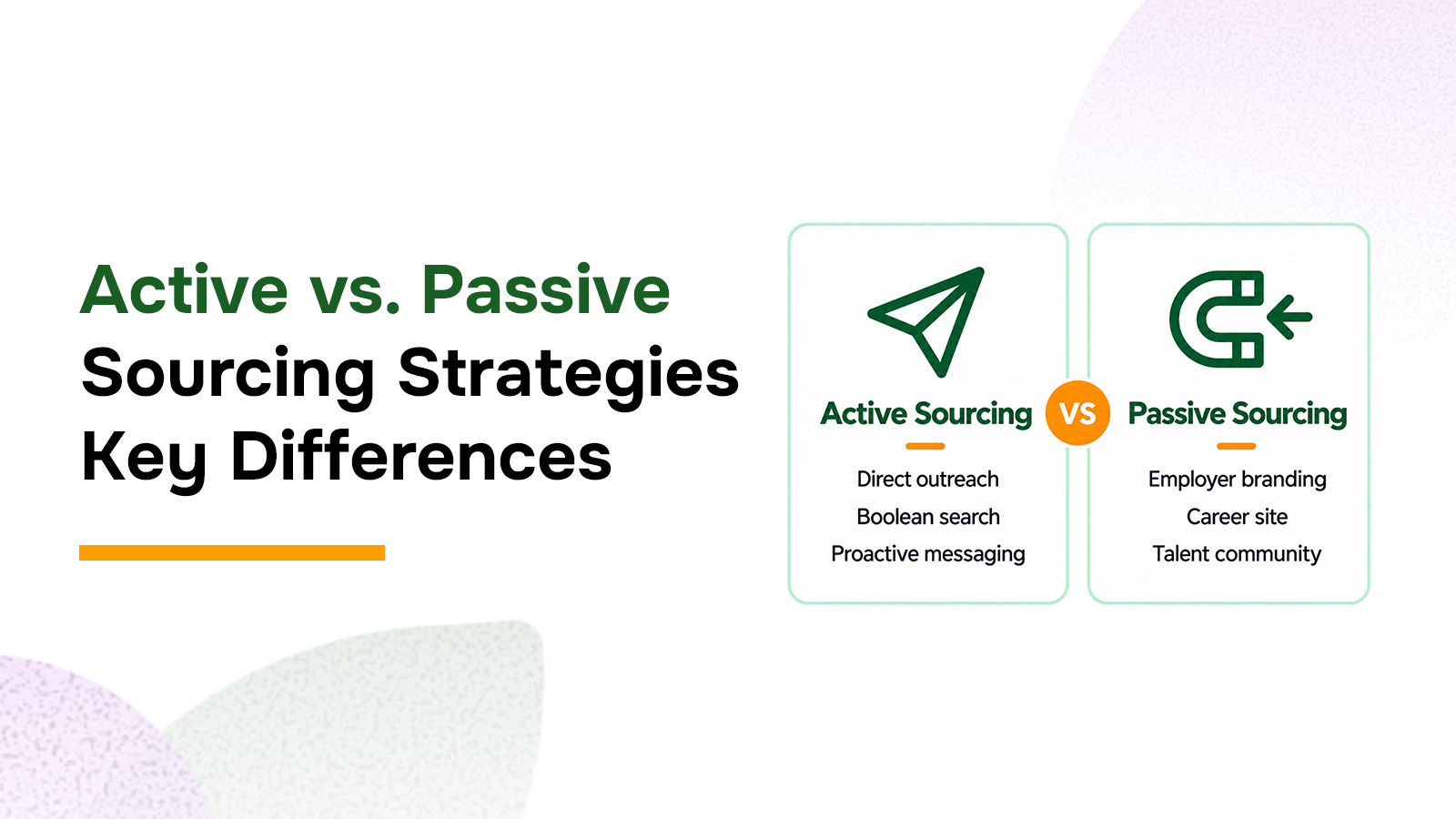
Both active and passive candidate sourcing help you find qualified professionals, but they target different talent pools and require different sourcing approaches.
The table below compares the key differences between active and passive candidate sourcing across important aspects of the hiring process:
Aspect | Active Candidate Sourcing | Passive Candidate Sourcing |
Target audience | Professionals actively looking for jobs | Professionals who are not actively job hunting |
Primary goal | Find job seekers who are ready to apply for open roles | Build relationships for current and future hiring needs |
Candidate interest | Already interested in changing jobs | Need a compelling reason to consider new opportunities |
Outreach method | Job boards, LinkedIn Easy Apply, career pages | Direct outreach, referrals, networking, talent communities |
Response rate | Generally higher | Lower, but often results in higher-quality hires |
Time to hire | Usually faster | May take longer because of relationship building |
Best use case | Immediate hiring needs | Hard-to-fill or specialized positions |
Both approaches are valuable, and most organizations combine them to build a stronger talent pipeline.
If you want to learn more about sourcing active professionals, explore our complete guide to Active Candidate Sourcing.
Key Metrics That Show Whether Your Sourcing Works
Rather than relying on assumptions, you should regularly measure sourcing performance and use the insights to improve future hiring efforts.
The most valuable candidate sourcing metrics include:
1.Outreach Response Rate
Outreach response rate measures the percentage of professionals who respond to your sourcing messages.
Formula: Response Rate = (Responses ÷ Outreach Messages Sent) × 100
2. Sourced-to-Interview Conversion Rate
This metric measures how many sourced professionals move from initial outreach to the interview stage.
Formula: Sourced-to-Interview Conversion = (Interviewed Candidates ÷ Sourced Candidates) × 100
3. Time to Fill
Time to fill measures how long it takes you to fill a position after sourcing begins. Efficient sourcing shortens your hiring timelines by helping you buiild a pipeline of qualified professionals before vacancies become urgent.
Formula: Time to Fill = Date Position Filled − Date Hiring Begins
4. Source of Hire
Source of hire identifies which sourcing channels consistently produce successful hires.
Tracking whether your hires come from employee referrals, job boards, talent communities, or your existing talent pool helps you invest more time in the channels that deliver the best results.
5. Quality of Hire
Quality of hire evaluates how successful sourced professionals are after joining your organization.
You can evaluate the quality of hire by tracking employee performance, retention rates, hiring manager feedback, and productivity over time.
6. Talent Pipeline Growth
Talent pipeline growth measures how effectively your sourcing efforts build a pool of qualified professionals for future hiring needs.
A growing talent pipeline reduces your sourcing time, improves hiring readiness, and enables you to respond quickly when new positions become available.
Organize, Rediscover, and Match Candidates in One Place
Mercury Recruit helps startups and SMEs manage talent pools, resurface past applicants, and match qualified professionals to open roles.
Try Mercury Recruit FreeH2: Conclusion
Candidate sourcing strategies have become a core part of how you recruit today. Instead of waiting for applications, sourcing enables you to reach a wider pool of qualified professionals, build a stronger pipeline, and fill roles more efficiently.
Successful candidate sourcing relies on a few consistent practices: defining clear candidate personas, using multiple sourcing channels, personalizing your outreach, using AI-powered tools where they help, and tracking what’s working.
Get that right, and you’ll spend less time finding candidates and more time engaging with the ones worth hiring.