
The Recruitment Process: 7 Stages, Best Practices & Tools for 2026
Recruit
Recruitment process
17 min read
Key Highlights
The recruitment process consists of seven stages, from identifying a hiring need to onboarding a new employee.
A structured recruitment process helps organizations hire faster, reduce costs, improve candidate experience, and make better hiring decisions.
Recruitment and selection are different stages that work together to build an effective hiring process.
Clear selection criteria, structured interviews, and recruitment metrics improve hiring quality and consistency.
Modern recruitment tools, including ATS, Recruitment CRM, AI-powered screening, and recruitment analytics, streamline the hiring process.
Introduction
Every successful business has one thing in common: it hires the right people.
But hiring the right people does not happen by accident. Behind every great team is a deliberate, well-structured recruitment process.
Without a structured recruitment process, organizations often face long hiring cycles, inconsistent evaluations, high recruitment costs, and missed opportunities to secure top talent.
A well-defined recruitment process addresses all of this. It gives your hiring team a clear roadmap, from identifying the need for a role to welcoming a new employee on their first day.
Whether you are hiring your first ten people or your next hundred, getting the process right makes all the difference. This guide will show you the full steps of standard recruitment process.
What Is a Recruitment Process? (Definition)
The recruitment process is the structured series of steps an organization follows to identify, attract, evaluate, and hire qualified candidates for open positions.
It starts when a job vacancy is identified and continues until a new employee joins the team.
Recruitment is not just about posting a job ad and waiting for applications; it is a planned process that includes finding candidates, reviewing applications, interviewing them, and choosing the right person for the role.
Its main goal is to hire the right person for the right role at the right time.
A well-defined recruitment process helps HR teams:
Reduce time to hire by eliminating guesswork at each stage
Improve quality of hire through consistent evaluation criteria
Lower cost per hire by avoiding repeat hiring cycles
Create a positive candidate experience that strengthens employer brand
Types of Recruitment Process
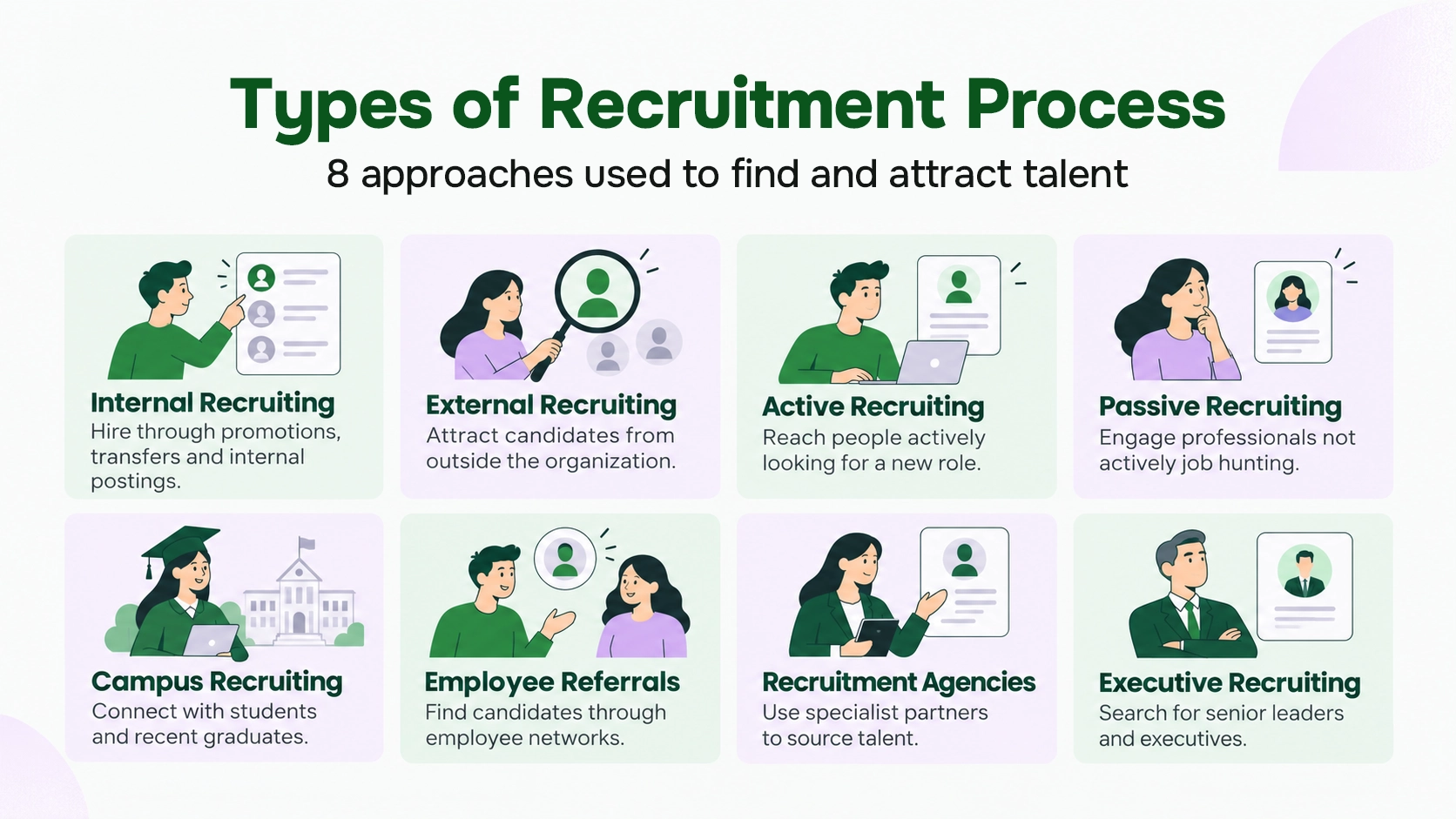
Organizations use different recruiting methods depending on the role, industry, hiring urgency, and business goals.
In many cases, companies combine several recruiting approaches to reach a wider talent pool and find the best candidates.
Here are the most common types of recruiting:
1. Internal Recruiting
Internal recruiting focuses on filling open positions with existing employees within the organization.
Companies identify qualified candidates through internal job postings, promotions, transfers, succession planning, and employee development programs.
2. External Recruiting
External recruiting focuses on attracting candidates from outside the organization.
Companies use job boards, career websites, recruitment agencies, social media, and employee referrals to reach qualified talent.
3. Active Recruiting
Active recruiting targets professionals who are actively looking for new job opportunities.
Recruiters typically source these candidates through job applications, career portals, and recruitment events.
4. Passive Recruiting
Passive recruiting focuses on professionals who are not actively searching for a job but are open to the right opportunity.
Recruiters connect with these candidates through LinkedIn, professional networks, referrals, and talent communities.
5. Campus Recruiting
Campus recruiting helps organizations hire students and recent graduates through university partnerships, career fairs, internship programs, and graduate recruitment initiatives.
It is commonly used to build an entry-level talent pipeline.
6. Employee Referral Recruiting
Employee referral programs encourage current employees to recommend qualified candidates from their professional network.
Referral hires often have shorter hiring cycles and higher retention rates because they already understand the company through the referring employee.
7. Recruitment Agency Recruiting
Recruitment agencies help organizations find candidates for permanent, temporary, contract, or executive positions.
They are especially valuable for hard-to-fill roles, niche skill requirements, or companies with limited internal recruiting resources.
8. Executive Recruiting
Executive recruiting, also known as executive search or headhunting, focuses on hiring senior leaders such as directors, vice presidents, and C-level executives.
This approach typically involves confidential searches and direct outreach to highly experienced professionals.
The Stages of the Recruitment Process (Step-by-Step)
The recruitment process has 7 core stages, and each stage builds on the previous one, forming a logical flow.
Here is a simplified breakdown of exactly what happens at each stage of the recruitment process:
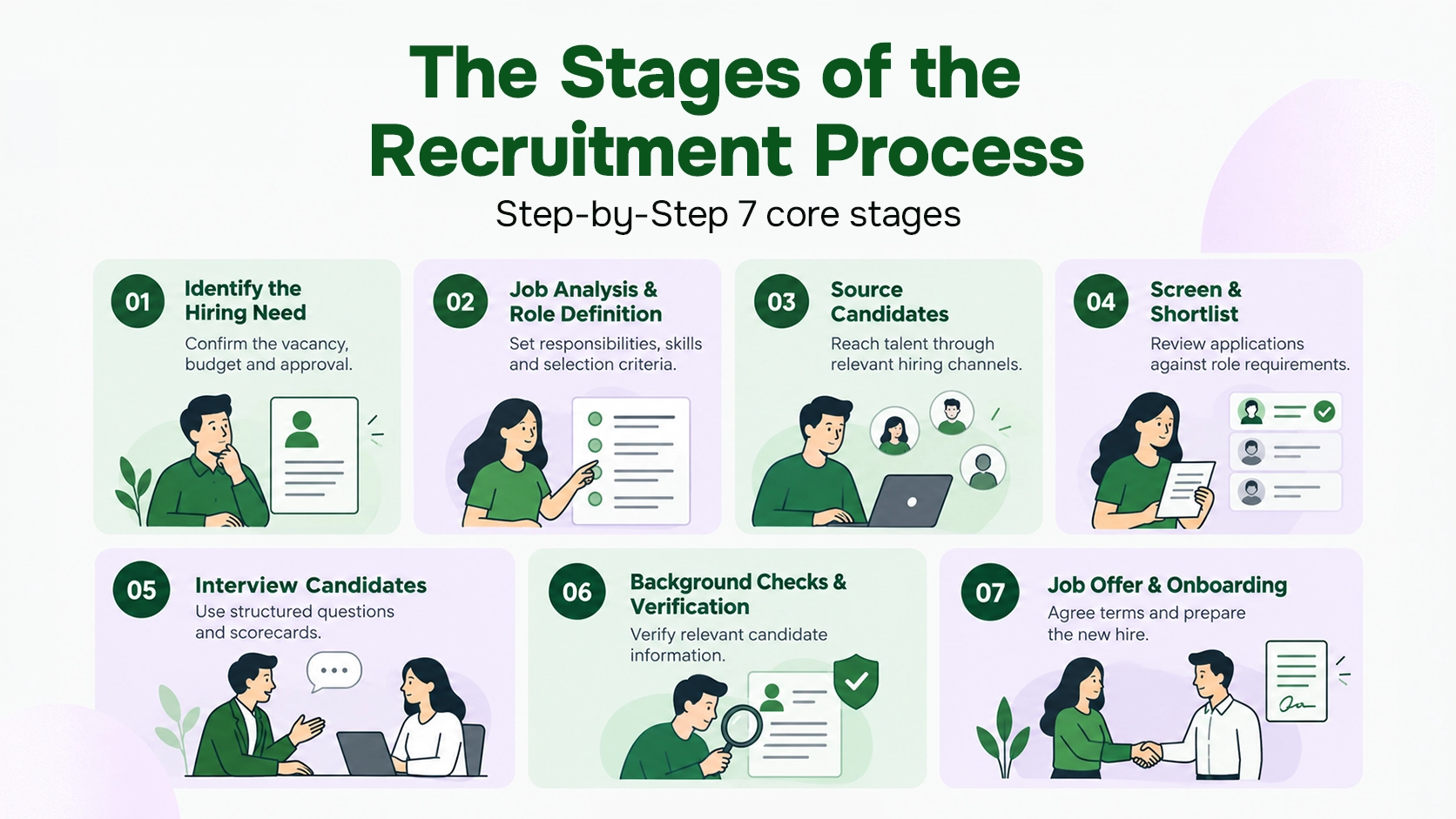
Stage 1: Identifying the Hiring Need
According to SHRM’s 2024 Talent Trends report, 75% of organizations struggled to fill full-time roles, with much of the difficulty linked to technical and soft-skill gaps among applicants.
That is why companies need to define the exact skills, responsibilities, and business reason behind the role before starting the recruitment process.
At this stage, the hiring manager submits a job requisition, a formal internal document that outlines:
Job title
Department
Hiring manager
Number of openings
Salary budget
Employment type
Required start date
Reason for hiring
Approval from decision-makers
Getting this stage right prevents scope from creeping later. If the role is not defined clearly here, every step that follows becomes harder.
Stage 2: Job Analysis and Role Definition
Once the requisition is approved, HR works with the hiring manager to build out the role in detail. This means defining:
The job title and department placement
Core responsibilities and day-to-day duties
Required qualifications, skills, and experience levels
Reporting structure and growth path
Salary range and employment type (full-time, contract, remote, hybrid)
This analysis forms the basis of the job description and also defines the selection criteria used later during screening and interviews.
Stage 3: Sourcing Candidates
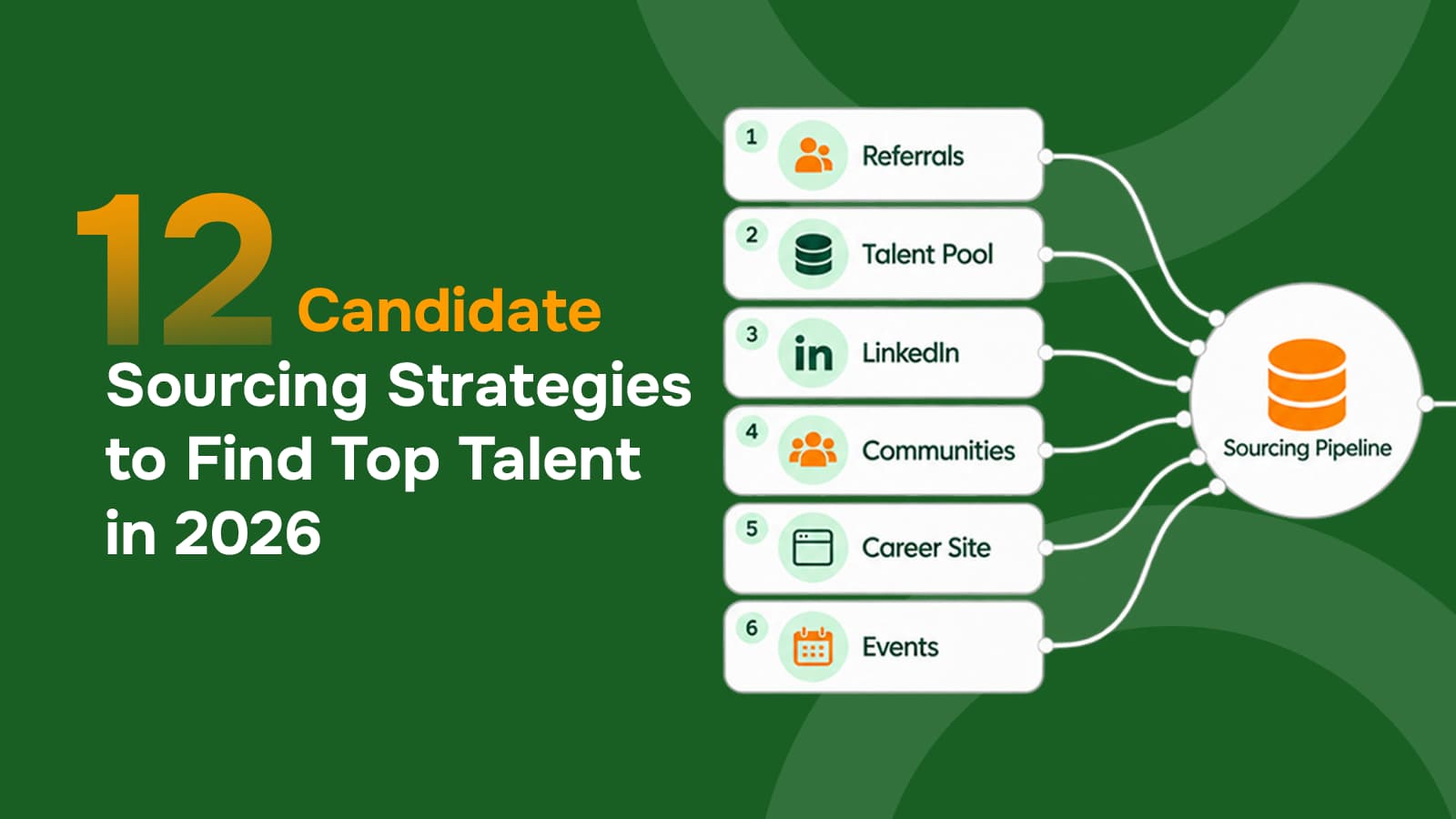
Sourcing is the process of finding potential applicants. It includes both active candidates who are looking for jobs and passive candidates who are currently employed but open to the right opportunity.
A strong sourcing strategy uses multiple channels simultaneously, such as:
Job boards (LinkedIn, Indeed, Glassdoor, niche industry boards): Reach active candidates who are actively looking for new jobs.
Company careers page: Attracts candidates who already believe in your brand.
Employee referral programs: Your existing team finds the next great hire.
Social media recruiting (LinkedIn, X, professional communities): Meets talent where they already spend time.
Recruitment agencies and headhunters: Particularly valuable for senior, niche, or hard-to-fill roles where speed matters.
ATS talent database and past applicants: Past applicants who were strong but not hired for a previous role.
Campus and graduate recruitment: Targeted at entry-level and early-career talent pipelines.
Stage 4: Screening and Shortlisting
Once applications start coming in, the focus shifts to one core challenge, i.e., candidate screening, separating the genuinely qualified from those who simply applied.
This is where screening comes in, and it happens in stages:
Resume/CV screening: HR reviews applications against the selection criteria from Stage 2. An applicant tracking system (ATS) automates much of this by filtering resumes based on keywords, qualifications, and experience.
Phone or video pre-screening: A short 15–20 minute call with shortlisted candidates to verify basic fit, such as availability, salary expectations, communication skills, and motivation.
Skills assessments: For technical or specialized roles, a task-based test validates real-world ability before advancing a candidate to the interview stage.
The output of this stage is a shortlist, a focused group of candidates who genuinely meet the role requirements.
Screen Candidates Faster With AI
Automate resume screening and shortlisting so your team spends time on real conversations, not inbox sorting.
Explore Mercury RecruitStage 5: Interviewing
Interviews are the most time-intensive stage of the recruitment process and one of the most important for evaluating candidate suitability.
Most organizations use a structured interview process that includes multiple stages:
HR Interview: Assesses the candidate's personality, career goals, communication skills, and cultural fit.
Hiring Manager Interview: Evaluates the candidate's technical expertise, work experience, and ability to perform the responsibilities of the role.
Panel Interview: Involves multiple interviewers who assess different aspects of the candidate's qualifications and overall fit.
Technical or Practical Interview: Measures job-specific skills through coding tests, design exercises, case studies, simulations, or practical assignments.
Executive or Final Interview: Allows senior leaders to make the final assessment before extending a job offer.
Regardless of the interview type, every interview should follow a structured evaluation process.
Asking every candidate the same core questions and using a standardized scorecard helps ensure fair comparisons, reduce bias, and support better hiring decisions.
Stage 6: Background Checks and Verification
After choosing the best candidate, the hiring team verifies their information before making the final offer.
Most employers conduct pre-employment checks to verify the information candidates provided:
Employment history verification
Education credential checks
Criminal background check (where legally permissible)
Reference checks with former managers
Identity verification
Credit checks (for finance or security-sensitive roles)
This step verifies candidate information, meets compliance requirements, and helps employers make confident hiring decisions.
Stage 7: Job Offer and Onboarding
The final stage begins after selecting the best candidate which includes:
Making the Job Offer: HR sends a formal offer letter that outlines the job title, salary, benefits, start date, and other employment terms. If needed, both parties discuss and finalize the offer before acceptance.
Pre-boarding: Once the candidate accepts the offer, HR completes documentation, collects required information, and shares important details such as the joining schedule, company policies, and IT setup before the first working day.
Employee Onboarding: Onboarding introduces new employees to their team, role, company culture, and work processes. A well-planned onboarding program helps new hires become productive faster and improves employee retention.
“Hiring is the most important people function you have, and most of us aren’t as good at it as we think.”
— Laszlo Bock, Former SVP of People Operations at Google
Why a Structured Recruitment Process Matters
A structured recruitment process is not about adding complexity to hiring. It is about removing the chaos that makes hiring slow, expensive, and inconsistent.
Here is what a well-structured process actually delivers:
1. Reduces Time to Hire
A structured recruitment process helps companies fill open positions faster.
When responsibilities are clear, interviews are scheduled on time, approvals move quickly, and candidates receive regular updates.
This keeps the hiring pipeline active and reduces unnecessary delays.
2. Lowers Cost Per Hire
A well-organized recruitment process helps companies save money by making hiring more efficient.
Every recruitment stage involves costs, including job postings, recruiter time, interviews, assessments, and background checks. A structured process reduces delays and unnecessary work, helping companies control recruitment costs.
Some HR research estimates that the average cost per hire is around $4,700, showing why an inefficient recruitment process can quickly become expensive.
Make Every Hiring Stage Count
Structured workflows and automation help you cut wasted recruiter hours and avoid repeat hiring cycles.
See How Mercury Recruit Helps3. Improves Candidate Experience
Candidates often judge a company by its hiring process.
Clear communication, timely updates, and a smooth interview experience create a positive impression, even for candidates who are not selected.
A 2026 candidate experience report states that 65% of job seekers judge an employer brand mainly by the application process. This means recruitment is not only an internal process, but also a part of the company’s brand experience.
4. Supports Fair and Compliant Hiring
Using the same interview process and evaluation criteria for every candidate creates a more consistent and unbiased hiring process.
It also helps organizations meet compliance requirements and make fair hiring decisions.
Google re also describes structured interviewing using the same interview questions and the same scoring scale for candidates applying for the same role.
5. Improves Quality of Hire
A structured recruitment process helps recruiters attract the right candidates, screen them effectively, and evaluate them consistently.
As a result, companies hire employees who are a better fit for the role, perform well, and stay with the organization longer.
Research based on Schmidt and Hunter’s selection-method findings shows that structured interviews are more predictive of job performance, with validity around r = .51, compared with r = .38 for unstructured interviews.
H2: Recruitment vs. Selection: What's the Difference?
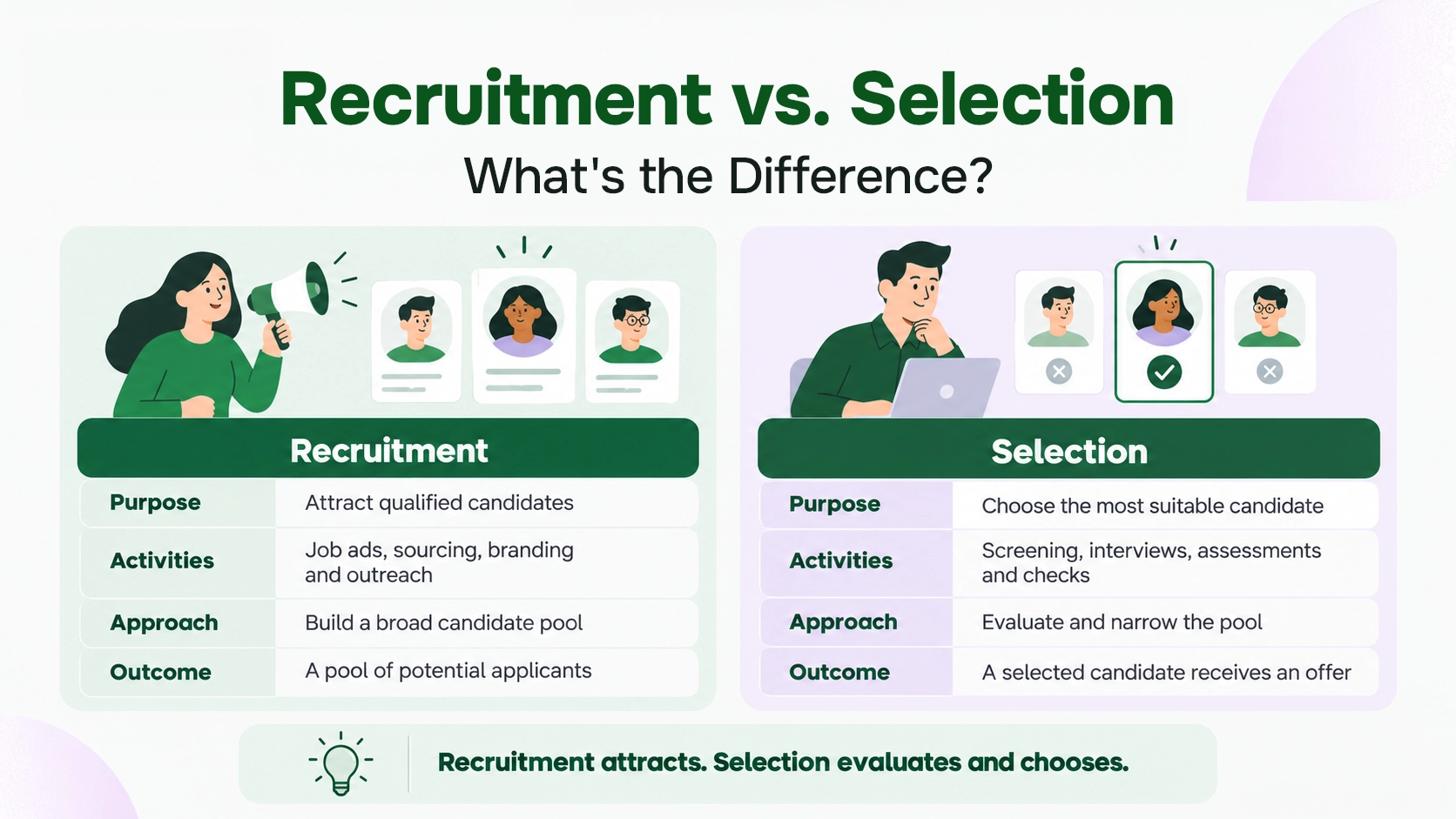
Recruitment and selection work together to build an effective hiring process, but they serve different purposes.
Weakness in either stage affects the overall hiring outcome, while a well-managed process helps organizations hire qualified employees more efficiently and consistently.
Aspect | Recruitment | Selection |
Purpose | Attract qualified candidates for a job. | Choose the best candidate from the applicant pool. |
Focus | Building a pool of potential candidates. | Evaluating and selecting the most suitable candidate. |
Activities | Job posting, candidate sourcing, employer branding, and outreach. | Resume screening, interviews, assessments, reference checks, and final evaluation. |
Outcome | A shortlist of qualified candidates. | One candidate receives the job offer. |
Approach | Broad and attracts many candidates. | Focused on narrowing the candidate pool. |
Stage in Hiring | The first phase of the hiring process. | The phase that follows recruitment. |
“Hiring the wrong people is the fastest way to undermine a sustainable business.”
— Kevin J. Donaldson, Entrepreneur and Business Leader
How to Make Your Recruitment Process Faster and More Effective?
Most recruitment problems do not require a complete reset to fix. In most cases, identifying and improving in a few areas makes a significant difference.
1. Define Clear Selection Criteria Before You Start
A successful recruitment process starts with clear hiring requirements. Before posting a job, HR and the hiring manager should agree on the skills, experience, qualifications, and qualities the ideal candidate should have.
Clear selection criteria help recruiters screen candidates consistently and reduce confusion throughout the hiring process.
2. Reduce Unnecessary Interview Rounds
A lengthy interview process often causes companies to lose qualified candidates. Review your interview stages and remove any that don't add value.
Keeping the process simple helps candidates stay engaged and allows your team to make faster hiring decisions.
3. Use Structured Interviews
Ask every candidate the same role-specific questions and evaluate them using the same scorecard.
This creates a fair hiring process, reduces bias, and makes it easier to compare candidates objectively.
4. Build a Talent Pipeline
Don't wait until a position becomes vacant to start looking for candidates. Build relationships with qualified professionals before you need them.
A strong talent pipeline reduces sourcing time and helps fill future positions more quickly.
5. Track Recruitment Metrics
Measuring recruitment performance helps identify where improvements are needed.
Track important recruitment KPIs such as:
Time to Hire: The number of days from application to offer acceptance.
Time to Fill: The number of days from opening a position to hiring a candidate.
Cost per Hire: The total recruitment cost for each successful hire.
Source of Hire: The channels that produce the best candidates.
Offer Acceptance Rate: The percentage of candidates who accept job offers.
Quality of Hire: How well new employees perform and remain with the company.
Review these metrics regularly to improve your recruitment strategy and hiring performance.
6. Communicate Throughout the Hiring Process
Regular communication creates a better candidate experience. Keep candidates informed about the next steps, provide timely updates, and let every applicant know the final decision.
Even candidates who aren't selected should leave with a positive impression of your organization.
“I hire people brighter than me and then I get out of their way.”
— Lee Iacocca, Former CEO of Chrysler
Want to improve both stages of hiring? Read our guide on How to Improve Your Recruitment and Selection Process.
Tools Every Hiring Team Needs for Better Recruitment Process
Modern recruitment depends on technology to reduce manual work, improve collaboration, and make hiring more efficient.
The right tools help recruiters manage candidates, automate repetitive tasks, and make better hiring decisions throughout the recruitment process.
Here are the core tools that support a modern hiring process:
1. Applicant Tracking System (ATS)
An ATS is the central hub of any recruitment operation. It manages job posting and collecting applications to screening candidates, scheduling interviews, tracking progress, and sending offer letters.
For any hiring team, an ATS replaces the chaos of spreadsheets and email threads with one single platform.
If your organization hires regularly, recruits for multiple positions, or receives a large number of applications, investing in an ATS is a practical way to improve recruitment efficiency.
For businesses looking for an all-in-one recruitment platform, Mercury Recruit is a strong choice.
It is designed for startups, small and medium-sized businesses, recruitment agencies, and growing enterprises that want to streamline their hiring process.
Other popular ATS platforms include Greenhouse, Lever, Workable, BambooHR, iCIMS, and so on.
One Platform for Your Entire Recruitment Process
From job posting to offer letters, manage every stage of hiring without switching tools.
Book A Demo2. Recruitment CRM
A Recruitment CRM (Candidate Relationship Management) system helps recruiters build and maintain relationships with potential candidates before vacancies arise.
Instead of starting every hiring process from scratch, recruiters can nurture passive candidates, store candidate profiles, and stay connected through regular communication.
This makes future hiring faster and helps organizations build a strong talent pipeline for frequently hired roles.
Popular Recruitment CRM solutions include Beamery, Avature, Phenom, Gem, Recruit CRM, and Bullhorn CRM.
3. Job Distribution Tools
Job distribution tools simplify job advertising by helping recruiters reach more candidates with less effort.
Rather than posting the same vacancy on multiple job boards individually, these tools distribute a single job listing across several recruitment platforms at once.
This saves time, improves job visibility, and helps attract candidates from multiple sourcing channels.
Some popular job distribiution tools include Broadbean, JobAdder, VONQ, SmartRecruiters Job Distribution, and Manatal.
4. Video Interview Platforms
Video interviewing platforms make remote hiring easier by allowing recruiters and hiring managers to conduct interviews from anywhere. Many platforms also support recorded or asynchronous interviews, where candidates complete interviews at their convenience.
These tools simplify scheduling, reduce travel costs, and speed up the early stages of the recruitment process.
Widely used video interview platforms include Zoom, Microsoft Teams, Google Meet, HireVue, Spark Hire, and Willo.
5. Background Check Software
Background check software helps employers verify important candidate information before making a final hiring decision.
Depending on the role, this may include employment history, education, identity verification, criminal records, or professional certifications.
Automating these checks speeds up the verification process while helping organizations reduce hiring risks and meet compliance requirements.
Leading background screening solutions include Checkr, GoodHire, HireRight, Sterling, and First Advantage.
6. AI-Powered Screening Tools
AI-powered recruitment tools such as Mercury Recruit, SeekOut, hireEZ, Eightfold and similar platforms help recruiters review large volumes of applications more efficiently.
They analyze resumes, match candidate skills with job requirements, and highlight the most relevant applicants based on predefined criteria.
According to SHRM’s 2024 Talent Trends report, 26% of organizations use AI to support HR-related activities.
Among organizations using AI in HR, 64% use it for recruiting, interviewing, or hiring, and among those using AI for recruitment, 34% use it to review or screen applicant resumes.
While AI significantly reduces manual screening time, final hiring decisions should always include human evaluation to ensure fairness and accuracy.
7. Recruitment Analytics Tools
Recruitment analytics tools provide valuable insights into hiring performance by tracking key metrics such as time to hire, cost per hire, source of hire, offer acceptance rate, and recruitment funnel performance.
These insights help HR teams identify bottlenecks, improve recruitment strategies, and make data-driven hiring decisions that lead to better long-term results.
Organizations often use tools such as Visier, Greenhouse Analytics, Ashby Analytics, SmartRecruiters Analytics, Tableau, and Microsoft Power BI to monitor hiring performance.
Conclusion
A strong recruitment process is one of the most valuable investment an organization can make.
The seven stages covered in this guide work together to help organizations attract, evaluate, and hire the right candidates.
Skipping or rushing any stage can affect the quality of the final hiring decision.
Successful organizations don't always have the biggest recruitment budgets. They have a clear, consistent hiring process and follow it for every recruitment.
Review your current process, identify the areas that need improvement, and make changes one step at a time.
Continuous improvements lead to better hiring decisions, stronger teams, and long-term business success.