
Structured Interview Process: 7 Steps, Questions & Scorecard
Recruit
Job Interview
10 min read
Key Highlights
Structured interviews use standardized questions and scoring criteria for every candidate.
Questions should measure competencies identified through job analysis and description.
Consistent scoring makes candidate comparisons clearer and reduces subjective judgment.
Behavioral and situational questions collect different forms of job-related evidence.
Interview scorecards help panels document ratings before discussing the final decision.
Introduction
An interview often determines who gets hired, yet it remains one of the least consistent stages of the hiring process.
Different interviewers ask different questions, focus on different skills, and judge candidates based on different expectations. As a result, hiring decisions can become subjective rather than evidence based.
A structured interview process solves this problem by giving every candidate the same job-related questions and evaluating their answers against predefined criteria.
Instead of relying on memory, personal impressions, or unplanned conversations, structured interviews create a consistent framework for assessing candidates.
This leads to fairer comparisons, stronger hiring decisions, and a more reliable recruitment process. So, let's learn how to conduct a structured interview that helps you make fair and reliable hiring decisions.
What is a Structured Interview?
A structured interview process is a standardized method for questioning and evaluating job candidates.
Every applicant receives the same core questions in the same order, and interviewers score each answer against an agreed rating scale.
According to the US Office of Personnel Management, structured interviews assess job-related competencies by asking candidates about their past behavior or how they would respond to hypothetical workplace situations.
However, structure does not mean you must read from a script without listening.
You can still ask approved follow-up questions when a response needs clarification, provided every candidate receives a comparable opportunity to explain their evidence.
Key features include
Standardized questions
Consistent question order
Job-related focus
Defined scoring criteria
Behavioral anchors
Consistent follow-up questions
Documented evidence
Structured vs. Unstructured Interviews: Which is More Effective?
Structured and unstructured interviews differ mainly in how questions are asked, and answers are evaluated.
Research generally supports the use of greater interview structures.
A meta-analysis by Wiesner and Cronshaw examined 150 validity coefficients (how accurately an interview predicts job performance) and found that structured interviews produced mean validity coefficients approximately twice as high as unstructured interviews.
Likewise, a separate meta-analysis by McDaniel and colleagues reviewed 245 validity coefficients involving 86,311 individuals and found out that interview validity depended partly on the level of structure used.
The following table shows how structured and unstructured interviews differ in practice:
Key area | Structured interview | Unstructured interview |
Questions | Every candidate receives the same predetermined core questions. | Questions change according to the candidate and the direction of the conversation. |
Question order | Questions are generally asked in the same order. | The interviewer can change the order or introduce new questions. |
Job relevance | Questions are based on defined job duties and competencies. | The conversation may not cover every competency required for the role. |
Scoring | Interviewers use a shared rating scale and agreed criteria. | Evaluation relies more on notes, impressions, and personal judgment. |
Follow-up questions | Interviewers use approved prompts to clarify relevant details. | Follow-up questions are spontaneous and may differ between candidates. |
Candidate comparison | Standardized answers make candidates easier to compare. | Candidates may provide different types and amounts of information. |
Interviewer flexibility | Interviewers follow a consistent framework. | Interviewers have greater freedom to direct the conversation. |
Main benefit | Supports fair, consistent, and evidence-based evaluation. | Creates a more flexible and conversational experience. |
Main risk | Poorly designed questions can make the process too rigid. | Personal preferences, first impressions, and confirmation bias may influence decisions. |
Twice the Predictive Power, With the Same Interview Time
Learn about setting up consistent questions, scorecards, and feedback in Mercury Recruit.
Contact Us NowBenefits of a Structured Interview Process
A structured interview process improves hiring decisions by giving interviewers a shared method for assessing candidates.
Here are some more benefits structured interviews can bring to your hiring process:
More consistent candidate comparisons: Standardized questions help hiring teams compare candidates using the same evidence and competencies.
Stronger connection to job performance: Questions based on job analysis keep the interview focused on the skills and responsibilities required for the role.
Less room for interview bias: Shared questions and scoring criteria reduce the influence of personal impressions and instinct.
A fairer candidate experience: Every applicant receives a comparable opportunity to demonstrate relevant skills and experience.
Better documentation: Structured notes and ratings create a clear record of why a candidate advanced or was rejected.
“Structured interviewing begins with defining the ideal candidate before you even begin recruiting for the role.”— Alex Moore, Director of Talent Acquisition at Credera.
How to Build a Structured Interview Process
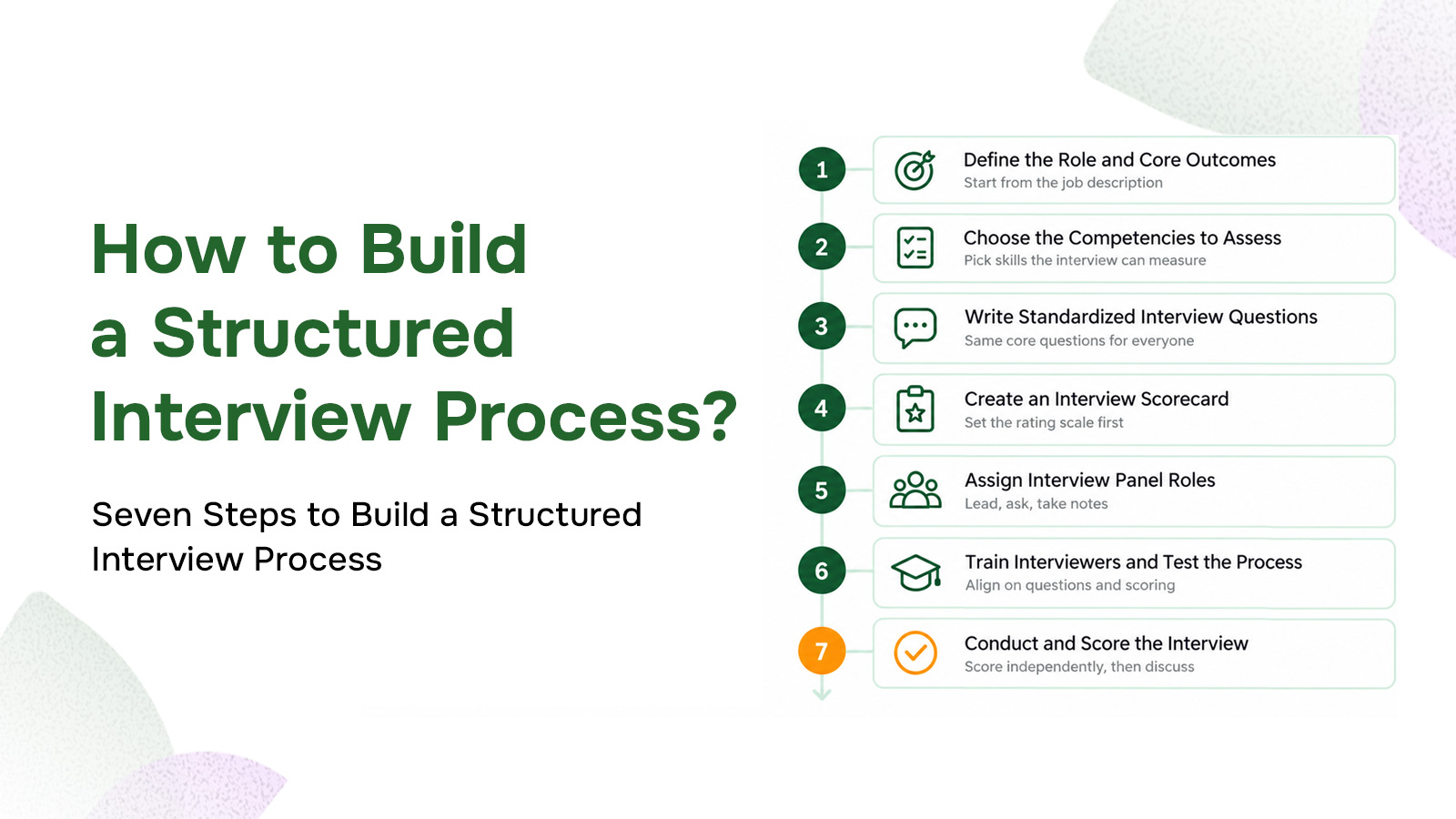
Building an effective process requires more than writing a list of questions. You need to connect to role, competencies, questions, scoring standards, and interviewer responsibilities.
The following steps show the key stages involved in creating a consistent and effective structured interview process.
Step 1: Define the Role and Core Outcomes
Start with the job description and confirm what the candidate must achieve after being hired.
Focus on the main tasks, responsibilities, and expected results rather than listing every possible qualification.
Separate the requirements into:
Essential requirements: Skills or experience the person needs to perform the role.
Preferred requirements: Qualifications that may improve performance but are not necessary from the first day.
Step 2: Choose the Competencies to Assess
Select the competencies that the interview can measure effectively.
For example, you might assess:
Problem-solving: Identifies causes and evaluates possible solutions.
Communication: Explains information clearly to relevant audiences.
Collaboration: Works through disagreement and shared responsibilities.
Planning: Prioritizes tasks and manages deadlines.
Technical judgment: Applies role-specific knowledge to realistic problems.
Do not try to assess every competency in one interview. Use screening, work samples, technical tests, and reference checks when those methods can provide stronger evidence.
Step 3: Write Standardized Interview Questions
Prepare the same core questions for every candidate applying for the role. Connect each question to one competency and make it open enough for candidates to explain their reasoning and provide evidence.
Combine both behavioral and situational questions, keeping each clear, concise and relevant to the work.
Where appropriate, encourage candidates to explain the situation, the action they took, and the result.
Step 4: Create an Interview Scorecard
Before interviewing candidates, create a scorecard, so you know how each response will be evaluated.
During the interview, it helps you focus on useful evidence, take clear notes, and score every candidate using the same standards.
It also keeps the discussion focused on the skills needed for the role.
After the interview, you can compare candidates more easily and explain your final decision with clear evidence.
Step 5: Assign Interview Panel Roles
Decide who will lead the interview, ask each question, take notes, explain the role, and manage candidate questions.
Assigning these responsibilities in advance prevents confusion and keeps the conversation organized.
Ask each panel member to score the candidate independently before discussing their ratings.
This reduces the chance that the first or most senior person to speak will influence everyone else’s judgment.
Step 6: Train Interviewers and Test the Process
Make sure everyone involved understands the competencies, approved questions, scoring scale, note-taking standards, and follow-up rules.
Panel members should also know which questions they can ask and which topics they must avoid.
Run a practice interview with a colleague before the first real candidate. This can help you identify:
Unclear or repetitive questions
Questions that produce limited answers
Inconsistent scoring standards
Confusion about panel responsibilities
Step 7: Conduct and Score the Interview
Ask the approved questions in the planned order and give every candidate a comparable opportunity to respond. Listen carefully and record factual evidence instead of personal impressions.
Score each answer against the predefined standards rather than comparing candidates during the interview. After everyone submits their ratings, the panel can discuss major scoring differences and review the supporting evidence.
Document the final decision and the reasons behind it. This creates a clearer and more defensible hiring record.
“Evidence-based interviewing is about designing the interview so that the truth is pulled out and exposed so it can be evaluated.”— Victoria Gates, Co-founder of Expert Interviewers.
For detailed guidance on opening, conducting, and closing an interview, read our guide on how to conduct an interview.
Structured Interview Scorecard & Scoring Scale
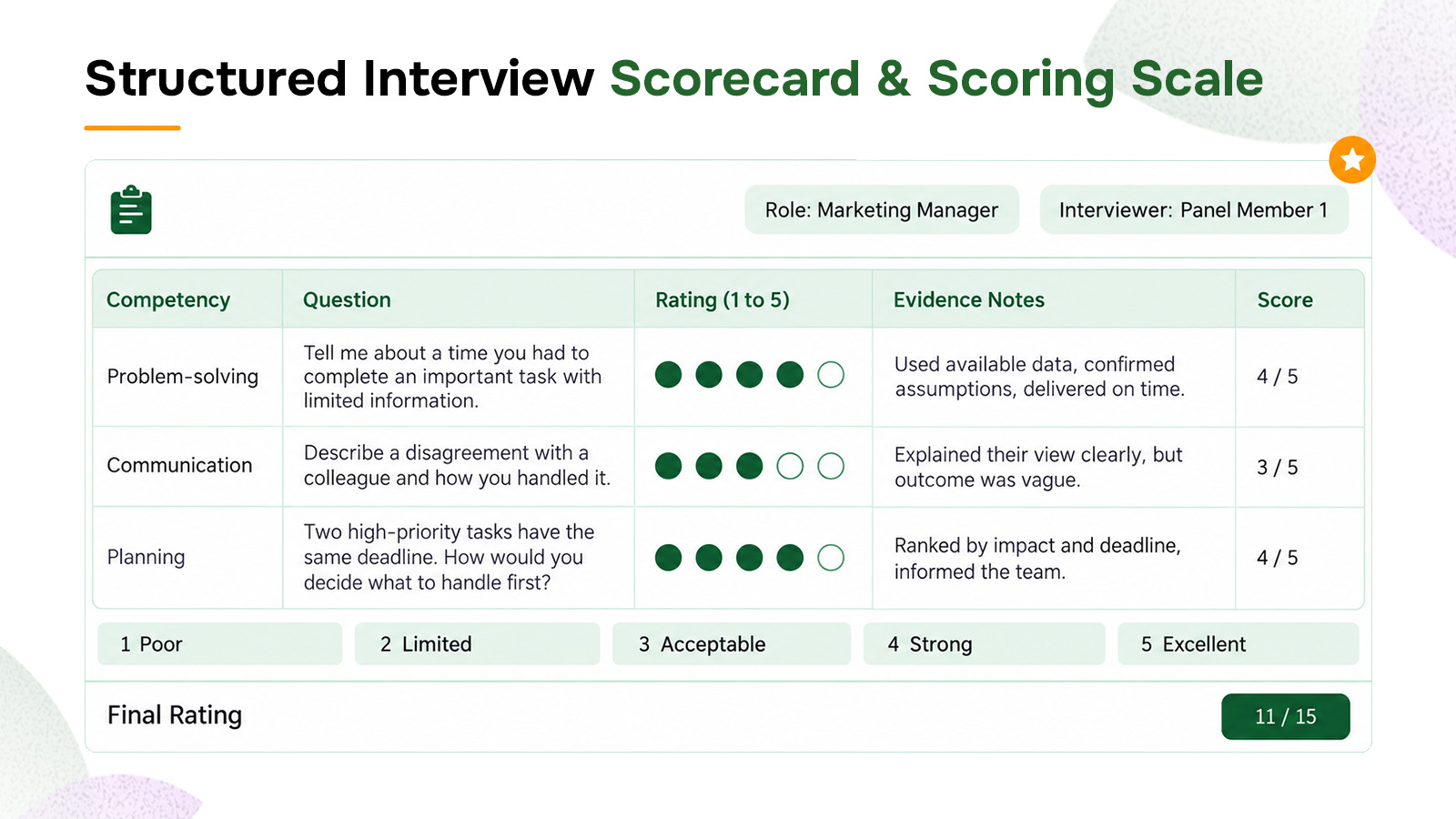
An interview scorecard gives you a consistent way to evaluate each answer. It links every question to a specific competency and explains what weak, acceptable, and strong evidence looks like.
A practical scorecard should include:
Competency: The job-related skill or behavior you are assessing.
Question: The standardized question you ask every candidate.
Rating scale: The numerical range you used to score the response.
Behavioral anchors: Clear descriptions of what different score levels represent.
Interview notes: Factual details and examples from the candidate’s answer.
Final rating: The score you assign based on the evidence provided.
Here is a simple five-point scale:
Score | Rating | Evidence standard |
1 | Poor | Provides no relevant example or does not answer the question directly. |
2 | Limited | Gives a weak example with little detail, ownership, or explanation. |
3 | Acceptable | Provides a relevant example and clearly explains their contribution. |
4 | Strong | Shows sound judgment, clear ownership, and a measurable result. |
5 | Excellent | Provides detailed evidence, strong reasoning, and clear learning from the experience. |
“Scorecards are a good way to collect all of the skills, qualifications and attributes that a candidate would need to possess.”— Amy Giangregorio, then Senior Customer Success Manager at Greenhouse
The Same Rubric for Every Interviewer
Attach competency-based scorecards to each interview stage and collect independent ratings before the panel discusses.
Explore EvaluationStructured Interview Questions for Better Candidate Evaluation
Effective structured interview questions focus on real responsibilities and give candidates enough room to explain their reasoning.
Here are some example interview questions organized by question type and based on the competencies and responsibilities required for the role.
1. Behavioral Questions
These questions ask candidates to describe how they handled relevant situations in the past.
Tell me about the time you had to complete an important task with limited information.
Describe a disagreement with a colleague and explain how you handled it.
Give an example of a process you improved in a previous role.
Tell me about a deadline you were at risk of missing. What did you do?
2. Situational Questions
These questions present realistic workplace scenarios and ask candidates how they respond.
Two high-priority tasks have the same deadline. How would you decide what to handle first?
You identify an error shortly before a client's presentation. How would you respond?
A team member repeatedly misses an important handoff. What steps would you take?
You receive a task outside your experience with limited guidance. How would you begin?
3. Role-Specific Questions
These questions assess the technical knowledge, judgment, and responsibilities connected to a particular position.
Which metrics would you use to evaluate a paid campaign?
How would you investigate rising costs and declining conversions?
How would you allocate a limited budget across several channels?
What would you review before launching a new campaign?
Questions used during earlier recruitment stages should be shorter and focused on basic eligibility.
For best practices, read our guide to candidate screening questions when designing the screening stage.
Conclusion
A structured interview process works because it replaces guesswork with evidence.
Once the questions, scoring scale, and panel roles are set, every candidate is judged against the same standard, and each hiring decision is supported by a record the team can explain and defend.
Start with the job description, build the scorecard before the first interview, and train the panel to score independently. That sequence is what turns a good hiring process into a repeatable one.
This process does not remove professional judgment; it gives that judgment a clearer framework.
Make Every Interview Structured by Default
Standardized questions, shared scorecards, and documented panel feedback in one ATS, so every hiring decision has a record you can explain.
Try Mercury Recruit FreeFAQs
Frequently Asked Questions
Prepare the criteria and questions, open the meeting, ask and probe consistently, answer candidate questions, close clearly, score responses, and follow up.