
What Is Candidate Experience? Stages, Metrics & How to Improve It
Recruit
Candidate Experience
14 min read

Key Highlights
Candidate experience is the overall impression applicants form through their interactions with a company during the recruitment process.
A clear application process, timely communication, and consistent updates create a better candidate journey.
Poor candidate experience leads to drop-off, negative reviews, and missed hiring opportunities.
You can calculate response times, acceptance rates, and other hiring metrics to identify areas for improvement.
To improve candidate experience, focus on clear job descriptions, simple applications, timely communication, respectful interviews, efficient recruitment technology, and a smooth transition into onboarding.
Introduction
According to CareerPlug’s 2025 Candidate Experience Report, 66% candidates say a positive hiring experience influences their decision to accept a job offer, while 26% declined an offer in 2024 because of a poor experience.
Every stage of recruitment shapes how applicants perceive your company. From searching for a job and submitting an application to attending interviews and receiving a final decision, each interaction influences their overall impression.
So, what exactly makes up the candidate experience, and why does it matter? This guide covers its key stages, benefits, metrics, challenges, and ways to improve it.
What Is Candidate Experience?
Candidate experience is the overall impression a prospective hire gets from your company, from the first job posting they see to the final outcome, whether an offer or a rejection.
A clear job description, simple application process, timely communication, respectful interviews, and constructive feedback create a good hiring experience. While delayed or no responses, interview cancellations, or a complicated application process quickly leaves a negative impression.
Moreover, candidate experience is not determined by whether someone receives a job offer. It reflects how applicants are treated at every stage of the recruitment process because, in the end, people may forget where they applied, but they rarely forget how an employer made them feel.
What are the Stages of the Candidate Journey?
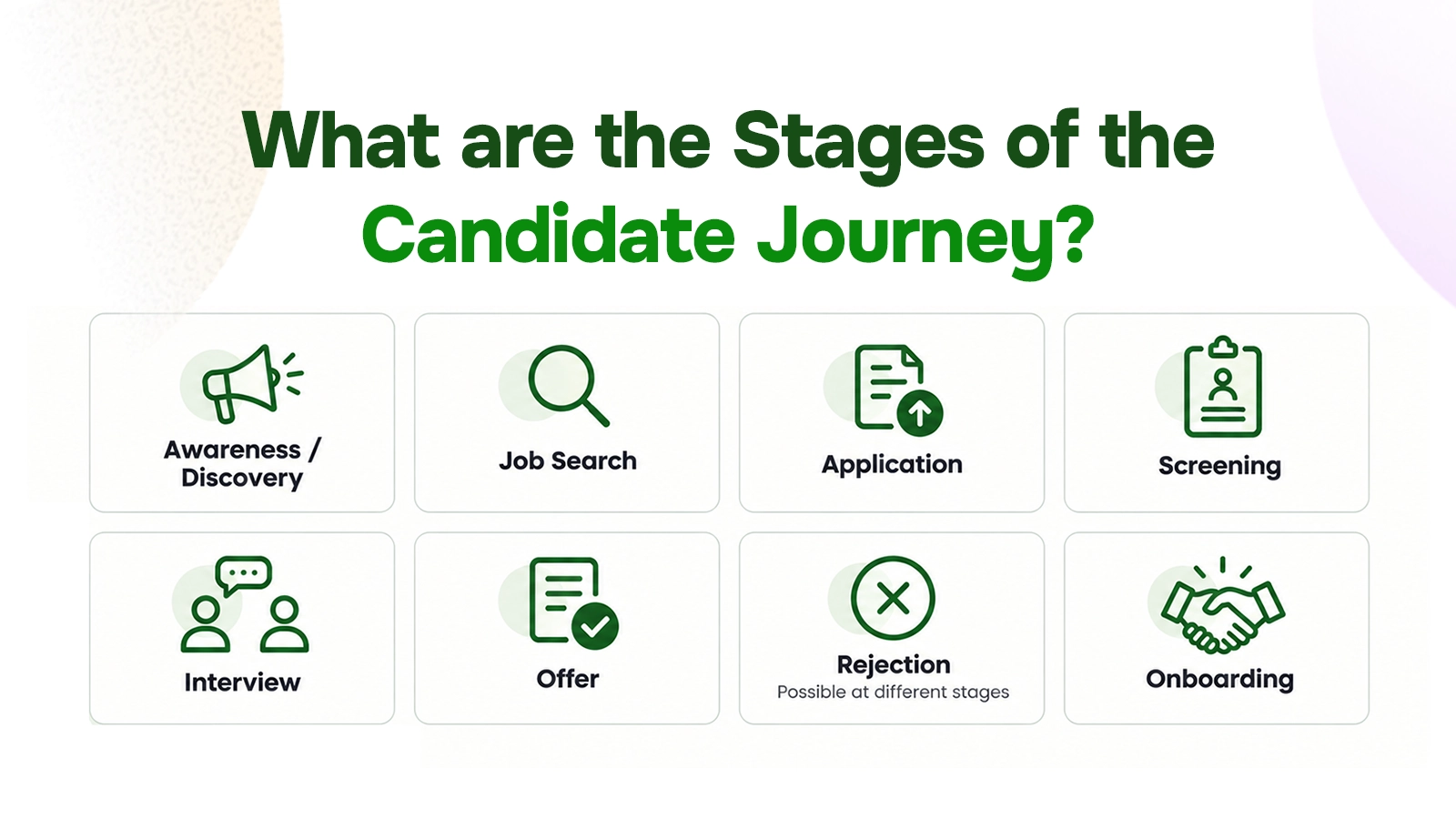
The candidate journey describes every step a person takes from discovering an employer to becoming a new hire or leaving the recruitment process. Understanding each stage helps you identify where applicants lose interest and how to improve their experience.
1. Awareness/ Discovery
The journey begins when someone first learns about your organization. This happens through job boards, social media, career sites, employee referrals, search engines, career fairs, or word of mouth.
At this stage, talents evaluate your employer branding before they consider applying. Company culture, employee reviews, career content, and recruitment marketing all influence whether they move to the next step.
2. Job Search
Once interested, jobseekers explore your career site and available positions. They want to understand the role, responsibilities, salary range (where provided), benefits, and growth opportunities.
Clear job descriptions reduce confusion and attract applicants whose skills and expectations align with the role.
3. Application
The application process is one of the most critical touchpoints. Long forms, unnecessary questions, or technical issues frustrate applicants and increase abandonment rates.
An effective application process is:
Mobile-friendly
Easy to complete
Free from duplicate data entry
Transparent about the next steps
Applicant gets acknowledgement emails
4. Screening
Recruiters review applications, conduct phone screenings, or use an Applicant Tracking System (ATS) to identify top talents.
This stage shapes perceptions through response times. Even if an applicant isn't selected, timely updates show respect for their time and effort.
5. Interview
Interviews allow both employers and candidates to evaluate whether the role is the right fit. Moreover, people often remember how they were treated during an interview long after it ends. This stage is one of the influential stages for applicant experience as 36% decline offers due to negative experience during the interviews.
A positive interview experience includes:
Clear scheduling
Prepared interviewers
Respectful conversations
Transparent hiring timelines
Learn more about how to conduct an interview that creates a positive candidate experience and leads to better hiring decisions.
6. Offer
The offer stage is more than just salary negotiations. People expect prompt communication, clear documentation, and enough information to make an informed decision.
Delays or inconsistent messaging at this stage create uncertainty and increase the risk of losing top talents.
7. Rejection
Once you know a candidate is no longer moving forward, the rejection stage begins. This is where you formally communicate the hiring decision and bring that candidate's journey to a close. Whether they were screened out after an application, declined after an interview, or not selected after the final round, they should receive a clear and timely update.
A rejection email is the final interaction a candidate has with your company for that role, but it does not necessarily have to end the relationship.
Prompt, respectful rejection messages ensure a positive candidate experience, and they may apply in future too. As a recruiter, you can add strong candidates to your talent pool to make your hiring easier. When a suitable role opens in the future, you can reconnect with these candidates instead of starting the search from scratch.
“Candidate experience better be at the top of your list when it comes to priorities in your organization. Candidate experience is the new marketing.” – Steve Cannon
8. Onboarding
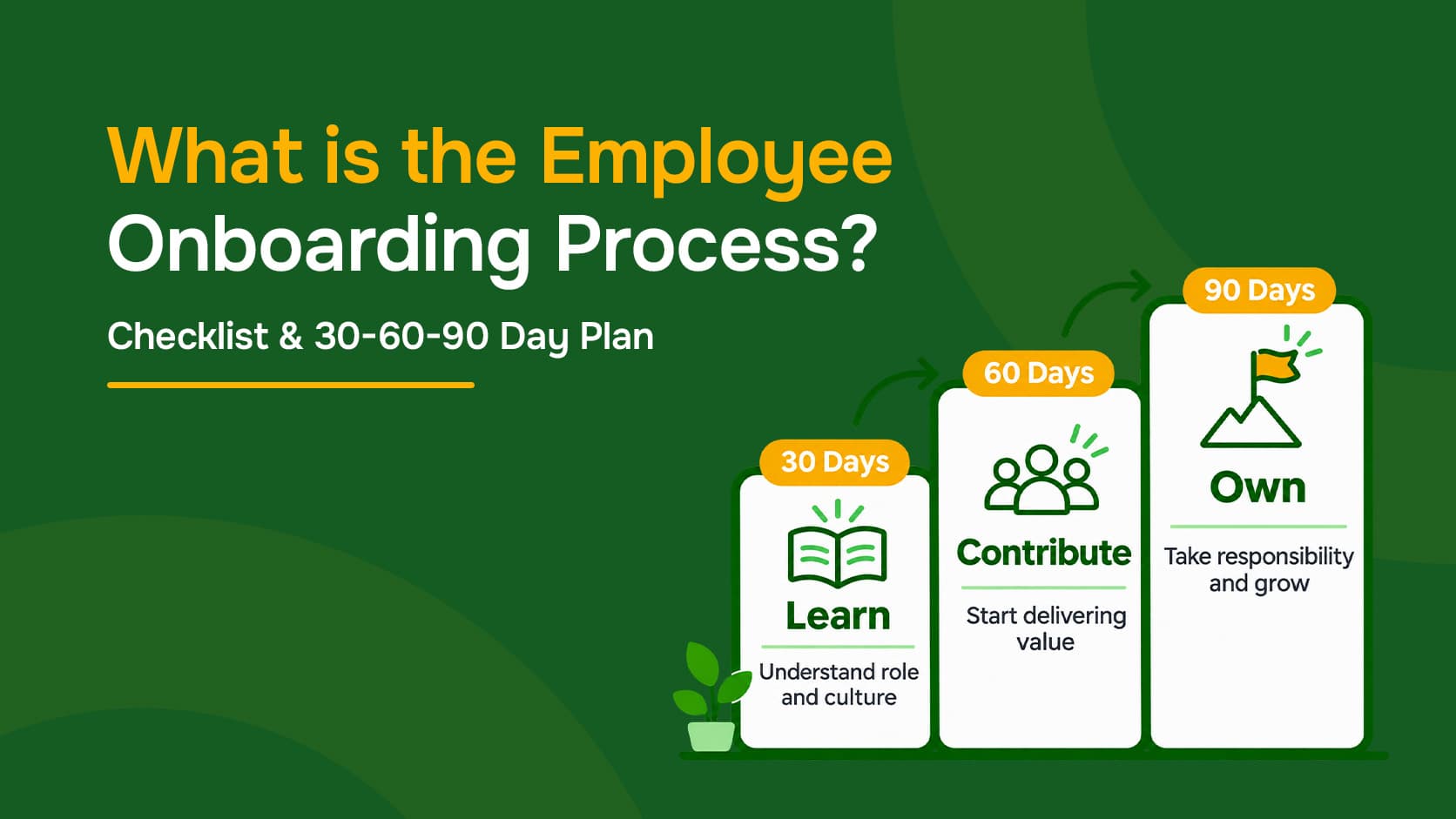
A structured onboarding process confirms that candidates made the right decision and helps them become productive more quickly.
Clear communication before the first day, completed paperwork, and a welcoming introduction to ensure the positive recruitment experience continues into employment.
Transform Your Candidate Experience With Mercury Recruit
Track every applicant’s detail and progress in one place.
See Candidate ManagementWhy Does Candidate Experience Matter?
A great candidate experience turn a good applicant into a new hire, while a poor one can make them walk away. A positive experience strengthens your employer brand, encourages referrals, and helps you avoid losing good talent because of a frustrating recruitment process.
Improves offer acceptance: Most employees say positive experience influences their decision to accept a job offer. So, it is essential to focus on candidate experience.
Strengthens your employer brand: Applicants often share their recruitment experiences on sites like Glassdoor, Indeed, and professional networks. 77% of people with a negative recruitment experience share it with others. So, a positive experience helps shape how potential applicants view your company.
Encourages future applications and referrals: A positive hiring experience turns unsuccessful applicants into part of your talent pool and also brand advocates. According to Indeed, 72% of people with a positive recruitment experience would share it with friends or family.
Reduces hiring time and costs: A smooth experience encourages candidates to stay in the process. This reduces drop-offs and the need to restart searches.
Looking to dive deeper? Read our guide on why candidate experience is important and how it shapes every stage of the recruitment process.
How to Measure Candidate Experience
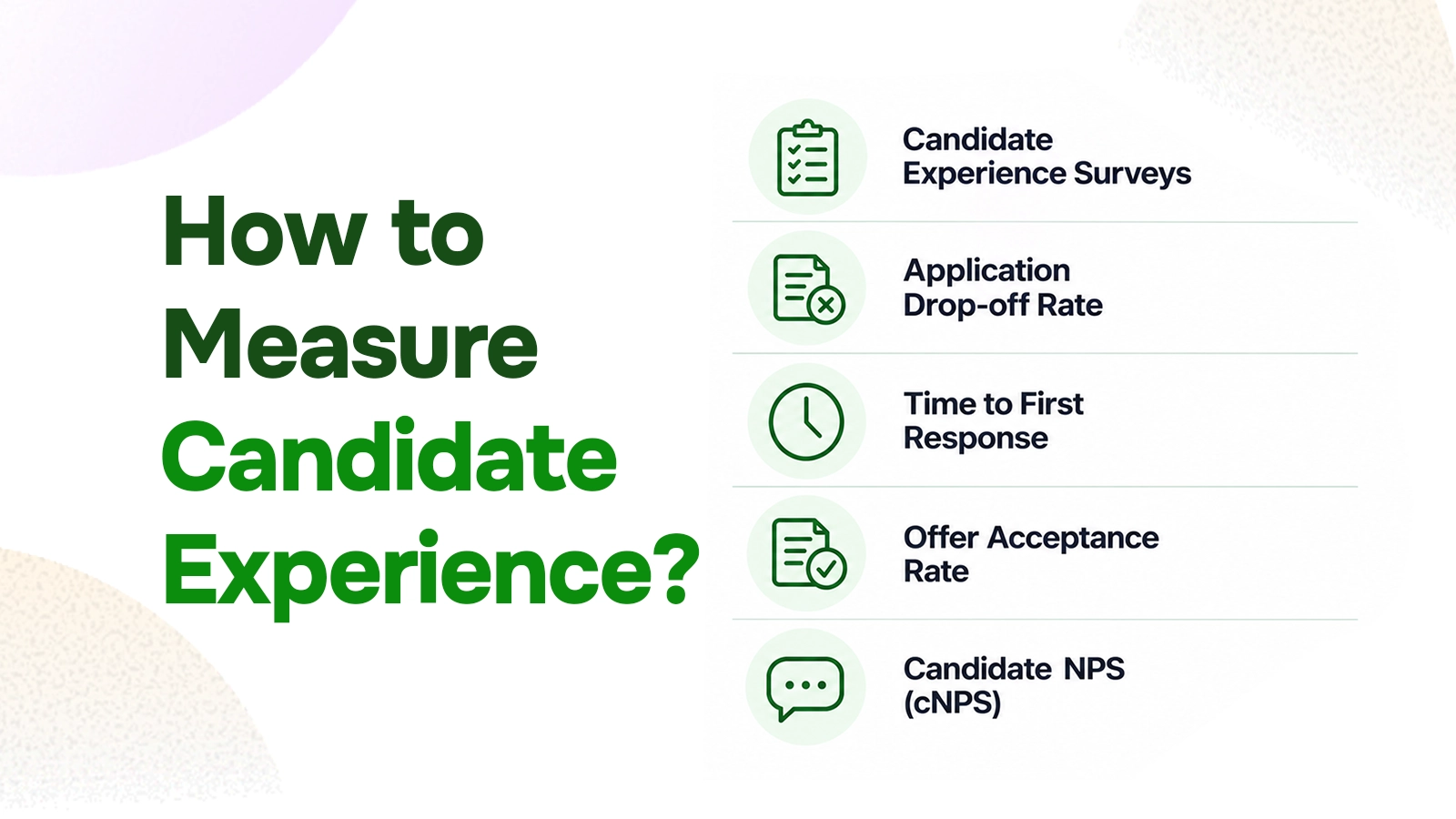
A good candidate experience is not something you should judge by guesswork. Track how applicants respond at different stages, from application to interview and offer, to see where the process works well and where it creates friction.
Use candidate surveys, feedback scores, application completion rates, interview feedback, and offer acceptance rates to turn those experiences into measurable insights.
Below are some of the most effective ways to measure candidate experience.
1. Candidate Experience Surveys
Candidate experience surveys collect feedback after important hiring stages, such as the application, interview, or final decision. Keep surveys short and ask them to rate communication, interview experience, and the overall recruitment process. Include one or two open-ended questions to gather specific suggestions for improvement.
Example questions:
How satisfied were you with the recruitment process?
Was communication clear and timely?
What could we improve?
2. Application Drop-off Rate
Application drop-off rate measures the percentage of people who begin an application but do not complete it.
A high drop-off rate often indicates lengthy forms, technical issues, or complex application steps.
Formula
Application Drop-off Rate = (Applications Started − Applications Completed) ÷ Applications Started × 100
Example
If 500 people start an application and 350 complete it:
{(500−350)/500} ×100 =30%
So, the application drop-off rate is 30%.
“When you serve the candidate better, they always return on your investment.” – Kara Parlin
3. Time to First Response
Time to first response measures how long it takes recruiters to acknowledge applications or provide the first update.
A shorter response time generally indicates a more responsive recruitment process, while a longer response time may indicate delays in communication and can lead to applicant frustration or disengagement.
Formula
Time to First Response = Date & Time of First Response - Date & Time of Application
Example
Application Submitted: Monday at 9:00 AM
First Recruiter Response: Monday at 3:00 PM
Calculation: 3:00 PM − 9:00 AM = 6 hours
Time to First Response = 6 hours
“Candidates who report a very poor recruiting experience are less likely to apply again, refer others, or make purchases.”-Talent Board - from the 2024 Candidate Experience Benchmark Research Report
4. Offer Acceptance Rate
Offer acceptance rate measures the percentage of applicants who accept a job offer. While salary influences this metric, positive recruitment experience also plays a significant role.
Formula
Offer Acceptance Rate = (Number of accepted offers ÷ Total offers extended) × 100
Example
20 offers were sent, and 16 applicants accepted.
Offer Acceptance Rate = 16 ÷ 20 × 100 = 80%
A declining acceptance rate indicates problems with communication, interview experience, or employer perception.
5. Candidate Net Promoter Score (cNPS)
Candidate Net Promoter Score (cNPS) measures how likely applicants are to recommend your company based on their hiring experience. Ask one question after an interview or once the recruitment process ends:
"How likely are you to recommend applying to our company to a friend or colleague?"
They respond on a scale of 0 to 10.
9–10: Promoters
7–8: Passives
0–6: Detractors
Formula
cNPS = % of Promoters − % of Detractors
Example
Promoters: 65%
Passives: 20%
Detractors: 15%
cNPS = 65 − 15 = +50
A higher cNPS indicates that applicants had positive recruitment experience and are more likely to recommend your company to others.
However, measure cNPS at key stages of the hiring journey rather than only at the end.
Starred's H1 2021 benchmark found scores ranging from -15 for candidates rejected after an assessment to +77 for candidates who were hired, showing how candidate sentiment varies across the recruitment process.
Measure Candidate Experience Without Spreadsheets
Track drop-offs, stage times, and offer acceptance across your pipeline.
Explore Analytics7 Ways to Improve Candidate Experience
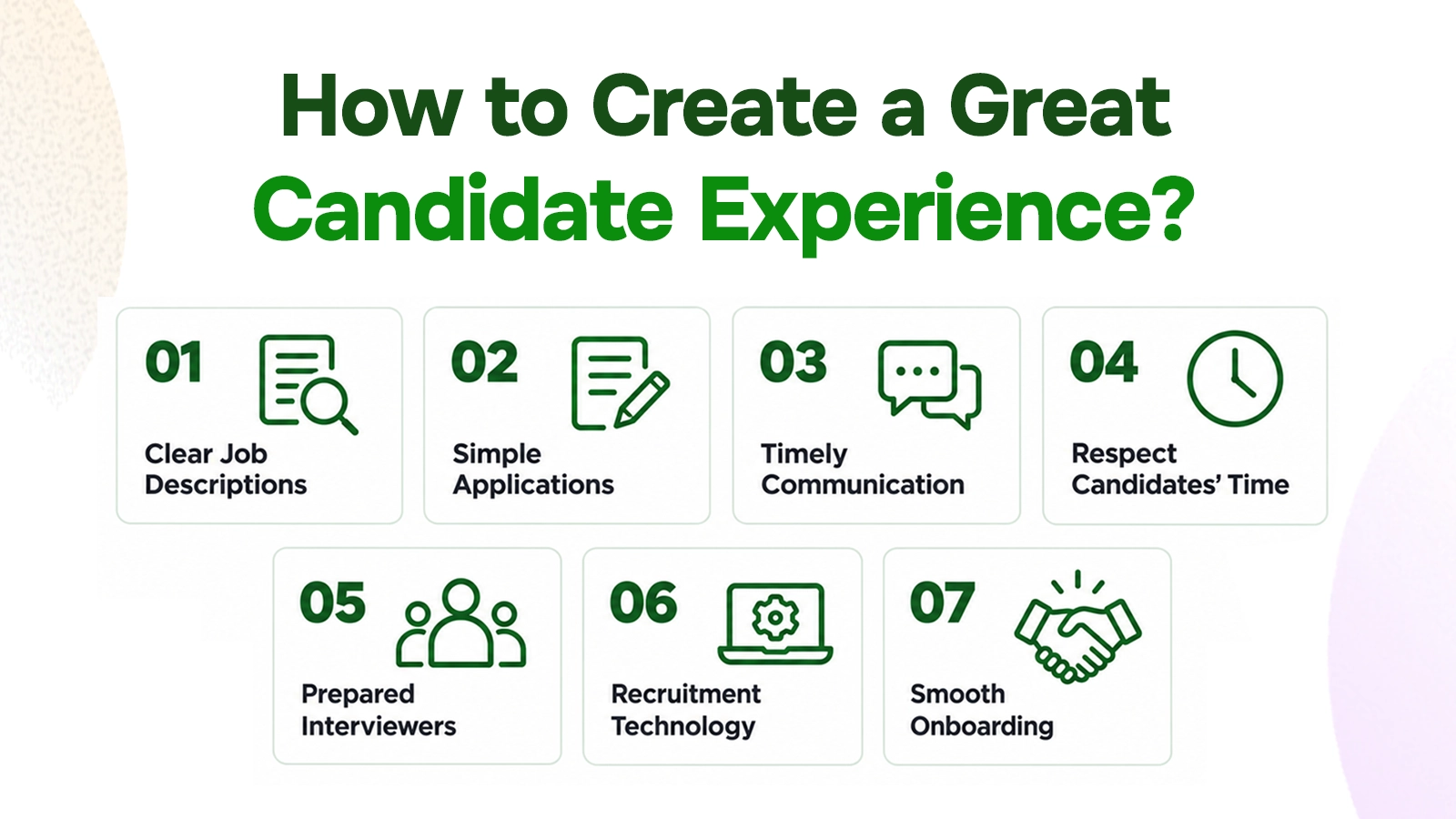
To create a positive candidate experience, ensure you have a clear, simple, and well-organized recruitment process. Also, focus on clear job descriptions, easy applications, timely communication, respectful interviews, and the right recruitment technology.
Follow these candidate experience best practices to create a better hiring experience.
Write clear and accurate job descriptions: Set clear expectations from the start. Explain the role, requirements, salary range where applicable, work arrangement, and hiring process in simple language.
Simplify the application process: 86% of active job seekers begin their job search using a smartphone, making mobile access essential. So, keep applications short, easy to navigate, and mobile-friendly. Also, remove unnecessary questions and avoid asking applicants to enter information already available on their resumes.
Communicate throughout the hiring process: Keep applicants informed about their application status, interview details, delays, and next steps. Even during delays, a quick update helps applicants know what to expect.
Respect candidates’ time: Schedule interviews promptly, start and end them on time, and avoid unnecessary interview rounds. If delays occur, let applicants know and provide an updated timeline.
Choose the right interviewers: Prepare interviewers to ask relevant questions, evaluate applicants consistently, and explain the post-interview process clearly. They should also leave time for applicants to ask questions and understand the next steps.
Use recruitment technology: Recruitment technology helps reduce delays and keep communication organized. An ATS, application portal, resume screening software, and interview scheduling tools can simplify different stages of the recruitment process.
Continue the experience through onboarding: Candidate experience does not end with an accepted offer. Ensure smooth employee onboarding, completed paperwork, and a structured first-day plan to maintain the positive employee experience too.
Build a stronger candidate journey with the practical strategies in our guide on How to create a great candidate experience.
Tools to Improve Candidate Experience During Hiring
The right tools help you create a better impression throughout the recruitment. You can use them to reduce delays, keep communication clear, and give applicants better visibility into their application, interviews, and next steps.
Here are some core tools that improve candidate experience during the recruitment process:
1. Applicant Tracking System (ATS)
An Applicant Tracking System (ATS) helps you create a clearer and more organized recruitment experience for applicants. It keeps application updates, interview details, and next steps organized, so candidates know where they stand and what to expect.
Platforms such as Mercury Recruit, Greenhouse, Lever, and Workable support these features, helping you provide timely and consistent communication throughout the process. This reduces uncertainty and creates a smoother, more transparent candidate experience.
A better ATS makes your hiring process more organized and improves the candidate experience. Explore our guide to the best applicant tracking systems to find the right option for your hiring needs.
2. Candidate Feedback and Survey Tools
Feedback tools help you find problems candidates experience that you might not otherwise notice.
A short survey after an interview or hiring decision reveals whether participants found the process clear, communication timely, and interviews well organized.
SurveyMonkey and Typeform collect candidate experience feedback so your hiring team can address recurring issues and improve the overall hiring experience.
3. Interview Scheduling Tools
Interview scheduling tools give applicants more control over their interview times while reducing unnecessary delays, creating a better candidate experience.
Calendly, GoodTime, and Cronofy allow candidates to choose a suitable interview time from available slots without repeated back-and-forth emails and messages. This saves time for both candidates and recruiters and makes scheduling less stressful.
A simple and flexible scheduling process helps candidates feel that their time is respected, creating a more convenient interview experience.
4. Candidate Communication Tools
Candidate communication tools make the hiring journey more transparent by keeping applicants informed.
Tools like Gem and Beamery help you send timely updates, interview reminders, and follow-ups. Applicants spend less time wondering about their application status and have a clearer idea of what to expect next.
This consistent communication reduces uncertainty and creates a smoother overall experience, especially when there are delays between hiring stages.
5. Video Interview Platforms
Video interview platforms make remote interviews more convenient and create a good applicant experience. Tools like Zoom, Microsoft Teams, HireVue, and Spark Hire provide clear interview links and details in advance, so applicants know where and when to join.
Some platforms also offer one-way interviews, giving them more flexibility to complete an interview at a suitable time. Easy access, clear instructions, and flexible options reduce confusion and make remote interviews more comfortable.
6. Candidate Portals
User-friendly applicant portals help create a more positive candidate experience by giving applicants a clear view of their progress.
Whether integrated into an ATS or offered as a standalone tool, they let applicants check application status, interview details, document requests, and next steps in one place.
This reduces the need to search through emails or wait for updates from recruiters. Having easy access to important information makes the process more transparent, convenient, and less stressful.
7. AI Chatbots and Recruitment Assistants
AI-powered recruitment assistants make the hiring experience more responsive by giving candidates immediate answers to common questions. Instead of waiting for a recruiter to reply, they can get information about job requirements, application steps, interview details, and next steps when they need it.
For example, a chatbot can answer questions about an open role or provide an application update utside recruiters’ working hours. This reduces waiting and uncertainty, helping applicants feel more supported throughout the hiring process.
Conclusion
Candidate experience influences far more than a single hiring decision. It shapes how people view your company before they ever become employees. Every interaction from the first application to the outcome, shapes your employer brand, future talent pipeline, and hiring success.
Therefore, focus on creating a recruitment process that is clear, timely, and respectful at every stage. As your hiring grows, use the right recruitment technology to deliver a consistent candidate experience, strengthen relationships with talent, and make every hiring interaction count.
Make Every Hiring Interaction Count
Clear stages, timely updates, and organized feedback in one ATS.
Try Mercury Recruit FreeFAQs
Frequently Asked Questions
To provide a good candidate experience, inform, respect their time, and value them throughout the selection process. It includes clear job information, a simple application process, timely communication, and updates on what happens next, even for candidates who are not selected.