
Candidate Experience Feedback: Questions, Metrics & Best Practices
Recruit
Candidate Experience
15 min read
Key Highlights
Candidate feedback exposes communication and process problems that standard recruitment metrics cannot explain.
Surveys work best when sent soon after the recruitment stage being evaluated.
Rating scales measure performance, while open-ended questions explain the reasons behind each score.
Candidate NPS measures overall advocacy but should be supported by stage-specific questions.
A structured feedback loop turns candidate responses into accountable recruitment improvements.
Introduction
Candidates experience your hiring process from a perspective that recruiters and hiring managers cannot see.
They notice unclear job descriptions, delayed updates, repetitive interviews and impersonal rejection messages, issues that operational recruitment metrics not fully explain.
Candidate experience feedback gives you direct evidence about these interactions. This feedback is one part of the broader candidate experience.
It helps you understand whether applicants found your process clear, fair, respectful, and well organized.
The consequences are measurable. According to the Greenhouse report, 20% of surveyed candidates had rejected a job offer because of a poor interview experience.
This means candidate feedback is not only about satisfaction; it can reveal issues that influence hiring outcomes.
In this blog, you will learn when to collect candidate feedback, which survey questions to ask, how to measure the results, and how to turn feedback into hiring improvements.
Why Candidate Experience Feedback Matters in Recruitment
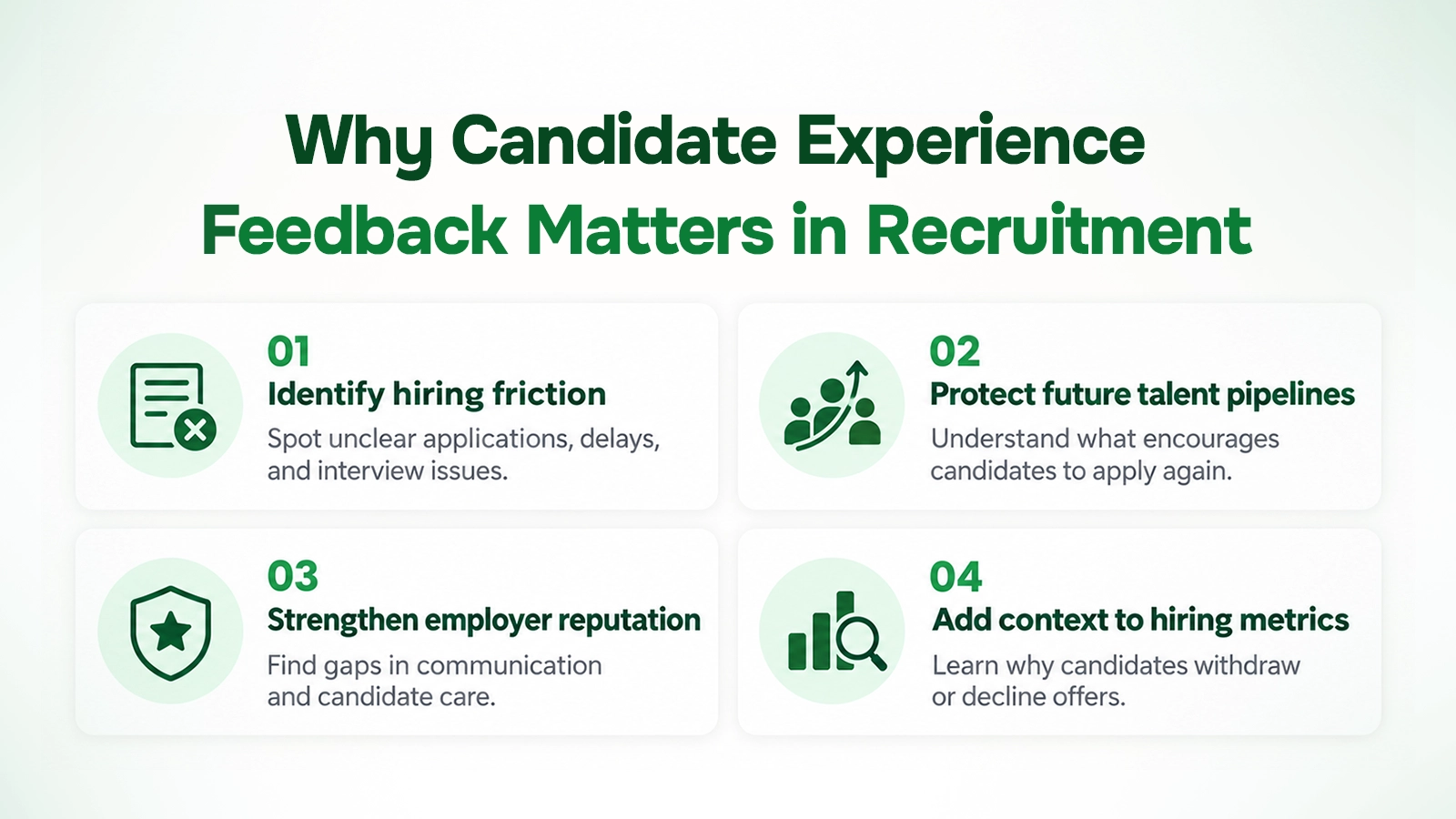
Candidate experience feedback shows how applicants perceive your hiring process rather than how your team assumes they perceive it.
Internal metrics might reveal a slow process, but they do not explain how that delay affected candidate confidence.
Here are some of the key reasons why collecting candidate experience feedback should be an essential part of every recruitment process:
1. Identify Problems Across the Hiring Journey
A candidate experience survey can reveal problems at specific recruitment touchpoints, including:
Complicated application forms
Unclear job descriptions
Late interview instructions
Repetitive interview questions
Irrelevant assessments
Long periods without updates
Unclear decision timelines
Generic rejection messages
These observations give your team more precise improvement targets than a general satisfaction score.
By segmenting responses by recruitment stage, role, department, recruiter, or location, your team can identify where problems occur most often and prioritize the changes likely to have the greatest impact.
For example, candidates may be satisfied with the interview itself but frustrated by the time it takes to receive an update. This shows that the communication process needs attention rather than the interview format.
2. Protect Future Applications and Talent Pipelines
Rejected candidates may still be suitable for future opportunities. The way you communicate the current decision affects whether they remain interested.
The Greenhouse report found that 79% of surveyed candidates would consider applying to the company again if they received feedback after an unsuccessful interview.
Thoughtful post-interview feedback can therefore help preserve relationships with qualified candidates.
For high-volume roles, providing detailed individual feedback may not always be practical. However, a timely and respectful rejection message is still better than leaving candidates without an update.
3. Strengthen Your Employer Reputation
Candidates share their experiences through professional networks, review platforms and social media.
Consistent communication supports your employer branding, while ghosting or disorganized interviews can weaken it.
The Greenhouse research report found that 52% of surveyed candidates had experienced employer ghosting during the interview process.
Collecting feedback helps you identify the stages where communication stops and whether the problem is concentrated within particular roles, departments, or recruiters.
“Whether they’re communicative, how transparent they’re being and whether they respect candidates’ time directly determine their ability to hire and retain top talent.”— Daniel Chait, CEO, Greenhouse
4. Add Context to Recruitment Metrics
Recruitment metrics explain what happened and candidate feedback helps explain why it happened.
The table below shows how common recruitment metrics can be interpreted alongside candidate feedback to identify the underlying causes of hiring challenges.
Recruitment Signal | What Candidate Feedback Reveal |
High application abandonment | The form was long, confusing, or difficult to use. |
Frequent interview withdrawals | Scheduling was slow, or expectations were unclear. |
Low offer acceptance | Interviews reduced confidence in the role or organization. |
Repeated candidate complaints | A particular stage or interviewer needs attention. |
Low reapplication interest | Rejected candidates felt ignored or disrespected. |
These patterns should be treated as diagnostic signals rather than definitive conclusions.
Your team should compare survey responses with recruitment data, open-ended comments, recruiter observations, and hiring manager feedback before deciding what caused a particular result.
Together, these sources provide a broader view of the hiring process and help teams understand where improvements are needed across the candidate journey.
The Best Time to Send a Candidate Experience Survey
Send a candidate experience survey soon after the interaction you want the person to evaluate.
Candidates provide clearer answers when the experience is recent, and stage-based surveys make it easier to connect feedback to a specific problem.
A single survey at the end of recruitment is easier to manage, but it can miss application or screening issues.
Multiple surveys provide more detail but reduce the response rate if candidates receive too many requests.
The Qualtrics guidance organizes candidate measurement across five touchpoints:
Career site
Application
Interview
Offer
This stage-based approach helps teams distinguish between general satisfaction and problems within a particular part of recruitment.
We adapt this into five candidate-facing touchpoints below:
1.After the Application
A post-application survey can evaluate:
Job-description clarity
Application length
Mobile usability
Technical problems
Document-upload requirements
Clarity about the next step
Avoid sending the same candidate repeated application surveys within a short period.
For example, the Qualtrics guidance recommends configuring post-application contact rules so one person does not automatically receive a new survey for every role they apply to. Its default example limits the invitation to once every 90 days.
2. After the Screening Stage
A screening-stage survey helps you understand how candidates experienced their first direct interaction with the recruitment team before entering the main interview process.
It can reveal communication gaps, scheduling difficulties, unclear role expectations, or inconsistencies in how screening conversations are conducted.
The survey can evaluate:
Recruiter communication
Scheduling efficiency
Clarity of the role and salary discussion
Professionalism during the screening call
Understanding of the next recruitment stage
Overall screening experience
3. After the Interview Stage
Post-interview feedback is most useful after the complete interview phase rather than after every individual conversation.
Send the survey before announcing the final decision when you want feedback that is less influenced by acceptance or rejection. Send it after the decision when you also want to assess how the outcome was communicated.
The survey can evaluate:
Interview preparation
Scheduling
Interviewer professionalism
Question relevance
Perceived fairness
Role clarity
Communication about the next step
4. After Rejection
Rejected candidate feedback helps you assess whether the decision was communicated promptly, clearly and respectfully.
Anonymous feedback can be particularly useful at this stage because candidates hesitate to criticize the process when they want to remain eligible for future roles.
You can make identification optional, so candidates choose whether they want a follow-up.
5. After an Accepted Offer
Successful candidates can evaluate the complete hiring journey, including whether the role and offer matched what recruiters described.
This survey can also examine the transition from recruitment to onboarding.
However, it should remain separate from later engagement surveys, which measure employee experience rather than the hiring process.
“Like anything in business, you can only manage candidate experience if you can measure it.”— Jordan Burton, Business Development Lead at Talgo
Today’s Rejection, Next Quarter’s Hire
Tag silver medalists by skill so you can reach out first when roles reopen.
Explore Talent PoolCandidate Experience Survey Questions and Ready-to-Use Template
Effective candidate experience survey questions measure both the outcome and the reason behind it.
Rating questions make comparison possible, while open-ended questions provide context.
Keep the survey focused. Each question should support a specific decision or improvement.
Here are the main types of questions to include in your candidate experience survey:
1.Application Experience Questions
Use these questions to understand whether candidates found the job description, application form, and submission process clear and easy to complete.
How clearly did the job description explain the role?
How easy was it to complete the application?
How satisfied were you with the time required to apply?
Did you experience any technical problems?
Did you understand what would happen after applying?
What would have made the application easier?
A five-point Likert scale is suitable for satisfaction and agreement questions:
Very dissatisfied
Dissatisfied
Neither satisfied nor dissatisfied
Satisfied
Very satisfied
Keep the direction of the scale consistent throughout the survey. Switching between positive and negative scales can confuse respondents and make results harder to interpret.
2. Post-Interview Feedback Questions
These questions help you evaluate interview preparation, scheduling, professionalism, relevance, fairness, and communication.
Did you receive enough information to prepare?
Did the interview begin at the expected time?
Did the interviewer explain the role clearly?
Were the questions relevant to the position?
Did you have enough time to discuss your experience?
Did the interview process feel fair?
Did you understand the next step?
What should we improve about the interview?
Post-interview feedback should evaluate the process rather than ask candidates to assess their own performance.
3. Rejected Candidate Feedback Questions
Use these questions to assess whether rejected candidates received a timely, respectful, and clear conclusion to the hiring process.
Was the decision communicated within a reasonable period?
Was the rejection message clear and respectful?
Did you receive useful feedback about the decision?
Would you apply for another role with us?
Would you recommend applying to our company?
What is the main change we should make?
Provide closure before requesting feedback. A survey invitation should not become the first communication a candidate receives after an interview.
4. Offer and New-Hire Questions
These questions help you understand whether the offer matched earlier discussions and whether the transition from recruitment to onboarding was well organized.
Did the final offer match what was discussed?
Did you receive enough information to make a decision?
Did recruitment increase your confidence in joining?
Was the transition to onboarding organized?
Did the role match the expectations created during hiring?
What should we retain or change?
Candidate Experience Survey Template
A concise survey can use these eight questions:
Which recruitment stage did you reach?
How satisfied were you with the overall experience?
How clear was communication throughout the process?
How fair and relevant did the interviews or assessments feel?
How satisfied were you with the speed of the process?
How likely are you to recommend applying to our company?
What worked particularly well?
What is the most important improvement we should make?
Make names and contact details optional when anonymous feedback is appropriate. You can still request non-identifying information such as hiring stage, department, or role type for analysis.
“Most candidates want to work with a company that values their time, communicates frequently and is transparent.”— Carin Van Vuuren, Chief Marketing Officer at Greenhouse
Know Where to Ask Candidates “Why”
Track stage times and drop-offs to spot where feedback is needed most.
Explore AnalyticsHow to Measure Candidate Experience Feedback
You can measure candidate experience feedback in different ways depending on what you want to understand, the stage of the hiring process, and the type of responses you collect.
Here are the key metrics and methods you can use to measure candidate experience feedback:
1.Candidate NPS
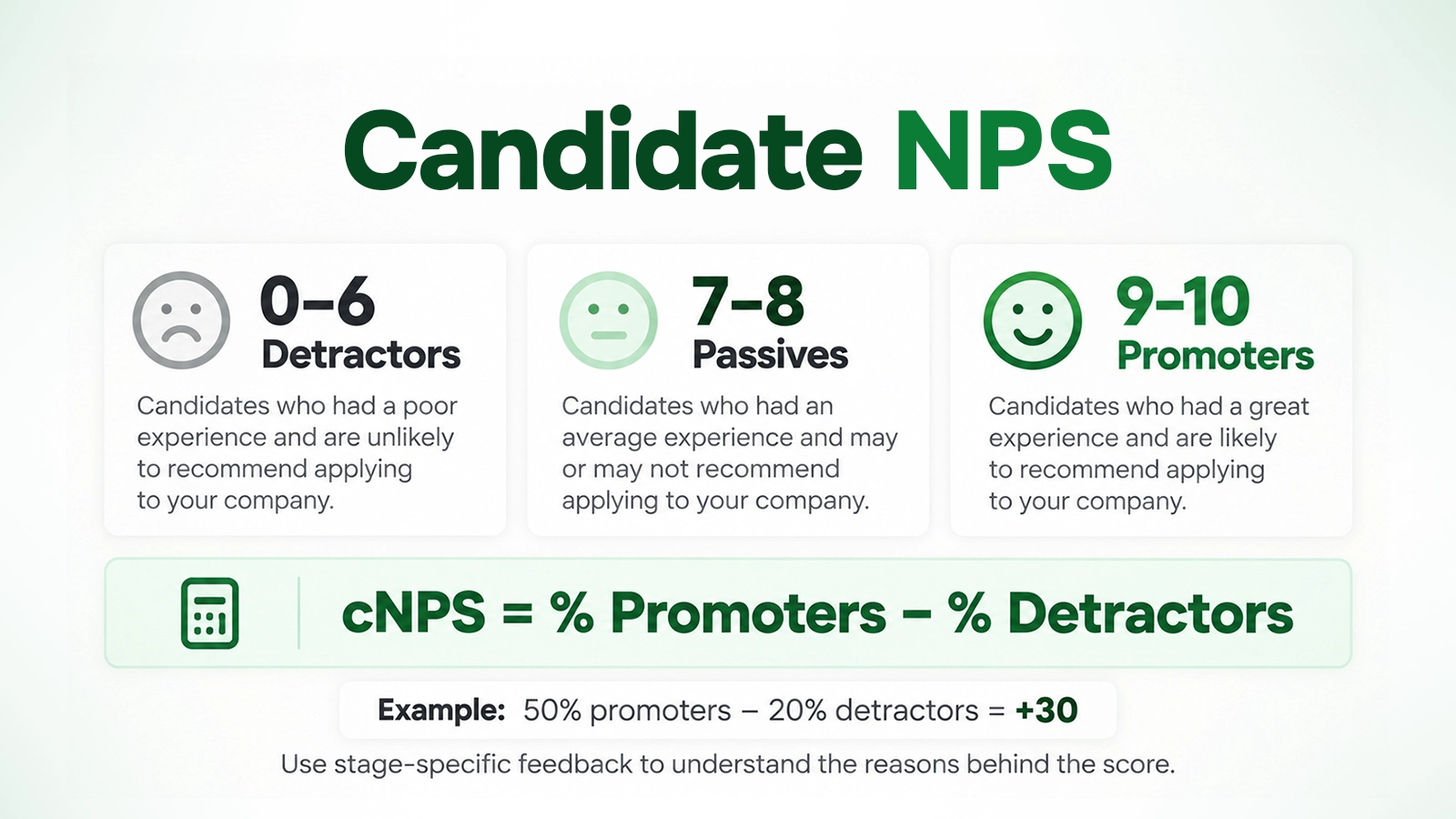
Candidate Net Promoter Score, or candidate NPS (cNPS), measures whether candidates would recommend applying to your organization.
Ask:
On a scale from 0 to 10, how likely are you to recommend applying to our company?
Group responses as:
Promoters: Scores of 9 or 10
Passives: Scores of 7 or 8
Detractors: Scores from 0 to 6
Calculate the score using:
Candidate NPS = Percentage of promoters − Percentage of detractors
For example, if 50% of respondents are promoters and 20% are detractors, your candidate NPS is 30.
However, the overall score becomes more useful when you break it down by recruitment stage, department, role type, or hiring manager, provided each group has enough responses to support a meaningful comparison.
This helps you identify differences that a company-wide average may hide, such as a positive application experience but a poor interview experience.
“I believe that providing an extraordinary candidate experience for serious and well-qualified candidates is essential.”— Lou Adler, CEO of Performance-based Hiring Learning Systems
2. Rating-Scale Results
Rating-scale results show how candidates scored specific parts of the recruitment experience.
Track responses to questions about:
Communication clarity
Recruitment speed
Interview fairness
Interviewer professionalism
Role transparency
Overall satisfaction
When reviewing the results, do not rely only on the average score. Examine how responses are distributed across the full rating scale.
An acceptable average still contains a meaningful group of candidates who selected the lowest rating.
Reviewing both the average and the distribution helps you identify problems that otherwise be overlooked.
3. Open-Ended Feedback and Sentiment
Open-ended questions explain why candidates selected a particular score.
Categorize comments into recurring themes such as communication, scheduling, interviews, technology, fairness, and rejection. This makes it easier to identify repeated concerns and compare feedback across different hiring stages.
Additionally, sentiment analysis can help sort large numbers of comments into positive, neutral, and negative groups.
However, a recruiter or analyst should still review the original comments because automated tools can misread mixed opinions, context, or sarcasm.
4. Response Rate
Response rate measures the percentage of candidates who completed your survey after receiving an invitation.
Calculate response rate using:
Completed surveys ÷ Delivered survey invitations × 100
Compare response rates by survey stage, length, timing and delivery channel. A low response rate indicate that the survey arrives too late, contains too many questions or does not explain how the feedback will be used.
Always report the number of responses alongside percentages. Results from a small or self-selected group should not be presented as the view of every candidate.
5. Benchmarking
Benchmarking means comparing candidate experience results over time or against other groups to understand whether performance is improving, declining, or remaining consistent.
Start with internal benchmarking. Compare the same questions across quarters, hiring stages and departments.
External benchmarking is useful only when the other survey uses comparable questions, scales, and candidate populations.
Otherwise, differences in methodology can make the comparison misleading.
Effective benchmarking depends on having candidate feedback, evaluations, and recruitment data stored consistently in one place.
Mercury Recruit supports this with candidate management tools that centralize feedback, evaluations, and notes in one workplace, plus hiring analytics that track pipeline activity and status changes over time.
How to Turn Candidate Experience Feedback into Recruitment Improvements
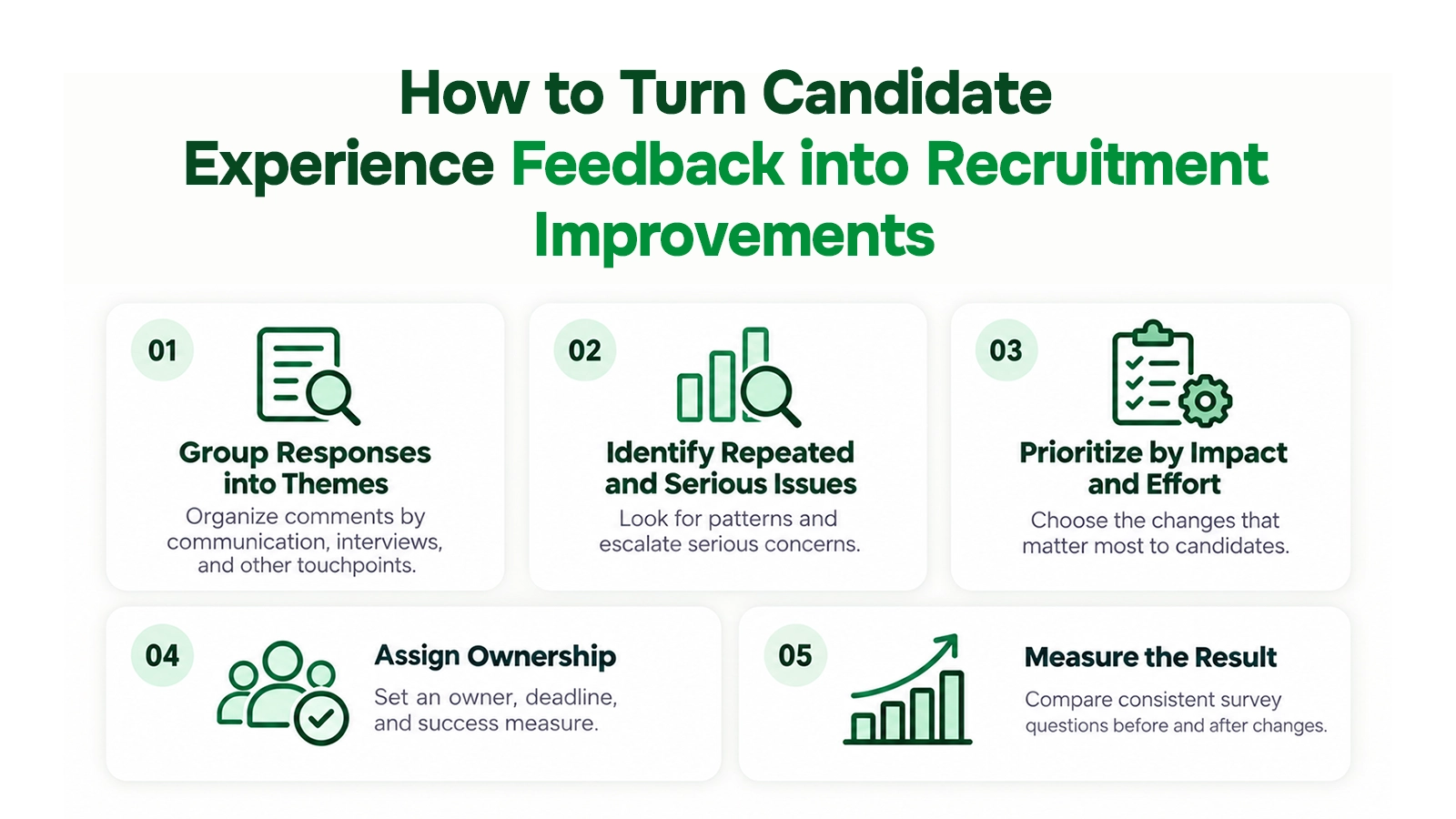
To turn candidate feedback into recruitment improvements, you need to identify recurring issues, prioritize the most important changes, assign clear ownership, and measure whether those changes improve the candidate experience.
Here are the key steps for turning candidate feedback into measurable recruitment improvements:
1. Group Responses into Themes
Use consistent categories such as:
Application experience
Communication
Scheduling
Interview quality
Assessment relevance
Fairness
Decision speed
Rejection experience
Offer process
Onboarding transition
This makes patterns easier to identify than reviewing individual comments without a framework.
2. Identify Repeated and Serious Issues
Look for patterns across:
Hiring stages
Recruiters
Interviewers
Departments
Role types
Successful and rejected candidates
Recruitment periods
A repeated issue usually deserves priority, but do not ignore an isolated report involving discrimination, misconduct, privacy or safety.
The Greenhouse report found that 54% of surveyed candidates said they had encountered discriminatory interview questions.
Feedback channels must therefore allow serious fairness concerns to be identified and escalated, not merely combined into an average satisfaction score.
3. Prioritize by Impact and Effort
Not every issue requires the same level of attention. Evaluate each finding based on how strongly it affects candidates and the effort required to resolve it, then use that comparison to set priorities.
The table below shows how common feedback issues can be classified:
Finding | Candidate impact | Effort | Priority |
Candidates do not know the next step | High | Low | Immediate |
Application form repeats information | Medium | Medium | Near term |
Interviewers ask duplicate questions | High | Medium | Near term |
Career-site redesign is required | Medium | High | Planned |
One email contains unclear wording | Low | Low | Routine fix |
4. Assign Ownership
Every approved action should include:
A named owner
A completion date
The process being changed
A success measure
A review date
Without ownership, collecting candidate feedback becomes a reporting activity rather than an improvement process.
5. Measure the Result
After introducing a change, compare:
Relevant survey ratings
Candidate NPS
Candidate withdrawal rates
Interview no-shows
Time between stages
Offer acceptance
Reapplication interest
Recurring complaint themes
Keep the question wording and scale consistent before and after the change. Otherwise, you cannot determine whether the result changed because of the process or because of the survey design.
Use these findings to confirm which changes are working, identify areas that still need attention, and turn recurring feedback into consistent candidate experience best practices.
Over time, applying those lessons across communication, interviews, decisions, and onboarding can help you create a great candidate experience throughout the hiring journey.
Keep Feedback, Evaluations, and Hiring Data Together
Centralize candidate records and team evaluations in one workflow.
Book A DemoConclusion
Candidate experience feedback becomes valuable when hiring teams collect it at the right moments, analyze it alongside recruitment data, and assign responsibility for improvements.
Start with a small number of high-value touchpoints, keep surveys focused, and measure the same indicators after making changes.
Over time, this creates a feedback loop that improves communication, fairness, and consistency throughout the recruitment process.
FAQs
Frequently Asked Questions
Candidate experience feedback is information applicants provide about their interactions with an employer during recruitment.