
What Is Employer Branding? Importance, Strategy & How to Build It
Recruit
Employer Branding
15 min read

Key Highlights
Employer branding actively shapes how candidates and employees perceive your organization as a place to work.
Your employer brand must reflect the real employee experience rather than relying on polished recruitment messages.
A clear employer value proposition explains why suitable candidates should join and why current employees should stay.
Careers pages, employee stories, online reviews, and candidate interactions all influence your reputation in the talent market.
You should measure employer branding through recruitment outcomes, employee feedback, engagement, and reputation indicators.
Introduction
You post a role with competitive pay, strong benefits, and a good team, yet qualified candidates still withdraw, stop responding, or accept offers elsewhere.
Often, their decision begins before they speak to a recruiter. Candidates review your careers page, employee feedback, social media, and job descriptions to decide whether your organization feels credible and trustworthy.
That perception is your employer brand. Every company has one, even without a formal employer-branding campaign.
According to LinkedIn research, 75% of job seekers consider an employer brand before applying for a job. A credible employer brand therefore supports your wider recruitment process before a recruiter speaks to the candidate.
In this blog, you will learn what employer branding means, how it differs from related concepts, why it matters, and how you can build and measure it.
What Is Employer Branding?
Employer branding is the process of shaping and communicating your organization’s reputation as a place to work.
It combines the experience you provide with the messages candidates and employees see across recruitment and workplace channels.
Your employer brand is the resulting perception. It includes what people believe about your culture, leadership, purpose, career opportunities, compensation, flexibility, and employee experience.
This distinction matters because branding cannot create a credible reputation by itself.
You can promote your workplace, but employees and candidates will ultimately judge whether the promises match their actual experience.
Employer Brand vs. Company Brand vs. Consumer Brand: What's the Difference
These three brands, employer, company and consumer brand, are connected, but each one speaks to a different audience and decision.
An employer brand explains what your organization is like as a workplace; a company brand represents the organization’s broader identity, purpose and reputation, while a consumer brand influences how customers perceive its products and services.
The following table clarifies the primary audience and purpose of each brand:
Brand Type | Main Audience | Main Question It Answers |
Employer brand | Candidates and employees | Why should I work or continue working here? |
Company brand | Employees, customers, investors and the public | What does this organization represent? |
Consumer brand | Buyers and users | Why should I choose this product or service? |
These three brands are connected, but each speaks to a different audience and influences a different decision.
When they align, the organization appears more trustworthy to every audience member.
“Employer branding is not only about hiring, it is also about shaping the perception of a company’s work culture and having those stories be aligned to its larger brand.”— Marquise McCoy ,former Employer Branding Program Manager, Netflix
Employer Brand vs. EVP: What Does Each One Do
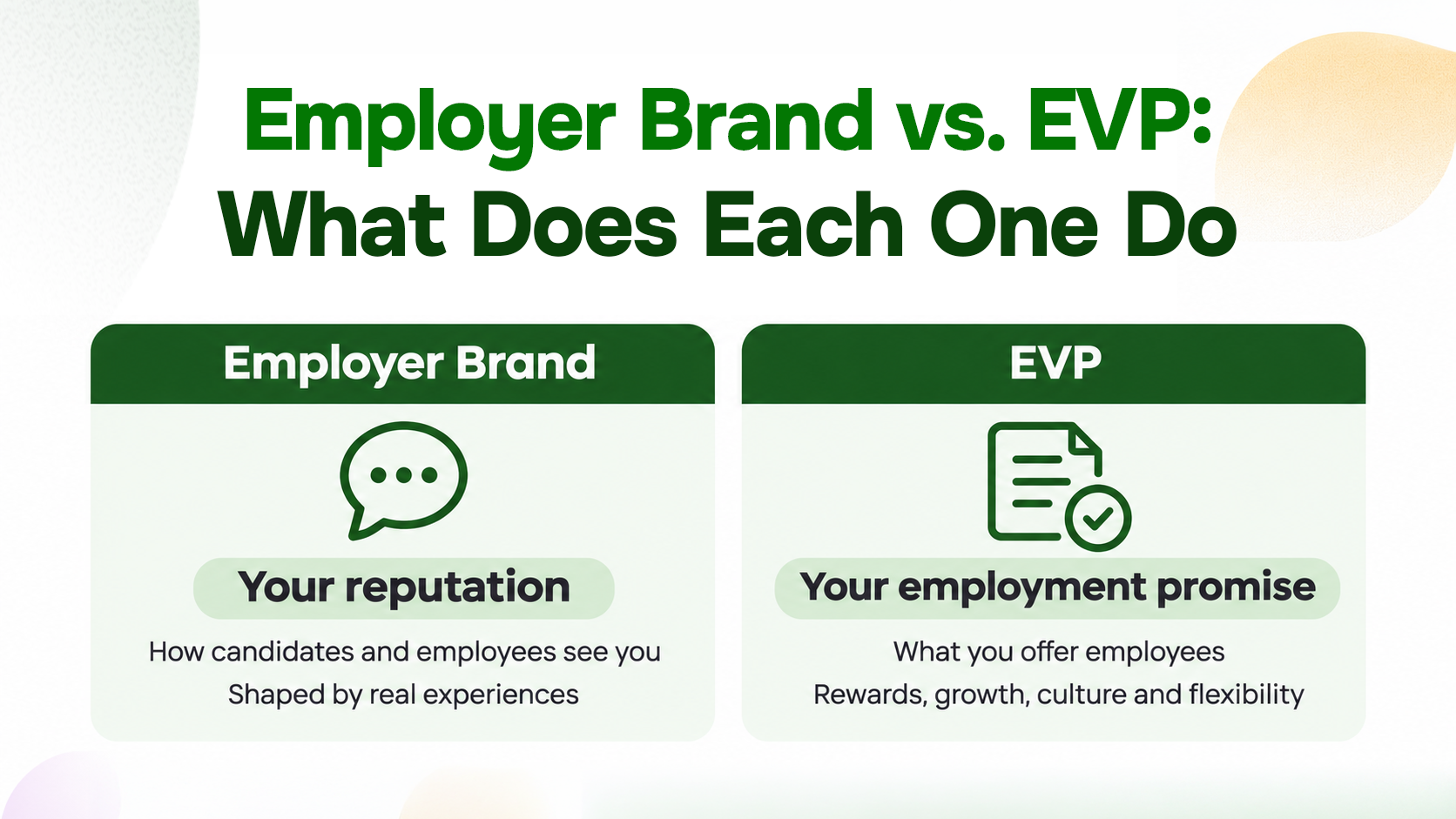
Your employer brand is the wider reputation people hold, whereas your EVP (Employer Value Proposition), is the specific promise you make to employees.
An EVP explains what people receive in exchange for their skills, effort and commitment. It covers compensation, career development, flexibility, meaningful work, recognition, leadership, and workplace culture.
The relationship is straightforward:
Your EVP defines the employment offer.
Your employee experience proves whether the offer is real.
Your employer branding communicates that offer.
Your employer brand reflects how people interpret it.
A strong EVP should be distinctive, relevant, and accurate. Generic promises such as “great culture” or “competitive benefits” offer little value unless you explain what they mean in practice.
When the EVP is delivered consistently, it strengthens the employee experience and helps build a more credible employer brand. Together, they shape how people experience your workplace and contribute to a stronger culture.
Why Employer Branding Matters for Better Recruitment
Employer branding matters because candidates evaluate your reputation before and throughout the hiring process.
A clear and credible brand helps suitable people understand your workplace, while an inconsistent one creates doubt and unnecessary hiring friction.
The following benefits show how employer branding can influence recruitment cost, candidate quality, offer decisions and retention:
1. Reduce Cost per Hire and Time to Hire
A recognized employer brand can generate candidate interest with less direct outreach and paid promotion.
In an analysis of activity on its platform, LinkedIn found that companies with strong talent brands spent 43% less per hire than companies with weaker talent brands.
The same analysis found that organizations with stronger brands grew their workforces 20% faster, indicating that existing awareness and interest can support faster hiring.
When candidates already understand your organization’s purpose, culture, and employment offer, recruiters spend less time introducing the company and more time assessing fit.
This also supports your candidate sourcing, because qualified people are more likely to respond when they recognize and trust the employer behind the opportunity.
A strong brand can also make it easier to nurture a relevant talent pool. Candidates who already recognize your organization be more receptive when a suitable role becomes available.
Turn Brand Interest into a Ready Talent Pool
Save engaged candidates now and reach out when the right role opens.
2. Improve Applicant Quality and Offer Acceptance
Employer branding helps candidates decide whether your organization matches their expectations before they apply.
Clear content about responsibilities, values, working arrangements and career development can discourage unsuitable applications while attracting people who identify with the opportunity.
This does not mean narrowing your audience through vague ideas of “culture fit”; it means providing enough information for candidates to make an informed decision.
Employer reputation also affects offer decisions. Candidates frequently compare your official messages with reviews and employee experiences before accepting.
Glassdoor reports that 83% of job seekers are likely to research company ratings and reviews when deciding where to apply, while its users read an average of six reviews before forming an opinion.
As a result, candidates are unlikely to judge your employer brand from a single career-page statement.
They compare your official message with employee reviews, interview experiences, and the way your organization communicates throughout recruitment.
Build your job descriptions with same message by clearly explaining the role, expectations and opportunity without making promises the wider candidate experience cannot deliver.
3. Support Employee Retention
Employer branding affects retention when the external promise matches what employees experience after joining.
A candidate who joins because of promised flexibility, development or meaningful work will quickly notice whether those conditions exist.
When the experience contradicts the message, the employer brand attracts people initially but fail to retain them.
LinkedIn reports that almost six in 10 employees choose a workplace based on shared values, while 40% said they would leave if they disagreed with their employer’s position on important issues.
These figures show why you need to communicate values carefully and demonstrate them through leadership decisions and workplace practices.
Employer branding should therefore involve current employees, not only recruitment teams.
Retention improves when the organization addresses the workplace issues that influence its reputation rather than attempting to manage perception through content alone.
Key Components of a Strong Employer Brand
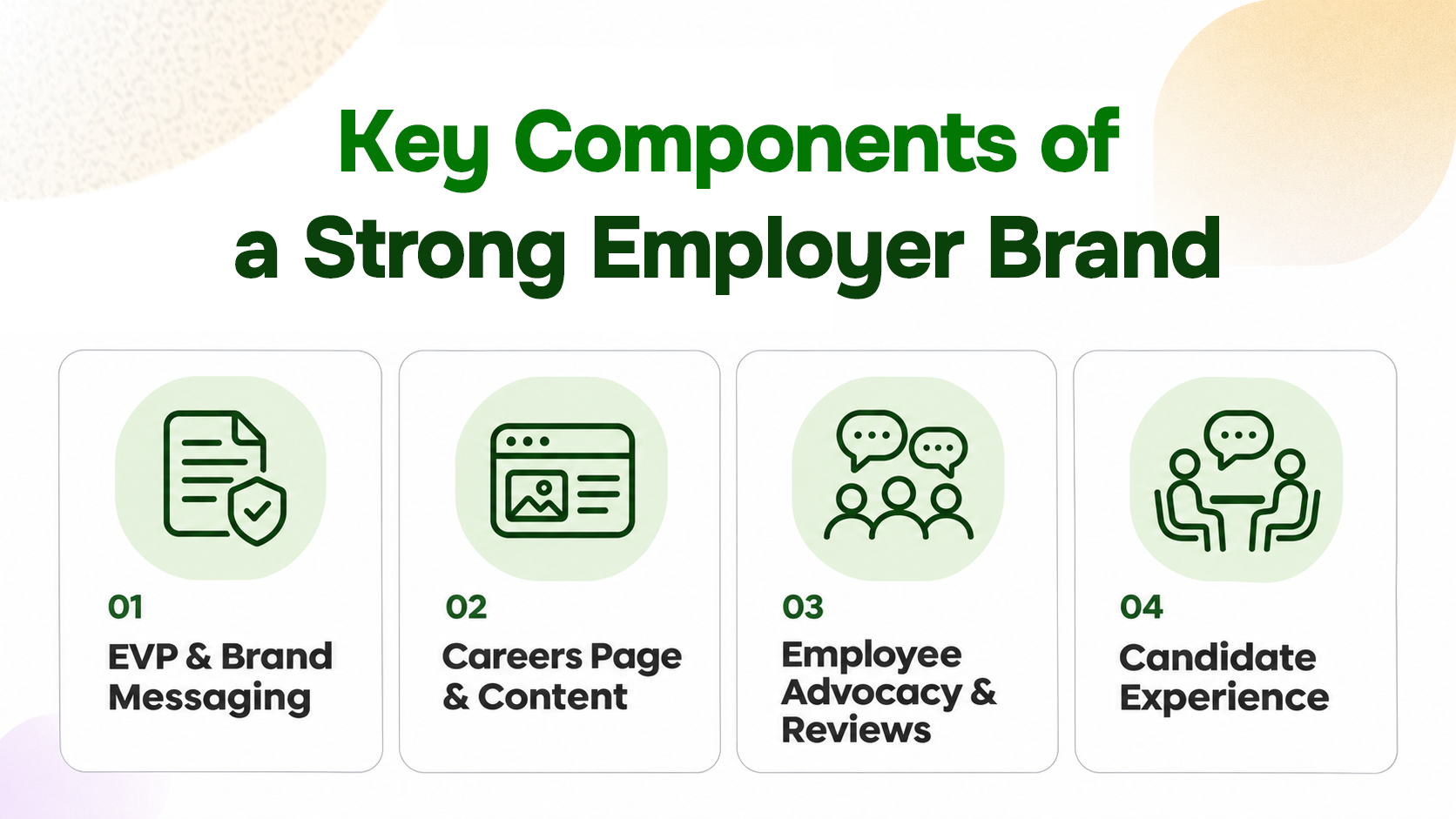
A strong employer brand combines a clear employment promise with credible evidence from employee and candidate experiences.
The following components shape how people understand your workplace and decide whether they trust your message:
1.Employer Value Proposition and Brand Messaging
Your EVP gives your employer brand a clear foundation. It should answer why the right person would join, contribute and remain with your organization.
A useful EVP includes:
Purpose: The impact employees can make through their work.
People: The leadership, colleagues and communities they will work with.
Growth: The opportunities to learn, progress and take responsibility.
Rewards: Compensation, benefits, recognition and security.
Working environment: Flexibility, tools, location and management practices.
Your messaging should translate these themes into specific proof. Instead of saying you support career growth, describe mentorship, learning budgets, internal mobility, or promotion practices.
2. Careers Page and Employer Brand Content
Your careers page gives candidates a central place to evaluate your organization before applying.
The page should explain more than open vacancies. It should show your purpose, culture, teams, working arrangements, benefits, development opportunities, and recruitment process.
The following content helps candidates understand what working with you involve:
Employee stories and realistic role examples
Leadership perspectives
Workplace policies and benefits
Learning and progression opportunities
Office, remote or hybrid arrangements
Diversity and inclusion commitments supported by evidence
Recruitment stages and expected timelines
Links to relevant vacancies
Employer-brand content should use real employees, locations, and examples where possible.
Glassdoor found that 53% of job seekers search for more company information after reading a job post, showing that candidates regularly move from vacancy content to broader employer research.
Your careers page should help them complete that research without relying entirely on third-party sources.
3. Employee Advocacy and Online Reviews
Employees make employer branding more credible because candidates often trust their experiences more than corporate messages.
Employee advocacy is most credible when employees voluntarily share honest experiences through reviews, referrals, testimonials, and social posts.
Likewise, online reviews deserve active attention because they influence how candidates interpret your official messaging. You should monitor themes, respond professionally, and use recurring feedback to improve employee experience.
According to Glassdoor research, 70% of users are more likely to apply when an employer is active on the platform, while 71% say their perception improves when an employer responds to reviews.
These figures suggest that candidates value visible listening and accountability, not a perfect review history.
4. Candidate Experience
Every candidate interaction either supports or weakens your employer brand.
Your candidate experience includes application usability, recruiter communication, interview behavior, assessments, decision speed and rejection messages. Candidates compare these interactions with the values you claim to hold.
For example, a company that promotes respect but leaves interviewed candidates without updates creates a visible contradiction.
Similarly, a company that claims transparency but refuses to explain the recruitment stages produces the same problem.
Greenhouse found that 20% of surveyed candidates had rejected an offer after a poor interview experience.
This finding shows that employer branding cannot compensate for disorganized or disrespectful recruitment practices.
Keep Your Brand Promise After They Apply
Track every candidate’s stage and updates so no one is left waiting.
See Candidate Management FeaturesHow to Improve Your Employer Branding
Improving employer branding begins with identifying the difference between what you communicate and what people experience.
The following actions help you strengthen the brand without turning the work into a superficial marketing exercise:
Audit your current reputation: Review employee surveys, candidate feedback, social comments, career-page analytics, and workplace reviews.
Identify recurring gaps: Compare your stated values and EVP with patterns in employee and candidate feedback.
Fix experience problems first: Address communication, management, development, flexibility or fairness issues before promoting claims in those areas.
Clarify your EVP: Define the strongest and most credible reasons people join and stay.
Improve your careers content: Use specific examples, employee perspectives and clear working information.
Review your job descriptions: Ensure every vacancy reflects the same voice, expectations, and employment promise.
Train recruiters and interviewers: Give candidates a consistent experience across roles and departments.
Respond to reviews constructively: Use feedback as operational insight rather than treating every negative comment as a reputation problem.
Support employee advocacy: Make it easy for employees to share authentic stories without scripts or pressure.
Measure the change: Track both brand engagement and recruitment outcomes.
For a more detailed improvement plan, use the guide on how to improve employer branding.
“Candidates can see through it. They’re tapping into their networks on the insides of your companies to understand who you really are beyond what your career site says you are.”— John Graham, former Vice President of Employer Brand, Diversity and Culture, Shaker Recruitment Marketing
How to Build an Employer Branding Strategy
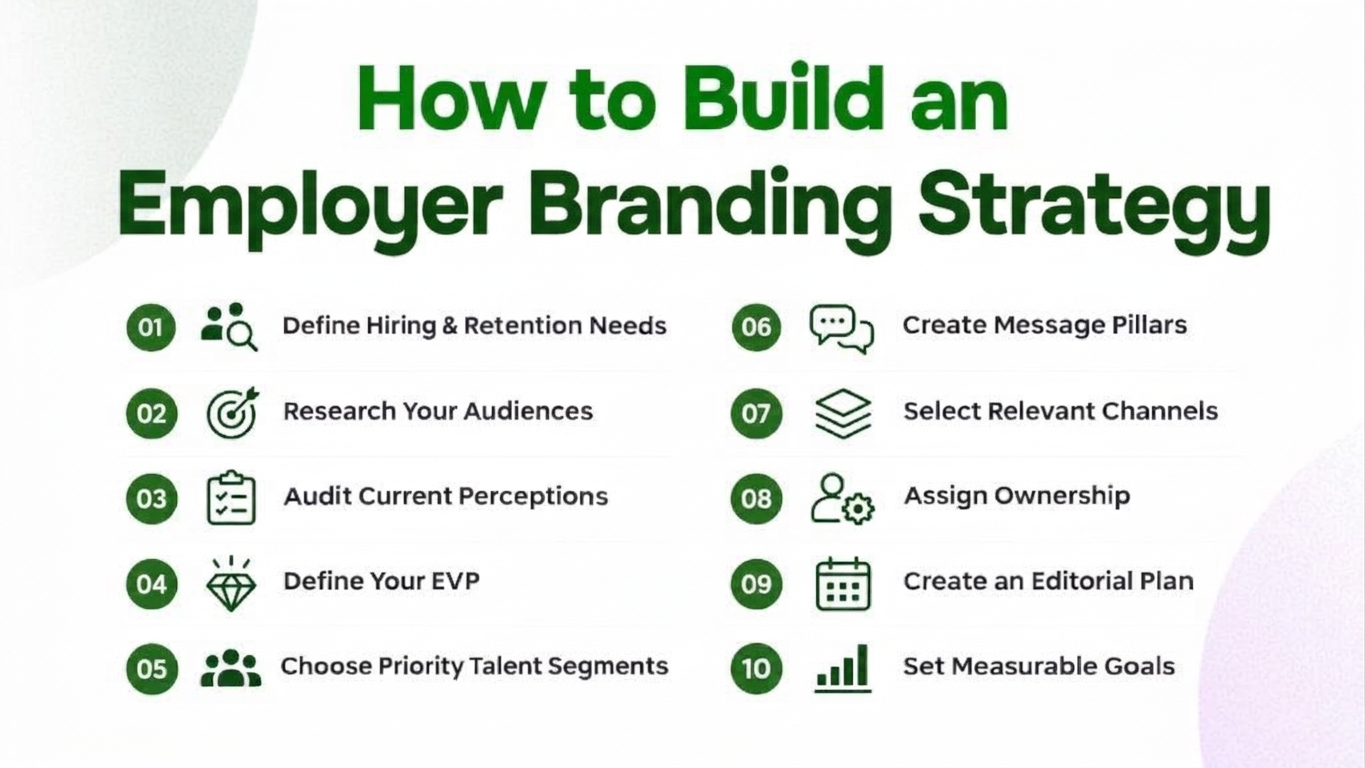
An employer-branding strategy connects workforce needs, employee insight, positioning, content and measurement in one plan.
The following steps help you build a strategy that supports recruitment and retention rather than producing disconnected campaigns:
Define the hiring and retention problem: Identify the roles, locations, skills or employee groups where reputation affects outcomes.
Research your audiences: Understand what suitable candidates and current employees value, expectations and questions.
Audit internal and external perceptions: Compare leadership assumptions with surveys, reviews and recruitment feedback.
Define your EVP: Create an evidence-based promise that reflects the experience you can provide.
Choose priority talent segments: Tailor messages to the people you need without creating contradictory versions of your brand.
Create message pillars: Organize your story around themes such as purpose, growth, people and working experience.
Select relevant channels: Use your careers page, social media, events, employee advocacy, job descriptions and recruiter outreach.
Assign ownership: Clarify the responsibilities of HR, talent acquisition, marketing, communications and leadership.
Create an editorial plan: Decide which stories, proof points and employee perspectives you will publish.
Set measurable goals: Connect brand activity to awareness, engagement, applications, offers and retention.
Once the strategy is defined, the 4 Ps provide a simple way to check whether it covers the full employment experience.
One useful version of the 4 Ps framework comes from Universum, which organizes employer branding around People, Purpose, Place, and Product.
For a deeper planning framework, use the complete guide on employer branding best practices.
“You’ve got to own what you are and who you are. And that way the right people for you will say, ‘This is somewhere I want to be and think I will thrive.’”— Ed Nathanson, former Vice President of Talent and Talent Branding, EQRx
Employer Branding vs. Recruitment Marketing: How They Work Together
Employer branding defines and manages your reputation as an employer, while recruitment marketing promotes specific messages and opportunities to attract candidates.
The following table shows how the two activities differ and work together:
Comparison Area | Employer Branding | Recruitment Marketing |
Main objective | Build a credible employer reputation | Generate interest and applications |
Time frame | Long term and continuous | Campaign or vacancy based |
Core message | Why work and stay here? | Why consider this opportunity now? |
Main inputs | EVP, culture and employee experience | Audience, vacancy and campaign goals |
Common channels | Careers pages, reviews, social media and employee stories | Job ads, email, paid media and sourcing campaigns |
Key outcomes | Awareness, trust, preference and retention | Reach, engagement, applications and conversions |
For a full comparison, see our guide to employer branding vs. recruitment marketing.
“Talent Brand Index finally allows us to measure our talent brand, and understand the progress we’ve made in establishing ourselves as an employer of choice relative to our peers.”— Wendy Sykes-Lague, former Manager of Talent Acquisition, EFI
How to Measure Employer Branding Performance and Impact
You should measure employer branding through a combination of reputation, engagement, recruitment, and employee outcomes.
No single score captures the complete brand. Social-media engagement shows visibility, while offer acceptance and retention show whether the message attracts people who fit the actual experience.
Key Employer Branding Metrics and KPIs
The metrics below help you connect employer-brand activity with meaningful outcomes:
Metric | What It Measures | Why It Matters |
Careers-page traffic | Visits and candidate interest | Shows awareness and research activity |
Content engagement | Reactions, shares, comments and video views | Indicates whether stories attract attention |
Review rating and sentiment | External employee perception | Highlights reputation strengths and risks |
Qualified application rate | Suitable applications per vacancy | Shows whether messaging attracts relevant people |
Application conversion | Visitors who complete an application | Identifies content or process friction |
Source of hire | Channels producing successful hires | Connects brand channels with outcomes |
Time to fill | Time required to fill a vacancy | Shows whether candidate interest supports hiring speed |
Cost per hire | Average recruitment cost | Helps evaluate hiring efficiency |
Offer acceptance | Accepted offers as a percentage of offers made | Indicates candidate confidence and competitiveness |
Retention and turnover | How long employees remain | Tests whether the promise matches the experience |
Employee referral rate | Hires or applicants generated by employees | Signals advocacy and internal confidence |
Tracking these metrics together helps you see whether your employer brand is building awareness, attracting suitable candidates, and supporting long-term retention.
Make Every Hiring Touchpoint On-Brand
Organize candidate communication and hiring stages in one platform.
Book A DemoConclusion
Employer branding is not limited to a careers page, campaign or collection of employee testimonials. It is the relationship between what you promise and what candidates and employees experience.
Start by understanding your current reputation, clarifying your EVP, and identifying where your recruitment or workplace practices contradict the message.
Then build content around real evidence, train the people who represent your brand, and measure the outcomes that matter.
A strong employer brand does not need to appeal to everyone. It should help the right people understand what you offer, what you expect, and whether they are likely to thrive in your organization.
FAQs
Frequently Asked Questions
Employer branding is the process of shaping and communicating how your organization is perceived as a place to work.