
How to Build a Talent Pool: 6 Steps for Faster Future Hiring
Recruit
Talent Pool
13 min read
Key Highlights
A talent pool is a structured database of people who may fit current or future hiring needs.
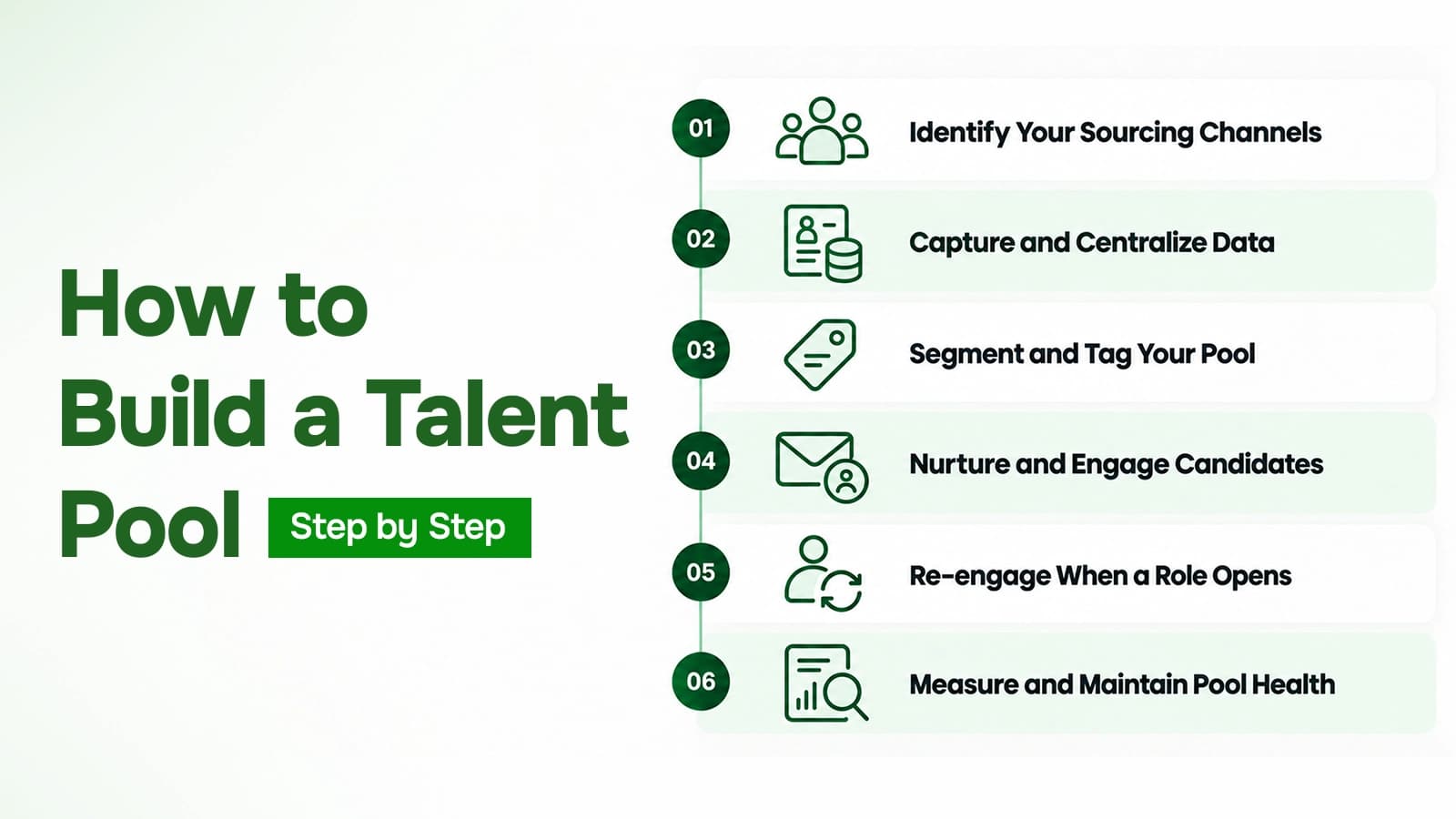
To build a talent pool, identify multiple sourcing channels, centralize their information, organize them with tags, nurturing relationships, and re-engage them when roles open and then maintain accurate records.
Diversify your sourcing channels, organize potential hires with consistent tags, and keep your talent pool updated and engaged.
Talent pool management requires ongoing maintenance through data updates, performance tracking, and consistent communication.
Avoid treating your talent pool as a one-time project, neglecting consent, poor segmentation, excessive outreach, outdated data, and overlooking internal talent.
Introduction
Many recruiters start each vacancy from zero. They spend weeks on searches, application reviews, and renewed outreach while hiring managers to wait for the skills their teams need. A 2026 benchmarking research report shows the average time-to-fill a vacancy is 42 days.
But what if your next strong hire already exists in your database?
That is where a talent pool helps. It gathers promising candidates organized before a role opens and gives recruiters a faster starting point. Instead of searching through old applications, spreadsheets, and scattered records, they quickly find suitable candidates and reduce the time to hire significantly.
This guide explains what talent pool is, who to include, and how to build a talent pool to transform your recruitment process.
What is a Talent Pool?
A talent pool is an organized group of candidates who may suit your current or future job openings. It gives you a searchable source of potential hires instead of leaving useful profiles scattered across old applications, résumés, and spreadsheets.
Your pool may include past applicants, silver-medalists, passive professionals, employee referrals, former employees, and current staff who want a new role. Think of it as a shortlist prepared in advance. When a vacancy opens, you already have relevant people to review and contact.
This preparation may reduce repeated sourcing work and help you reach a qualified shortlist sooner. However, these benefits depend on accurate records, clear segmentation, and regular contact.
How to Build a Talent Pool: Step by Step
To build a talent pool, identify your prospects from reliable sources and store them in one system like an ATS or CRM. Then, categorize candidates by skill, location, and source so you can filter fast. After that, ensure regular contact, and reach out with a personalized message when a role opens.
Step 1: Identify Your Sourcing Channels
Start candidate sourcing with people you already know about. Review silver medalists and past applicants first because they already have some connection with your company. Also, since they've already gone through the interview process, it saves your candidate screening time too.
Next, leverage your employee referrals too. Employees usually recommend people they believe will perform well, as their reputation is linked to the referral. This often leads to better-quality candidates as 88% of organizations believe their best employees were hired through referrals.
Plus, as mentioned in Zippia, referred employees stay longer, with a 46% retention rate, compared to 33% for hires from online job postings.
Furthermore, reach out to more people through networking events, industry meetups, and job fairs. These sources take more effort upfront, but they widen the pool beyond people actively browsing job boards.
Additionally, combine active sourcing with passive candidate sourcing to reach a wider range of candidates and improve your chances of finding the right hire faster.
Check out our guide on candidate sourcing strategies to learn more to find the right candidate from the start.
Step 2: Capture and Centralize Candidate Data
Once you find candidates, get their information into one system right away. As, a talent pool spread across spreadsheets, email threads, and sticky notes isn't really a pool, it's just scattered data.
So, you can use the Applicant Tracking System (ATS), or a Candidate Relationship Management system (CRMs) to store the candidate's information. Ensure every record includes their name, contact details, skills, where they came from, and their consent status.
Moreover, clarify and get clear permission before you store someone's information or contact them again as laws like GDPR require clear permission.
Step 3: Segment and Tag Your Talent Pool
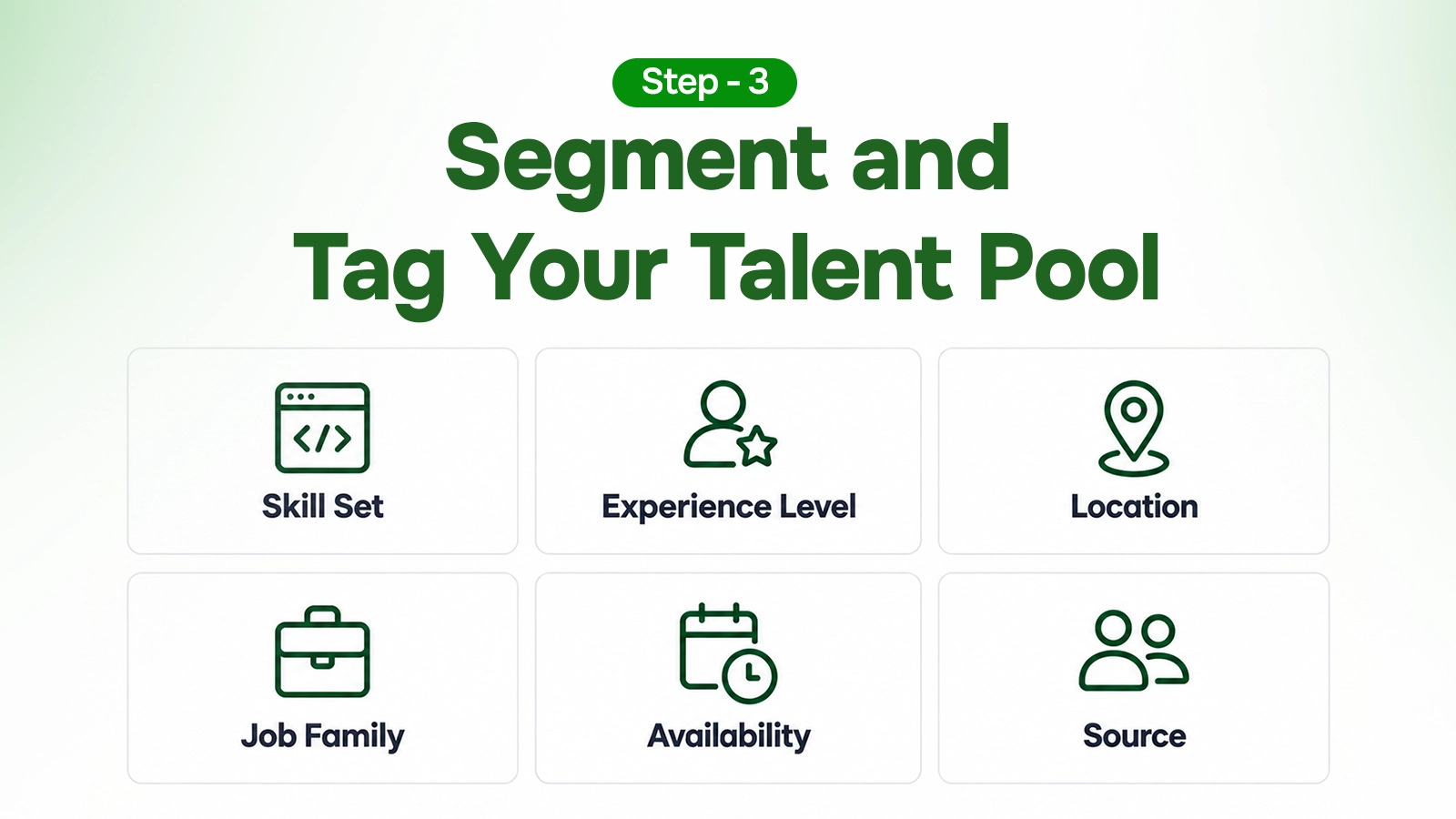
Once you have added candidates, organize them into clear groups as per your organizational needs. Categorize them with tags such as skill set, experience level, location, job family, availability, and source.
For example, one profile may include “senior developer,” “remote,” and “employee referral.” Another may include “entry-level marketer,” “Chicago,” and “job fair.”
If one recruiter uses "mid-level" and another uses "intermediate" for the same thing, the inconsistency confuses the system, and the result won't be accurate. So, keep your tags consistent across the whole database. Review tags regularly, so they reflect each candidate’s current skills, location, and interests without repeating or confusing the recruiter.
Step 4: Nurture and Engage Candidates
Talent pooling needs regular contact to stay useful. Without it, candidates lose interest over time, and your outreach starts to feel cold or impersonal. 1 in 5 sourcing teams struggle to engage passive candidates.
To prevent that, set up a simple nurture campaign for consistent and thoughtful communication. This might include a quarterly newsletter, updates about company news, or alerts about roles that match a candidate's background.
Share your employer branding content. A short video about your team's culture or a story about an employee's career path can keep candidates emotionally connected to your company, not just aware of it.
Also, candidates are more likely to accept job offers quickly when a recruiter reaches out, with 89% saying yes faster. So, avoid sending the same generic message to everyone. Instead, update and personalize the candidate’s skills, location, and level of interest.
Finally, set a clear contact schedule. Communicate often enough to stay relevant, but not so often that your messages feel repetitive or unwanted.
“You don’t hire for skills, you hire for attitude. You can always teach skills.”-Simon Sinek, Author and Speaker
Tag Once, Filter Anytime
Organize candidates by skill, location, and source in custom pools.
Explore Talent PoolStep 5: Re-engage Candidates When a Role Opens
This is the moment your talent pool pays off. Instead of starting a search from scratch, filter your pool by the skills and location the new role needs.
From there, reach out with a re-engagement email that feels personal, not generic. Mention the specific role, why it fits their background, and why you thought of them for it.
A generic "we're hiring, apply now" message rarely gets a strong response. A message that references someone's past application or their specific experience feels different, and it usually gets a reply.
For example, you might write: “We spoke after your interview for our sales role last year. A new position has opened that matches your experience in account management. Would you be open to a brief call?”
Speed matters too, as research shows top candidates just stay available on the market for just 10 days. The sooner you reach out after a role opens, the more likely a strong candidate is still available and interested.
Step 6: Measure and Maintain Talent Pool Health
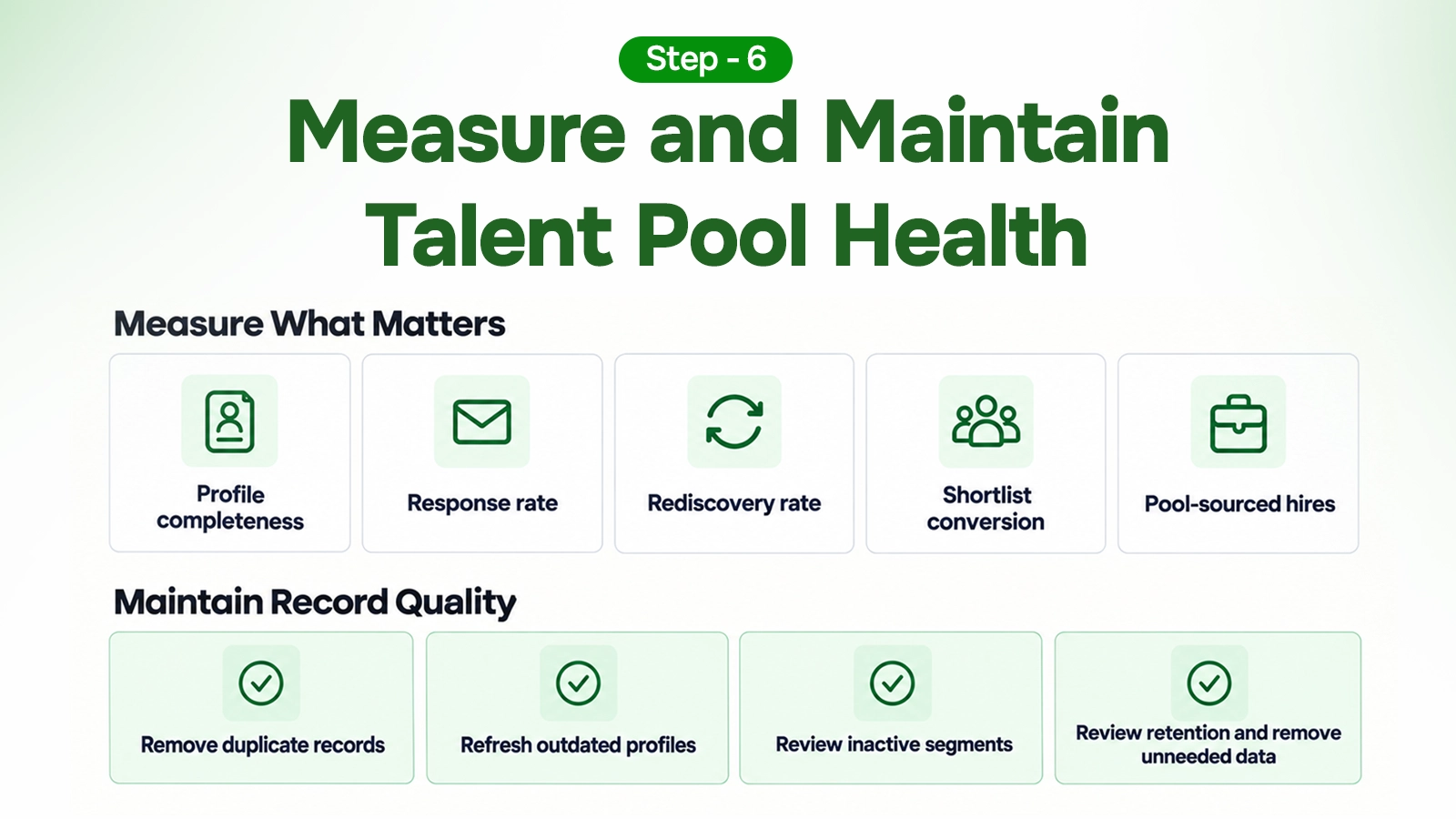
A talent pool needs upkeep, just like any other system your team relies on. Skipping this step lets the whole database quietly lose its value over time.
To stay on top of it, track a few simple numbers: how many hires come directly from your pool, how quickly those hires move through the process, and how often candidates respond to outreach.
Start with a few practical measures:
Profile completeness: Check whether records include current skills, location, role interests, and contact details.
Response rate: Measure how many replies to your messages.
Rediscovery rate: Track how often past return to an active shortlist.
Shortlist conversion: Review how many pooled candidates reach the shortlist stage.
Pool-sourced hires: Count how many hires came from the talent pool.
Then remove duplicate records, update stale profiles, and review inactive segments. You should also delete or anonymize data when you no longer have a valid reason to keep it.
These numbers tell you what is working. If referrals convert faster than job fair contacts, for instance, that's worth knowing before you plan your next sourcing push.
On top of tracking, set a regular schedule to clean up the database. Archive candidates who've gone cold or taken other jobs, and update information for people who are still active. A smaller, accurate pool beats a large one full of outdated contacts.
Best Practices for Building an Efficient Talent Pool
A useful talent pool needs more than records. The practices below help you keep it accurate, balanced, and ready for future hiring.
Diversify your sourcing channels: Start with referrals, events, past applicants, and direct outreach instead of relying on one source. Each channel brings a different type of candidate into the pool.
Use consistent tags: Next, apply the same fields and labels to every profile. Otherwise, your filters may miss suitable prospects or return incomplete results.
Automate nurture emails: As the pool grows, manual follow-up becomes harder to manage. So, implement a nurture program to help you maintain a steady contact schedule without adding repetitive work.
Respect consent and privacy rules: At the same time, review permissions, communication choices, and retention dates regularly. Do not assume that an old record still gives you a valid reason to contact someone.
Involve hiring managers early: They can clarify which skills, experience levels, and role needs matter most. Their input helps you build more useful segments and avoid unnecessary retagging later.
Review the pool every quarter: Then, update candidate details, remove duplicates, and check stale profiles. A regular schedule prevents the database from turning into a large cleanup task.
Track source performance: Finally, compare which channels lead to responses, shortlists, and hires. Focus more effort on sources that produce suitable candidates and reduce time spent on weak ones.
Talent Pool Management Software and Tools
The right tools help you keep candidate records organized, find suitable people faster, and maintain contact between hiring cycles. However, each tool supports a different part of your talent pool strategy.
1. Applicant Tracking System
An applicant tracking system (ATS) stores applications, resumes, interview notes, and assessments in one central database. It lets you organize this information into talent pools based on skills, roles, location, experience, or hiring stage, giving you a reusable database for future hiring.
For instance, ATS like Mercury Recruit and Greenhouse include features to move strong finalists who were not selected to go into a silver-medalist pool. When a similar role opens, you search the pool in your ATS, review the candidate's previous interactions, and move them into the new hiring pipeline without starting the sourcing and screening process again.
Make candidate management simpler with Mercury Recruit. Centralize applications, updates, and hiring decisions in one workspace, so your team stays aligned throughout the hiring process.
Let AI Surface the Best Match in Your Pool
Match pooled candidates to new roles by skills and experience.
2. Candidate Relationship Management Software
Candidate relationship management (CRM) software helps you build and maintain talent pools of candidates who are not currently applying for a role. You can add candidates from sourcing, referrals, events, and previous interactions, then group them by skills, interests, location, or job preferences.
The CRM keeps these candidates engaged through targeted emails, job updates, and follow-ups based on their interests. When a relevant role opens, you already have a group of qualified and engaged candidates to contact.
For example: Beamery.
3. Candidate Sourcing Tools
Candidate sourcing tools are valuable for building your talent pool. They search candidate databases and online profile according to your hiring needs, helping you find the most relevant and qualified potential hires beyond those who apply to your open positions.
You can save suitable profiles to sourcing projects or transfer them to an ATS or recruitment CRM, where you organize them into relevant talent pools. This gives you a steady way to expand your pool with candidates who match your future hiring needs.
Popular candidate sourcing tools include LinkedIn Recruiter, SeekOut, hireEZ, and AmazingHiring.
4. Email Automation Tools
Your talent pool should be more than a database of candidate profiles. Email automation tools help you keep candidates engaged even when there is no vacancy, so you can reconnect with prospects through an existing relationship when a suitable role opens.
When connected with your ATS or CRM, they send relevant updates based on role interests, location, source, or past engagement.
For instance, silver medalists receive alerts about suitable roles, while event contacts receive follow-up messages related to the session they attended. This keeps your talent pool active between hiring cycles.
For example: Mailchimp.
Looking to manage candidates more effectively? Explore the best talent pool management software for your hiring needs.
Common Mistakes to Avoid When Building a Talent Pool
Even a well-planned talent pool loses its value if a few habits slip. Here are the common mistakes to avoid when developing a talent pool:
Treating it as a one-time project: A talent pool needs ongoing sourcing and maintenance, not a single sprint you finish and forget. Teams that build it once and walk away usually find the whole database stale within a year.
Skipping consent: Storing candidate data without clear permission creates legal risk under laws like GDPR, and it damages trust if candidates find out. A simple checkbox at intake solves this before it becomes a bigger problem.
Leaving the pool unsegmented: An untagged database is nearly impossible to search for when you need someone fast. Without structure, recruiters end up scrolling through hundreds of profiles instead of filtering to the right five.
Over-emailing candidates: Constant contact pushes people to unsubscribe, which shrinks your pool faster than it grows. A steady, light touch keeps candidates engaged without wearing out their patience.
Letting data go stale: Outdated contact details and outgrown skills make the pool unreliable over time. Regular reviews catch this before you waste time reaching out to someone who's no longer fit.
Ignoring internal talent: Current employees looking to move into a new role belong in the pool too, not just external applicants. Overlooking them means missing people who already know your company and could fill a gap faster than anyone from outside.
Conclusion
A talent pool isn’t just a database of resumes; it’s a long-term recruitment asset that grows stronger the more attention you give it, helping you reach top talent before other employers do.
However, it works best when it’s managed with consistent sourcing, organized data, proper segmentation, regular engagement, and ongoing upkeep. Get those pieces right, and you’ll cut time-to-hire, build stronger candidate relationships, and make your overall recruitment process better.
Put Your Talent Pool Strategy Into Practice
Keep candidates organized, avoid duplicates, and find the right fit fast.
Try Mercury Recruit FreeFAQs
Frequently Asked Questions
To build a talent pool, source candidates through past applicants, referrals, events, and direct outreach. Then store, segment, and engage them through an ATS or talent CRM.