
What Is Candidate Screening? Process, Methods & Best Practices
Recruit
Candidate Screening
13 min read
Key Highlights
Candidate screening is the process of filtering applicants against predefined hiring criteria and shortlisting them before formal interviews begin.
A structured candidate screening process improves hiring quality, shortens time-to-hire, and reduces the risk of mis-hires.
Combine multiple candidate screening methods, such as resume screening, phone screening, skills assessments, and background checks for the complete candidate evaluation.
Consistent screening questions, scorecards, and documented decisions support fair and objective hiring.
An applicant tracking system (ATS) and AI-powered screening tools automate repetitive tasks, helping recruiters manage high application volumes while maintaining human oversight.
Introduction
A single job posting attracts hundreds of applications within days. While a larger applicant pool increases the chances of finding the right hire, it also makes it difficult for recruiters to review every resume in detail. There is a high chance qualified candidates can be overlooked, and the recruitment process may take longer than necessary.
This is where an effective screening process becomes essential. Instead of evaluating and interviewing every applicant in detail, recruiters narrow the pool to candidates who best match the role. Consequently, hiring teams spend less time reviewing unsuitable applications and more time engaging with promising talent.
In this guide, you'll learn what candidate screening is, why it matters, the different screening methods, best practices, common challenges, and the tools that help hiring teams make faster and more informed hiring decisions.
What is Candidate Screening?
Candidate screening is the initial stage of the hiring process, where employers review applicants to identify candidates who meet the role’s basic requirements and should move forward to the next stage.
The candidate screening process includes:
Resume screening
Application form review
Screening questions
Phone screening
Skills assessments
Knockout questions
Work sample checks
Background checks (when applicable, typically at a later stage)
The aim of candidate screening is not to make the final hiring decision. Instead, it identifies candidates who do not meet the job requirements, narrows the applicant pool, and selects those who deserve closer evaluation in the next stage of the recruitment process.
Moreover, a structured screening process promotes consistent and objective hiring decisions. It enables employers to evaluate candidates against predefined criteria, such as skills, experience, qualifications, and job-related competencies.
"People are not your most important asset. The right people are." -Jim Collins, Author
Why Does Candidate Screening Matter?
An effective candidate screening process filters out unsuitable applicants early, making hiring faster and more accurate. It also supports consistent decision-making, improves recruiter productivity, and ensures better experience for candidates.
Faster Time-to-Hire: Candidate screening removes applicants who do not meet the basic hiring criteria before interviews begin. This leaves recruiters with a smaller, more relevant pool and helps them reach hiring decisions sooner.
Reduced Risk of Mis-Hires: It improves hire quality as early checks reveal skill gaps, missing qualifications, and poor role fit before unsuitable candidates reach later hiring stages.
More Consistent and Fair Hiring: Clear screening criteria allow every applicant to be assessed against the same standards and reduce subjective decision-making.
Greater Recruiter Productivity: Early filtering eliminates numbers of unsuitable applicants that may otherwise require attention. So, now, you spend valuable time on qualified talents for their interviews.
Candidate Screening Process: How to Screen Candidates Step by Step
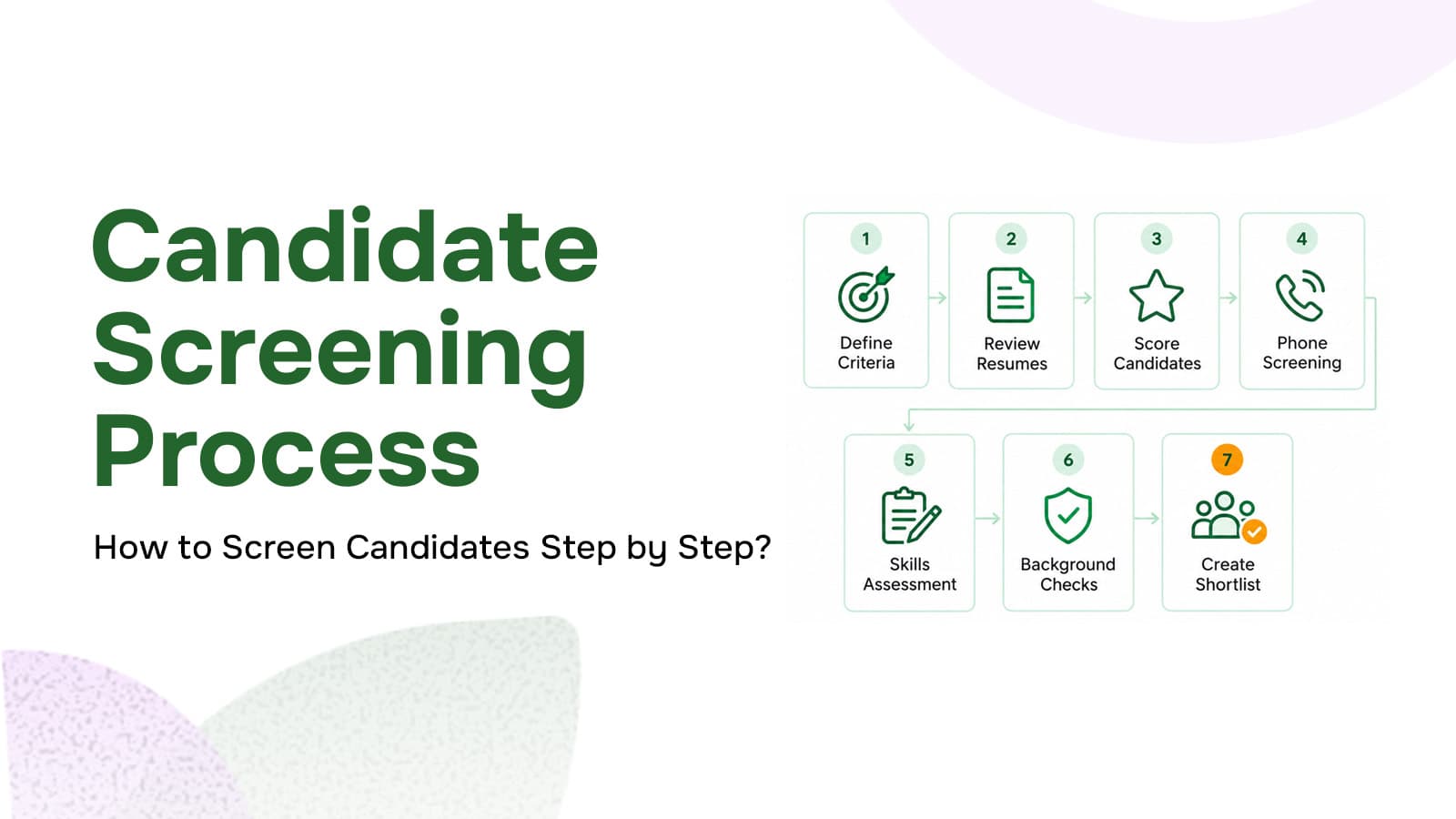
Candidate screening follows a structured workflow that helps recruiters identify the potentially right applicants before interviews begin. The exact process may vary between organizations, but most hiring teams apply these key steps to evaluate candidates consistently and build a strong shortlist.
Here's how to screen candidates step-by-step:
Step 1: Define the Screening Criteria
Start by reviewing the job description with the hiring manager. Together, define essential skills, experience, qualifications, certifications, and any knockout requirements, the non-negotiables that immediately disqualify an applicant if missing, such as work authorization or a required license.
Once these criterion are set, use it as the single standard to evaluate every applicant, so the process stays consistent and reduces bias from the very first resume you review to the last.
Also learn how to write job description.
Step 2: Review Applications and Resumes
Next, compare each application, resume, and cover letter against the criteria from Step 1, checking whether the applicant meets the role's minimum requirements.
For high-volume hiring, recruiters can speed this up with ATS filters that automatically flag or rank resumes based on keywords and qualifications, surfacing the closest matches first instead of requiring a manual read-through of every application.
Step 3: Score Candidates Against the Criteria
After the initial review, rate each applicant using a simple scorecard, marking every requirement as met, partly met, or not met. This turns a subjective first impression into a consistent, comparable record for each candidate.
Speed this step up further with AI-powered candidate screening and scoring tools, which automatically parse resumes and rank applicants against the same criteria. This makes side-by-side comparisons easier and reduces decisions based purely on gut feel or first impressions.
Rank Every Applicant Against Your Criteria in Seconds
Mercury Recruit parses resumes and generates ATS scores from skills and experience, so the closest matches surface first and your team makes the final call.
See AI ScreeningStep 4: Conduct a Phone or Video Screening
Candidates who pass the initial review move on to a short phone or video screening call, typically 15–30 minutes long. This conversation isn't meant to test deep technical skill; it's to double check the information provided by candidates.
Clarify any questions from the application, confirm availability and salary expectations, gauge the candidate's genuine interest in the role, and assess their communication skills. Based on this discussion, recruiters decide who moves forward.
Step 5: Evaluate Job-Related Skills
At this stage, give candidates a skills assessment, a work sample, writing task, technical exercise, or case study, depending on the role.
The assessment should reflect the actual duties the job requires, not abstract puzzles or unrelated tests. Recruiters can then compare the results alongside resume scores and screening notes to see whether a candidate's real ability matches their claimed experience.
Create structured assessments, standardize scoring, and compare candidates with Mercury Recruit's Assessment & Evaluation.
Step 6: Run Background and Reference Checks
Before finalizing the shortlist, verify employment history, credentials, and references, and run a formal background check where relevant. For roles involving finances, safety, or sensitive data, it's worth moving this step earlier in the process rather than waiting until an offer is made.
Step 7: Create a Shortlist
Finally, combine the evidence gathered at every stage, scorecards, interview notes, assessment results, and background checks, to identify the strongest candidates.
Share this shortlist, along with the supporting notes and results, with the hiring manager. This keeps formal interviews focused, informed, and grounded in evidence rather than first impressions alone.
“Hiring the right people takes time, the right questions, and a healthy dose of curiosity.” -Richard Branson, Co-founder of Virgin Group
Hand Over a Shortlist Backed by Evidence
Keep scorecards, assessment results, and team feedback on every candidate profile, so hiring managers see the full picture before interviews.
See Candidate ManagementWhat are the Common Candidate Screening Methods?
Recruiters use different screening methods depending on the role, hiring volume, and organization’s needs. Candidate screening rarely relies on a single evaluation technique.
Instead, recruiters combine different methods to assess qualifications, skills, and overall suitability before deciding who should move forward. The right combination depends on the role, hiring volume, and recruitment process.
1. Resume Screening
Resume screening is usually the first candidate screening method used after applications arrive. Recruiters compare each CV with the role’s minimum requirements and check for relevant skills, experience, education, certifications, achievements, and work history.
For example, when screening candidates for an accountant role, recruiters may look for accounting qualifications, spreadsheet skills, tax knowledge, and experience with specific financial software.
For high application volumes, recruiters use an applicant tracking system for resume parsing, filters, keyword searches, or AI matching to organize resumes and surface closer matches. However, recruiters should still review the results, since resumes alone cannot confirm practical ability, communication skills, or overall suitability for the role.
2. Phone or Video Pre-Screening Calls
Phone or video pre-screens are quick conversations that confirm basic fit before committing to a longer interview. Recruiters use this stage to verify information from the application. Recruiters verify that the candidate's answers align with the hiring criteria.
3. Skills Assessments
Skills assessments are task-based tests suited to technical, creative, or specialized roles, where seeing the work matters more than reading about it. Depending on the position, candidates may complete coding tests, writing assignments, design exercises, or other practical tasks to demonstrate their abilities.
Learn more about Mercury Recruit's Assessment and Evaluation features. Build custom skills assessments or use ready-made templates to screen candidates faster.
4. Background Checks
Background checks involve verification of employment history, education, and other claims made during the hiring process. Usually run later in the process once an offer is made; they help employers confirm that the information provided by the candidate is accurate.
5. Reference Checks
Reference checks involve conversations with former managers or colleagues that confirm performance and fit. This happens only after formal interviews. So, it is often the last check before an offer goes out; they provide additional insight into a candidate's work ethic, strengths, and professional conduct.
“Somebody once said that in looking for people to hire, you look for three qualities: integrity, intelligence, and energy. And if you don't have the first, the other two will kill you.”— Warren Buffett, American investor and former CEO of Berkshire Hathaway
What are Common Screening Questions to Ask
Screening questions help to gather information that may not be evident from a resume or application. Asking every candidate a consistent set of questions also creates a fairer evaluation process and makes it easier to compare responses.
Some common categories of screening questions include:
Background and Experience: Assess a candidate's relevant skills and work history.
Example: "Can you walk me through your experience with [specific skill or responsibility]?"Motivation: Understand why the candidate is interested in the role and the organization.
Example: "What motivated you to apply for this position?"Culture Fit: Explore how the candidate works with others and adapts to different workplace environments.
Example: "What type of work environment helps you perform at your best?"Situational Questions: Evaluate how candidates handle real workplace challenges and solve problems.
Example: "Tell me about a time you had to meet a tight deadline. How did you manage it?"
Learn which questions to ask so you can filter out applicants who do not meet essential job requirements. Read our detailed guide to the best candidate screening questions.
Red Flags to Watch for During Candidate Screening
Candidate screening reveals concerns that need a closer look before someone moves forward. However, one red flag should not lead to automatic rejection. Instead, recruiters should ask follow-up questions and consider the full context.
Unexplained Employment Gaps or Frequent Short Stints: Career breaks and short-term roles can happen for many valid reasons. Rather than making assumptions, recruiters should ask direct, non-judgmental questions to understand the candidate's circumstances.
Vague Answers About Past Accomplishments: Candidates should be able to describe their responsibilities and achievements with specific examples. A candidate who can't explain their own work in detail may be overstating their experience, so asking additional follow-up questions is important.
Inconsistencies Between the Resume and Conversation: Differences in employment dates, job titles, responsibilities, or qualifications deserve clarification before a candidate progresses to the next stage.
Unprofessional Communication: Slow responses, missed calls without notice, or a dismissive tone during scheduling can hint at how someone operates day to day. Even so, recruiters should consider individual circumstances before reaching conclusions.
Excessive Criticism of Previous Employers: Occasional frustration is normal. However, a pattern of blaming every previous employer or avoiding personal accountability may be worth a follow-up discussion.
Best Candidate Screening Practices to Improve Hiring
A structured screening process improves hiring quality, creates a better candidate experience, and ensures every applicant is evaluated fairly. The following best practices help recruiters identify qualified candidates while maintaining a consistent and efficient hiring process.
Define Clear Screening Criteria: Set the required skills, experience, qualifications, certifications, and knockout conditions before applications are assessed. Once established, these criteria give every candidate the same basis for evaluation.
Use more than one screening method: Do not rely on resumes alone. Add screening questions, phone screens, skills assessments, or work samples when the role requires more proof.
Ask Consistent Screening Questions: Use the same core questions for candidates applying for the same role. Consistent questions make responses easier to compare and support fairer decisions.
Use a candidate scorecard: Rate applicants against the agreed hiring criteria and record the reason behind each score. A scorecard makes comparisons clearer and limits decisions based on first impressions.
Balance AI With Human Judgment: AI screening can sort and rank applications quickly. However, recruiters should review the results for missing context, errors, or possible bias.
Communicate With Candidates Promptly: Acknowledge applications, schedule the next steps on time, and share updates whenever possible. Also, to make candidate experience better, ensure clear communication while reducing drop-offs.
Review the Process Regularly: Track hiring outcomes, recruiter feedback, time-to-hire, and stage conversion rates. Use those findings to update weak criteria or remove steps that slow the process.
Use an Applicant Tracking System: According to one survey, 45% of HR professionals use automated pre-screening to review resumes. So, use an ats to make the screening process faster and consistent.
What AI Tools Are Used in Candidate Screening?
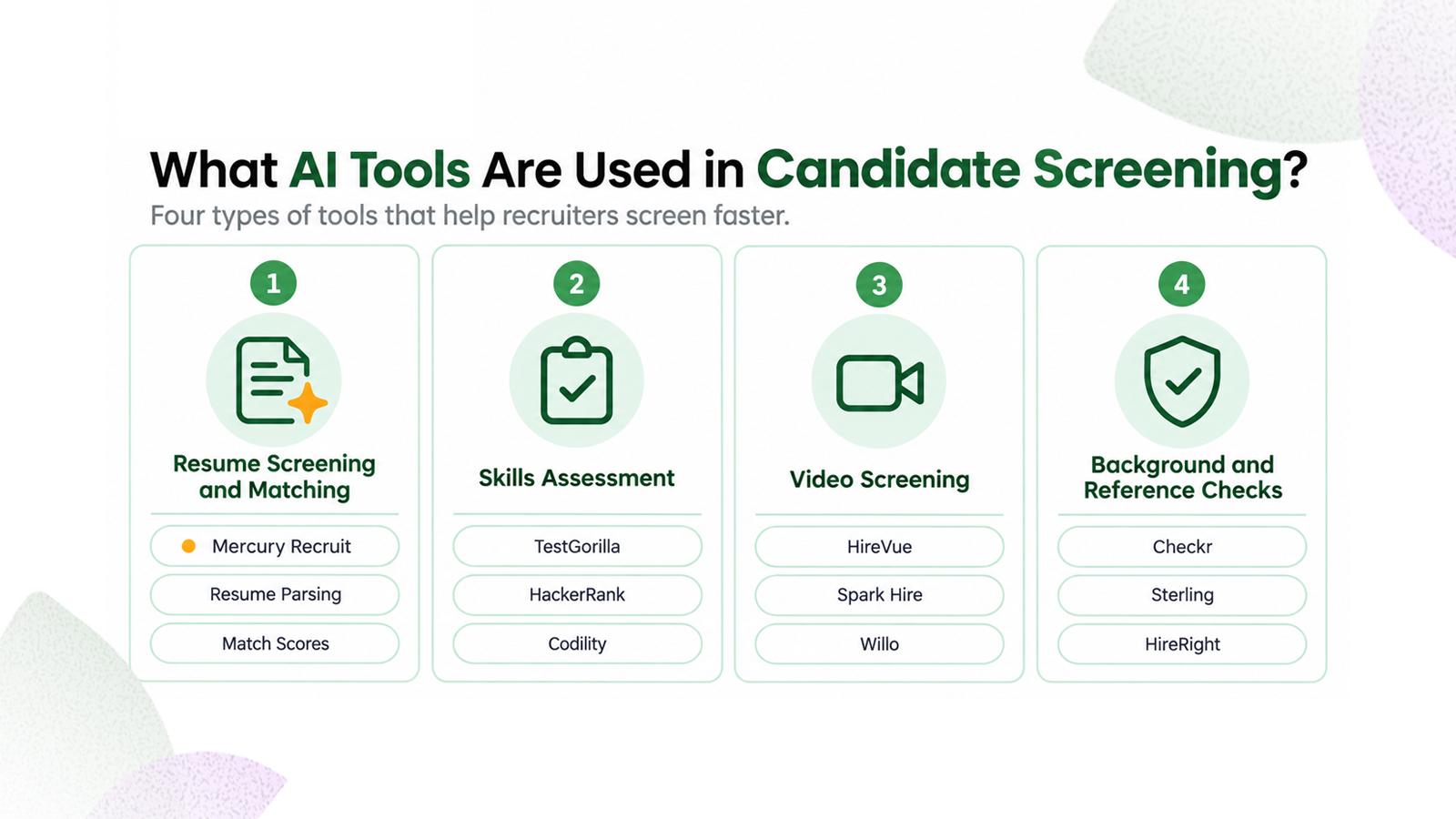
Candidate screening tools support different parts of the hiring process. Some assess skills or verify information, while an applicant tracking system brings applications, scores, feedback, and candidate stages into one place.
1. AI Resume Screening and Candidate Matching
AI screening tools parse resumes, identify skills and experience, and compare each profile with the job requirements. They can also generate match scores and rank applicants based on role relevance.
For example, Mercury Recruit creates ATS scores from a candidate’s skills, experience, and resume details, helping recruiters find closer matches faster.
2. Skills Assessment Tools
Skills assessment platforms test whether candidates can perform tasks linked to the role. Depending on the position, assessments may cover coding, writing, language ability, spreadsheet skills, or problem-solving.
Examples include TestGorilla, HackerRank, and Codility.
3. Video Screening Tools
Video screening tools support live interviews or recorded responses before a longer interview takes place. Recruiters can use preset questions to compare communication skills, interest, and basic role fit.
Examples include HireVue, Spark Hire, and Willo.
4. Background and Reference Check Tools
These tools verify details such as identity, employment history, education, licenses, and professional references. They are usually used later in the hiring process, once employers have identified stronger candidates.
Examples include Checkr, Sterling, and HireRight.
Also check out our complete guide to AI candidate screening and discover how it helps recruiters screen candidates faster.
Screen Faster Without Losing the Candidate
AI-powered resume matching, ATS and evaluation scores, candidate comparison, and structured team feedback, all in one platform.
Try Mercury Recruit FreeConclusion
Candidate screening is more than a resume review. It is a structured process that helps recruiters identify qualified applicants, reduce mis-hires, and make faster, more consistent hiring decisions. The right screening methods, relevant questions, and clear evaluation criteria can improve both hiring quality and the candidate experience.
As application volumes grow, consider using the best applicant tracking system and AI-powered screening tools to make the process easier to manage, while keeping recruiters in control of the final decision.
FAQs
Frequently Asked Questions
Candidate screening is an initial evaluation that determines whether applicants meet the basic requirements for a role and can be moved to interview or not while interviews take place later in the hiring process and explore a candidate's experience, skills, and overall suitability in greater detail.