
50 Candidate Screening Questions for Recruiters [With Examples]
Recruit
Candidate screening
15 min read
Key Highlights
Candidate screening questions verify qualifications, experience, and role fit before candidates move to formal interviews.
The right questions depend on the job requirements, the hiring stage, and the decision you need to make.
Strong screening mixes knockout, experience, role-specific, logistics, behavioral, situational, and phone screening questions.
Avoid discriminatory, personal, leading, vague, or job-irrelevant questions to keep decisions fair and consistent.
A shared scorecard and rubric make answers easy to compare and reduce bias during shortlisting.
Introduction
A single job post attracts around 118 applications on average. Now imagine reviewing every one of those resumes, only to find that many applicants don't meet the minimum requirements.
While you're filtering out unsuitable applicants, your strongest candidates may be accepting offers from competitors who move faster. Top talent is often off the market within about 10 days, so every delay raises the risk of losing your best hire.
That's why the right candidate screening questions matter from the start. Well-designed questions verify qualifications, test relevant skills, surface concerns early, and make it clear who deserves the next interview.
In this guide, you'll get 50 screening questions organized by purpose, hiring stage, and role. You'll also learn how to choose them, which questions to avoid, and how to score answers consistently so you can make faster, fairer hiring decisions.
What Are Candidate Screening Questions?
Candidate screening questions are targeted questions that show whether an applicant is qualified to move forward in the recruitment process.
They confirm that candidates meet the essential requirements before you invest time in formal interviews. They also reveal problems early, such as missing qualifications, salary mismatches, or limited availability, so you can make better shortlisting decisions.
Screening questions usually appear at one or more of these three points:
In the job application: Pre-screening questions and knockout questions are added to the application form in your applicant tracking system (ATS).
In a recruiter phone screen: A 15–30 minute call that confirms fit, interest, and logistics.
In a pre-screening interview: A short video or one-way interview before the structured interview with the hiring manager.
Whether you call them pre-screening interview questions, recruiter screening questions, or screening interview questions, the format varies but the goal stays the same: faster, more consistent hiring decisions and a smoother candidate experience for qualified applicants.
"The secret of my success is that we have gone to exceptional lengths to hire the best people in the world." — Steve Jobs
How Do You Choose the Right Candidate Screening Questions?
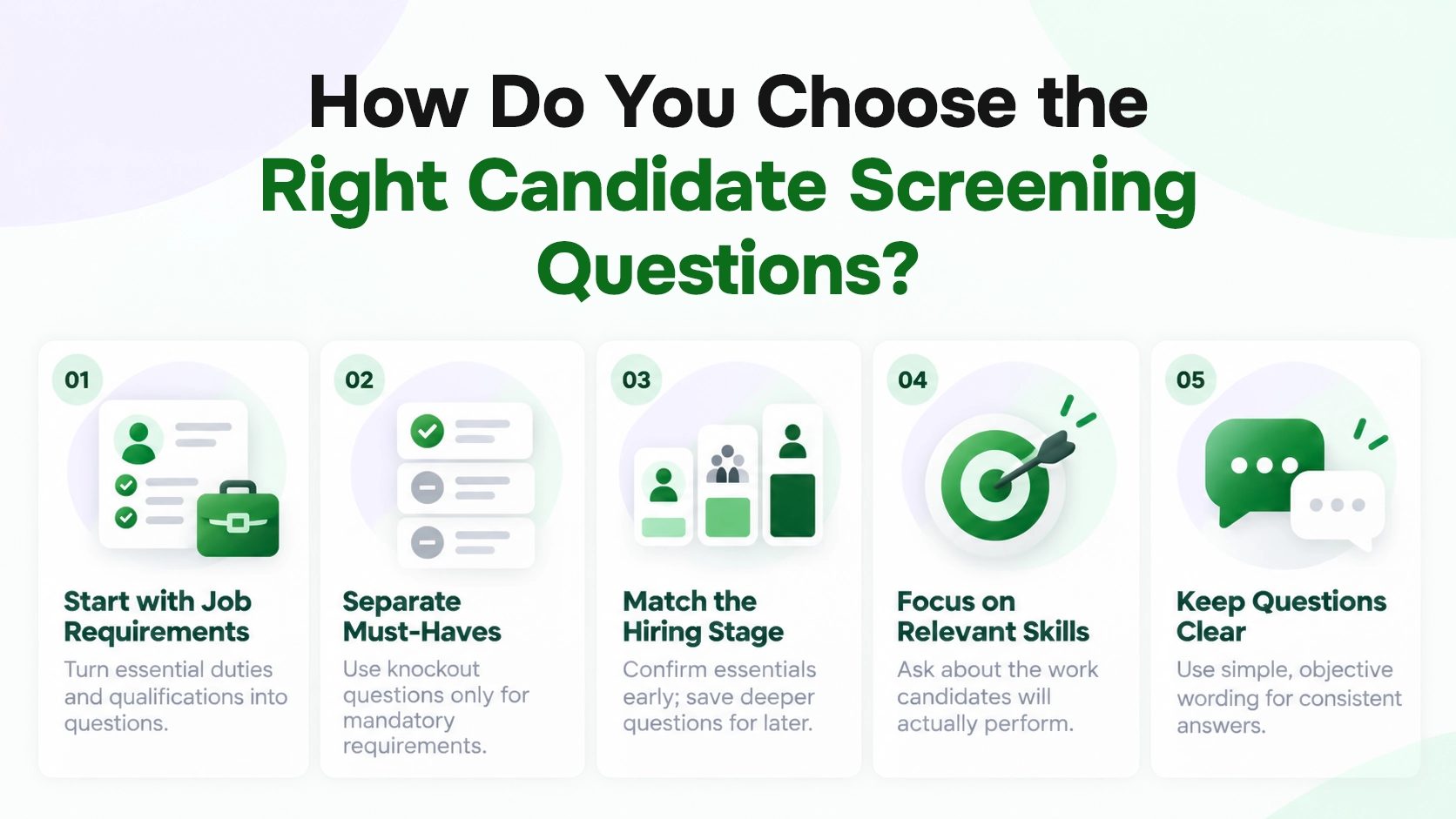
The right candidate screening questions depend on the role and the hiring stage. A customer service role needs very different knockout questions than a senior software engineer position. Use these five steps to build a list that filters for the right people:
Start with the job requirements: List the main duties, work conditions, and required qualifications in job description. Then turn each requirement into one clear screening question.
Separate must-haves from nice-to-haves: Decide which qualifications are non-negotiable and which are preferred. Use knockout questions only for true must-haves, such as a license or work authorization, never for skills a new hire can learn on the job.
Match questions to the hiring stage: Early screening should confirm qualifications, experience, availability, salary expectations, and notice period. Save deep technical, behavioral, and situational questions for later rounds.
Focus on the skills the role uses every day: Assess communication for customer-facing roles, quota attainment for sales, and problem-solving for technical roles. The role-specific questions (Q19–30) below show how.
Keep questions clear and objective: Use plain words that every candidate reads the same way, and ask every candidate the same core set. Consistent questions make answers easy to compare and support fair shortlisting.
For a full walkthrough of the process, read our guide What Is Candidate Screening?.
General Candidate Screening Questions
General screening questions give you a quick read on a candidate's background, motivation, and career goals before you move into detailed discussions. They're the pre-screening questions to ask candidates in your first recruiter conversation.
No. | Question | Why ask it? |
1 | Can you walk me through your current role and main responsibilities? | Shows recent experience and day-to-day scope. |
2 | What interested you in this position? | Tests motivation and whether they read the job description. |
3 | Which part of your experience is most relevant to this job? | Shows whether they can connect their background to the role. |
4 | Why are you looking for a new opportunity right now? | Reveals career goals and possible red flags in job changes. |
5 | What career achievement are you most proud of, and why? | Shows what they value and the scale of their impact. |
6 | What motivates you most in your work? | Helps judge long-term engagement and role fit. |
"I'd rather interview 50 people and not hire anyone than hire the wrong person.", - Jeff bezos, CEO of Amazon (LinkedIn)
Knockout / Qualifying Questions
Knockout questions check whether candidates meet the non-negotiable requirements for the role. A "no" answer removes the applicant before anyone spends time on an interview.
Use them only for true must-haves, such as work authorization, licenses, or shift availability. Don't use them for skills or tools a new hire can learn after joining, or you'll screen out strong candidates.
No. | Knockout question | Why ask it? |
7 | Are you legally authorized to work in [country]? | Confirms employment eligibility. |
8 | Will you now or in the future require visa sponsorship for this role? | Flags sponsorship needs early if the company can't sponsor. |
9 | Do you hold a current [license or certification] required for this position? | Verifies a legal or regulatory requirement. |
10 | Do you have at least [X] years of experience in [specific area]? | Confirms the minimum experience level, if one is truly required. |
11 | Can you work the schedule listed in the job description, including [shifts, weekends, or on-call]? | Catches scheduling conflicts early. |
12 | Can you work from [location], or follow the stated remote or hybrid arrangement? | Confirms the work setup fits the role. |
Tip: In your ATS, set knockout questions as yes/no or multiple-choice fields with auto-reject rules. Review auto-rejected applicants periodically to make sure the rules aren't filtering out qualified people.
Put Your Knockout Questions in the Application
Build custom screening questionnaires into each job post in Mercury Recruit, so must-have requirements are confirmed before you review a single resume.
Questions About Experience & Skills
Experience and skills questions show whether candidates have done similar work successfully. Don't ask them to repeat their resume. Ask them to explain what they owned, the challenges they faced, and the results they achieved.
Strong answers include specific examples, clear ownership, and measurable outcomes.
General experience and skills questions
No. | Question | What it assesses |
13 | Can you describe your hands-on experience with [core skill for the role]? | Depth of relevant expertise. |
14 | What was your role in a recent project similar to this position? | Ownership and scope of responsibility. |
15 | Which tools or software do you use most in your current role, and what do you use them for? | Familiarity with the role's tech stack. |
16 | Tell me about a result you delivered and how you measured it. | Focus on measurable outcomes. |
17 | Which skill have you improved most in the past year, and how? | Learning ability and self-development. |
18 | Which part of this job description would be newest to you? | Self-awareness and likely ramp-up time. |
Role-specific screening questions
These questions show how to tailor screening to the work a candidate will actually do. Pick the set that matches your opening and adapt it.
No. | Role | Question | What it assesses |
19 | Sales | What was your quota last year, and what percentage of it did you hit? | Track record against targets. |
20 | Sales | How do you build and manage your sales pipeline? | Prospecting habits and process. |
21 | Customer service | Tell me about a time you calmed an upset customer. What did you say? | Empathy and de-escalation. |
22 | Customer service | How do you keep quality high when ticket or call volume spikes? | Working under pressure and consistency. |
23 | Software / IT | Walk me through a technical problem you debugged recently. | Problem-solving approach. |
24 | Software / IT | Which languages or frameworks have you used in production in the last two years? | Current, hands-on technical skills. |
25 | Marketing | Which campaign are you most proud of, and which metrics proved it worked? | Data-driven results. |
26 | Marketing | With a limited budget, how do you decide which channels to prioritize? | Strategic thinking and trade-offs. |
27 | Frontline / hourly | This role involves [standing for long periods or lifting up to X kg]. Can you perform these duties, with or without reasonable accommodation? | Ability to meet the job's physical requirements, asked lawfully. |
28 | Frontline / hourly | Tell me about a time you handled a rush or covered for a teammate. | Reliability and teamwork. |
29 | Manager / leadership | How many people have you managed directly, and how did you support their growth? | Leadership scope and coaching. |
30 | Manager / leadership | Tell me about a time you addressed an underperforming team member. | Performance management, communication, and coaching skills. |
Questions About Availability, Salary & Logistics
Availability, salary, and logistics questions confirm that a candidate's expectations match the role's practical terms. Ask them early so neither side wastes time on a mismatch that could have been caught in five minutes.
No. | Question | Why ask it? |
31 | What is your notice period, and when is the earliest you could start? | Confirms the joining timeline. |
32 | What salary range are you targeting for this role? | Checks compensation alignment early. |
33 | Are you interviewing elsewhere or holding offers, and what's your decision timeline? | Tells you how fast you need to move. |
34 | Are you willing to travel or relocate if the role requires it? | Confirms flexibility for location-dependent roles. |
35 | Is there anything we can do to make the interview process more accessible for you? | Supports a fair, positive candidate experience. |
Behavioral, Situational & Culture-Fit Screening Questions
These questions show how candidates handle real workplace situations, work with others, and respond to challenges.
Behavioral questions ask about past actions ("Tell me about a time…").
Situational questions pose a hypothetical scenario ("What would you do if…").
Culture-fit questions test whether a candidate's work style matches how your team operates. Treat these as "culture add": look for shared values, not people who think exactly like your current team.
No. | Type | Question |
36 | Behavioral | Tell me about a time you received critical feedback. What did you change afterward? |
37 | Behavioral | Describe a time you had to juggle several competing priorities. |
38 | Behavioral | Tell me about a disagreement with a colleague and how you resolved it. |
39 | Behavioral | Tell me about a mistake you made at work and what you learned from it. |
40 | Situational | If two urgent tasks had the same deadline, how would you decide what to do first? |
41 | Situational | If you got an assignment with unclear instructions and your manager was unavailable, what would you do? |
42 | Culture fit | What kind of work environment helps you do your best work? |
43 | Culture fit | What do you know about our company, and what attracted you to it? |
Phone Screening Questions
A phone screen is a 15–30 minute recruiter call that confirms interest, communication skills, and deal-breakers before you schedule a structured interview. Open with a few general questions (Q1–4) and logistics questions (Q31–33), then use the phone-specific questions below. Ask every candidate the same core set so the screen stays fair and consistent.
No. | Phone screening question | Why ask it? |
44 | How did you hear about this role, and what made you apply? | Shows intent and tracks your best sourcing channels. |
45 | In your own words, what do you think this role involves day to day? | Checks they understand the job before you go further. |
46 | How does this role fit your career plans for the next two to three years? | Tests long-term fit and retention risk. |
47 | Is there anything that would stop you from accepting an offer from us? | Surfaces hidden deal-breakers early. |
48 | How do you prefer to communicate with your manager and team? | Shows working style and communication fit. |
49 | Are you available for a [video or on-site] interview in the next [X] days? | Keeps the hiring process moving. |
50 | What questions do you have about the role, the team, or the next steps? | Shows curiosity and gives the candidate a clear picture. |
Tip: Phone screens also test verbal communication. Note whether answers are clear, concise, and organized, especially for client-facing roles.
Which Candidate Screening Questions Should You Avoid?
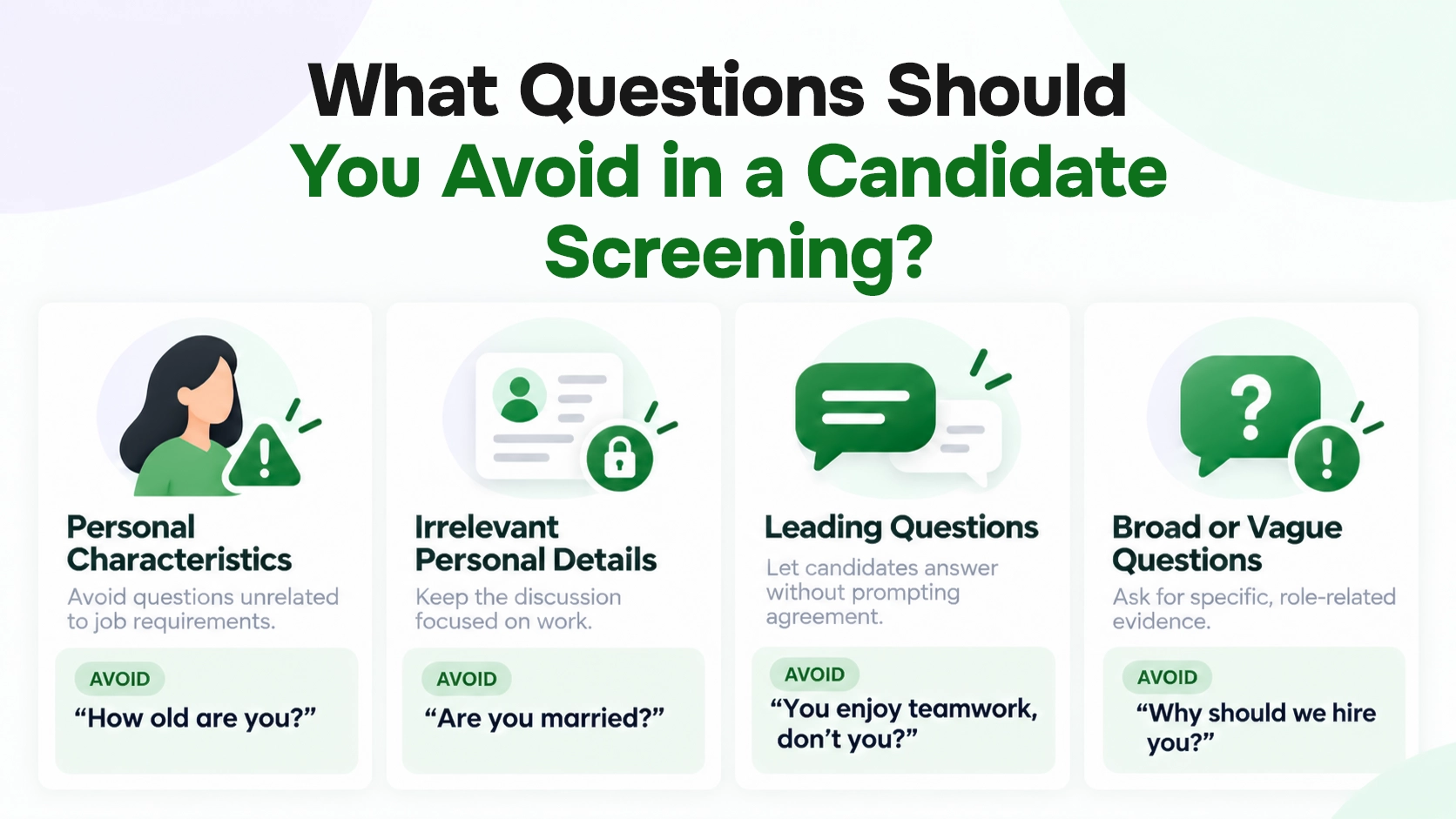
Good screening questions move the right candidates forward. Bad ones introduce bias, create legal risk, or collect information that tells you nothing about job performance. Avoid these four types.
1. Illegal or discriminatory questions: Never ask about protected characteristics such as age, race, religion, national origin, marital status, pregnancy, or disability. These questions can violate employment laws and lead to unfair hiring decisions, even when asked casually.
2. Irrelevant personal questions: Questions about political views, finances, relationships, or hobbies (unless directly relevant to the job) add no hiring value and can make candidates uncomfortable. Keep the focus on qualifications, skills, and work experience.
3. Leading questions: Leading questions hint at the "right" answer, so candidates tell you what you want to hear. The answers are hard to evaluate because every candidate says yes.
4. Vague questions: Broad questions produce generic, rehearsed answers that candidates interpret differently, which makes comparison inconsistent.
Avoid asking | Problem | Ask this instead |
How old are you? | Age discrimination | Are you at least 18 years old? (only if legally required) |
Are you married? Do you have children? | Marital and family status | Can you work the schedule listed in the job description? |
Where are you originally from? | National origin | Are you legally authorized to work in [country]? |
Do you have any health conditions? | Disability | Can you perform the essential duties of this role, with or without reasonable accommodation? |
What was your salary at your last job? | Banned in many US states and cities | What salary range are you targeting? |
You're comfortable working under pressure, right? | Leading | Tell me about a time you met a tight deadline. |
You enjoy teamwork, don't you? | Leading | Describe a project where you worked closely with others. What was your part? |
Tell me about yourself. | Too vague | Which part of your experience is most relevant to this job? |
What's your greatest weakness? | Rehearsed, generic answers | Which part of this job description would be newest to you? |
How to Evaluate Candidate Responses to Screening Questions?
Evaluate every answer against job-related criteria, using the same scorecard for every candidate. A shared structure makes answers easy to compare, reduces unconscious bias, and shows clearly who should move forward.
1. Compare Answers Against the Job Requirements
Check each answer against the role's must-haves first. Does it confirm the skills, qualifications, and experience the candidate needs for the next stage?
2. Ask for Examples
Don't accept broad claims like "I'm a great leader." Ask follow-up questions, or use the STAR method (Situation, Task, Action, Result) to learn what the candidate actually did and what happened.
3. Evaluate Every Candidate Using the Same Criteria
Next, assess every candidate using the same evaluation criteria. You should follow a consistent framework that makes responses easier to compare and reduces the chances of unconscious bias.
Evaluation area | What to look for |
Relevance | Does the answer address the question asked? |
Experience | Is the answer backed by relevant, specific examples? |
Technical knowledge | Does their knowledge match the role's requirements? |
Problem-solving | Can they explain how they approach a challenge? |
Communication | Is the answer clear, organized, and easy to follow? |
Culture fit | Does their work style suit your team and values? |
Motivation | Do they show real interest in the role and company? |
4. Score with a Standard Rubric
Before you begin reviewing candidates, define what excellent, good, average, and poor answers look like. Then, use the same scoring rubric for every candidate, so your evaluations remain objective and consistent.
Score | Description |
5 – Excellent | Clear answer with strong, specific examples and evidence. |
4 – Good | Relevant answer with only minor gaps. |
3 – Satisfactory | Meets the basics but lacks depth or examples. |
2 – Needs improvement | Partly answers the question and leaves important gaps. |
1 – Poor | Irrelevant, vague, or unsupported answer. |
Score Every Candidate on the Same Rubric
Set your criteria once, rate each response consistently, and compare candidates side by side in Mercury Recruit.
Explore Evaluation Features5. Watch for Red Flags
Vague answers with no concrete examples, even after follow-up questions
Details that contradict the resume or application, such as dates, titles, or responsibilities
Blaming former managers or teammates for every problem
Little knowledge of the role or company
Salary or availability far outside what the role offers
Missed calls or late replies during scheduling, with no explanation
6. Compare Candidates Side by Side
When screening is done, review all scorecards together instead of judging candidates one at a time. Comparing scores, strengths, and red flags side by side leads to consistent, data-driven shortlisting.
7. Notice How Candidates Answer
Pay attention to how candidates structure their thoughts and handle follow-up questions, not just what they say. Clear, specific, organized answers say a lot about communication, problem-solving, and self-awareness.
Want to screen faster? See our list of the best candidate screening tools for recruiters.
Ask Better Questions. Shortlist Faster.
Custom screening questionnaires, consistent evaluations, and AI insights on every candidate, all in one ATS.
ry Mercury Recruit FreeConclusion
Effective candidate screening questions make it easier to identify qualified candidates, reduce bias, and make confident hiring decisions. When your questions match the role, hiring stage, and purpose, candidate screening becomes faster, more consistent, and easier to manage.
As hiring needs grow, choosing a right Applicant Tracking System (ATS) helps you streamline and organize the entire screening process.
FAQs
Frequently Asked Questions
Basic screening questions are the question to assess whether a candidate meets the minimum requirement of a role. It includes qualifications, skills, experience, and certifications.