
AI Candidate Screening: How It Works, Benefits, Risks & Best Practices
Recruit
16 min read
Key Highlights
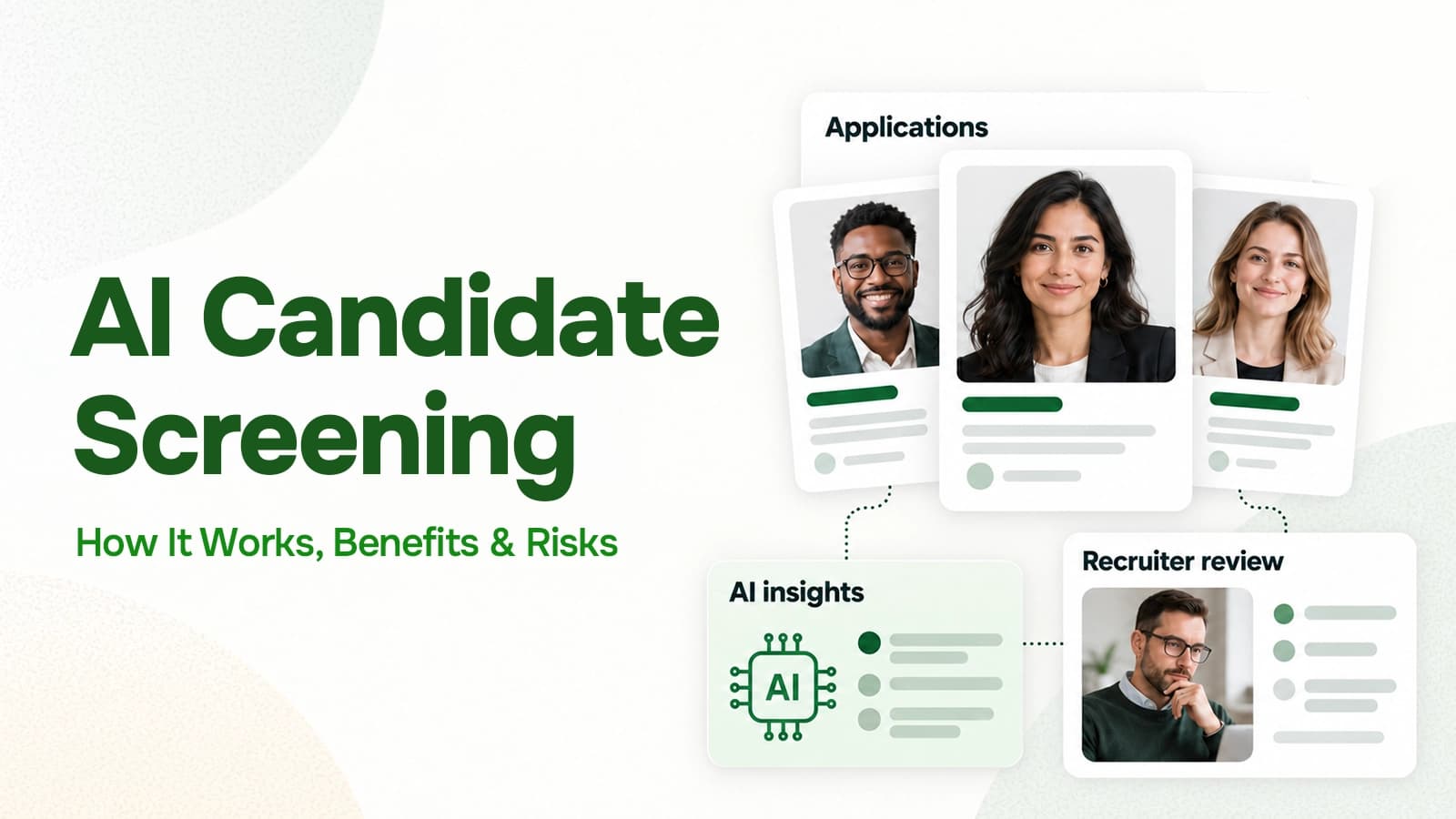
AI candidate screening evaluates resumes, applications, assessments, and early interview responses against role-related criteria.
Modern systems use machine learning, natural language processing, semantic matching, and structured scoring instead of relying only on exact keywords.
AI screening follows a structured workflow, including resume parsing, candidate matching, then scoring, shortlisting, and giving final review.
EEOC guidance, NYC Local Law 144, the EU AI Act, and privacy regulations are some major laws to follow for the responsible use of AI for quality screening.
Choosing the right AI candidate screening tool depends on hiring needs, such as resume screening, conversational AI, video interviews, or enterprise talent intelligence.
Introduction
Recruitment seems easy until you have to filter and find one top candidate among a pile of 300 applications.
Research from Ashby found that employers receive an average of more than 300 applications for every job opening. So, manual candidates screening becomes time consuming and also offers less visibility into candidate actual capabilities.
As top candidates stay on the market for only 10 days before accepting another offer, slow candidate screening may actually cost you the top talents. You end up with unsuitable ones and it's costly as a single bad hire costs your organization at least 30% of the employee's first-year earnings.
That is why AI candidate screening matters. It filters resumes, ranks applicants, and reduces a large candidate pool in minutes instead of hours or days.
This guide explains how AI candidate screening works, where it fits in the recruitment process, its benefits, risks, legal considerations, and the best practices for using it effectively.
What is AI Candidate Screening?
AI candidate screening is the process of using artificial intelligence to review, compare, and prioritize job applicants based on role-related requirements. It helps recruiters assess resumes, application forms, screening answers, skills, work history, assessments, and early interview responses faster than manual review.
Unlike basic ATS filtering, AI candidate screening does more than match keywords. Depending on the hiring process, it filters resumes, assesses pre-screening responses, review skills assessments, or ranks candidates based on job requirements. Then, AI recommends candidates who are the best match for the role.
This speeds up repetitive screening tasks and allows hiring teams to focus on qualified candidates. It also provides timely candidate updates and improves the overall candidate experience.
Manual Candidate Screening vs Rule-based ATS Screening vs AI Candidate Screening
Candidate screening methods have evolved from manual resume reviews to rule-based ATS filtering and now AI-powered evaluation. While all three identify qualified candidates, they differ in how they assess applications, recognize skills, rank candidates, and support recruiter decision-making.
Understanding these differences helps employers decide which approach should handle each part of the recruitment process.
Comparison | Manual Screening | Rule-Based ATS Screening | AI Candidate Screening |
How it works | Recruiters review each application individually. | Filters resumes using keywords, knockout questions, and predefined rules. | Analyzes resumes, assessments, and hiring data using AI models. |
Matching method | Human judgment. | Exact keyword and rule matching. | Contextual and semantic matching. |
Context awareness | Understands career changes, achievements, and transferable skills. | Limited to predefined keywords and rules. | Understands experience, related skills, career progression, and job context. |
Skill recognition | Identifies transferable and related skills. | Requires exact skill or keyword matches. | Recognizes similar skills, synonyms, certifications, and related job titles. |
Candidate ranking | Recruiters manually prioritize candidates. | Pass/fail or basic filtering. | Scores and ranks candidates based on overall job fit. |
Consistency | May vary between recruiters. | Applies the same rules to every applicant. | Applies consistent scoring across all candidates. |
Explainability | Recruiters can explain their decisions. | Explain filtering based on rules or keywords. | Varies by tool. |
Recruiter involvement | High. | Moderate. | Keeps human in a loop as human oversight is essential for final decisions. |
How Does AI Candidate Screening Work?
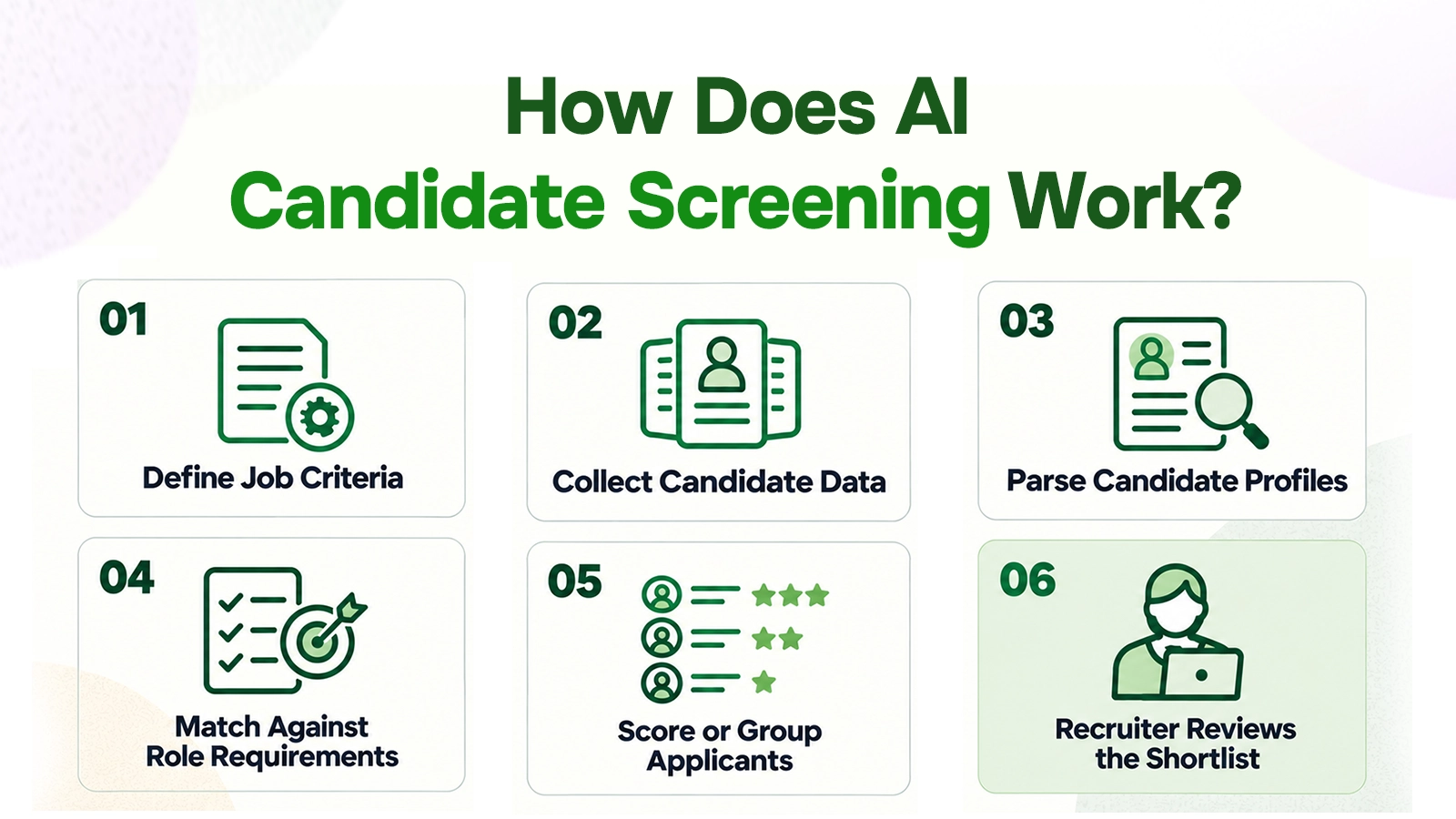
Image: Title: AI candidate screening process, concept: illustrate the steps of ai candidate screening including heading 'How AI-powered Candidate Screening Works?'
AI candidate screening follows a structured process to review applicants faster and more consistently. The system compares candidate information with job requirements. Then, it reviews profiles, identifies relevant skills and experience, ranks applicants based on their screening questions answer and resumes, and gives your hiring team a shortlist to review.
Define the job criteria: The process begins with clear role requirements from the hiring team. These benchmarks include required skills, experience level, qualifications, job responsibilities, and screening rules.
Collect candidate data: The system gathers information from resumes, application forms, screening questions, assessments, or early interview responses. This gives it enough data to compare each applicant against the role.
Read candidate profiles: Here, AI uses resume parsing and natural language processing (NLP) to extract structured information from unstructured resumes. It identifies relevant skills, job titles, education, certifications, and work history through entity extraction.
Match candidates with the role: The system compares each candidate with the job requirements. It checks how closely the applicant’s profile fits the skills, experience, and qualifications needed for the position.
Score or group applicants: After matching and identifying the gaps, the system score, rank, or group applicants into categories such as strong match, needs review, or not suitable.
Review shortlist: Your hiring team reviews the candidates with their evidence for selection and rejection. This human-in-the-loop approach helps catch the issues AI may miss, gaps, and avoid false rejections.
"AI is not going to replace humans, but humans with AI will replace humans without AI."— Karim Lakhani, Professor, Harvard Business School
What are the Benefits of AI Candidate Screening?
AI candidate screening improves both the speed and quality of candidate screening. It identifies qualified applicants more accurately, creates a consistent screening process, automates candidate communication, and supports hiring at any scale.
Faster resume screening: AI reviews hundreds or thousands of resumes in minutes and identifies candidates who meet the job requirements. Candidate screening moves forward much sooner, reducing delays in the hiring process.
Skills-based candidate matching: Traditional automated resume screening often filters candidates when the exact keywords are missing. But AI uses semantic matching to compare the meaning of skills and job titles, not just the exact words. For example, a candidate with People Operations experience qualifies for an HR Generalist role, because the system matches the underlying responsibilities hiring, employee relations, onboarding instead of searching for the exact phrase "HR Generalist" on the resume.
More consistent candidate evaluation: AI evaluates every application against the same job criteria. So, each candidate receives a consistent assessment, supported by clear match scores and documented results, increasing screening accuracy.
Rediscovery of existing talent: AI scans candidates already stored in the applicant tracking system (ATS) and surfaces profiles that match new job openings. Previous applicants become an active talent pool instead of remaining archived.
Automated candidate communication: AI sends application acknowledgments, answers common questions through chatbots, delivers assessments, and schedules interviews automatically. Candidates receive updates without waiting for manual follow-ups.
Scalable high-volume hiring: AI candidate screening follows the same criteria to process for hundreds or thousands of applications. So, high application volumes no longer create long screening backlogs or require additional screening resources.
Find Qualified Candidates Without the Manual Work
Reduce screening time with AI-powered resume parsing, ATS scores, and clear AI insights, all built into Mercury Recruit.
Explore AI Screening FeaturesWhat are the Risks and Limitations of Using AI in Candidate Screening?
The use of AI candidate screening surely improves the hiring process, but it also comes with limitations and potential risks that require careful management. Understanding these challenges helps recruiters use AI as a screening support tool rather than a replacement for human judgment.
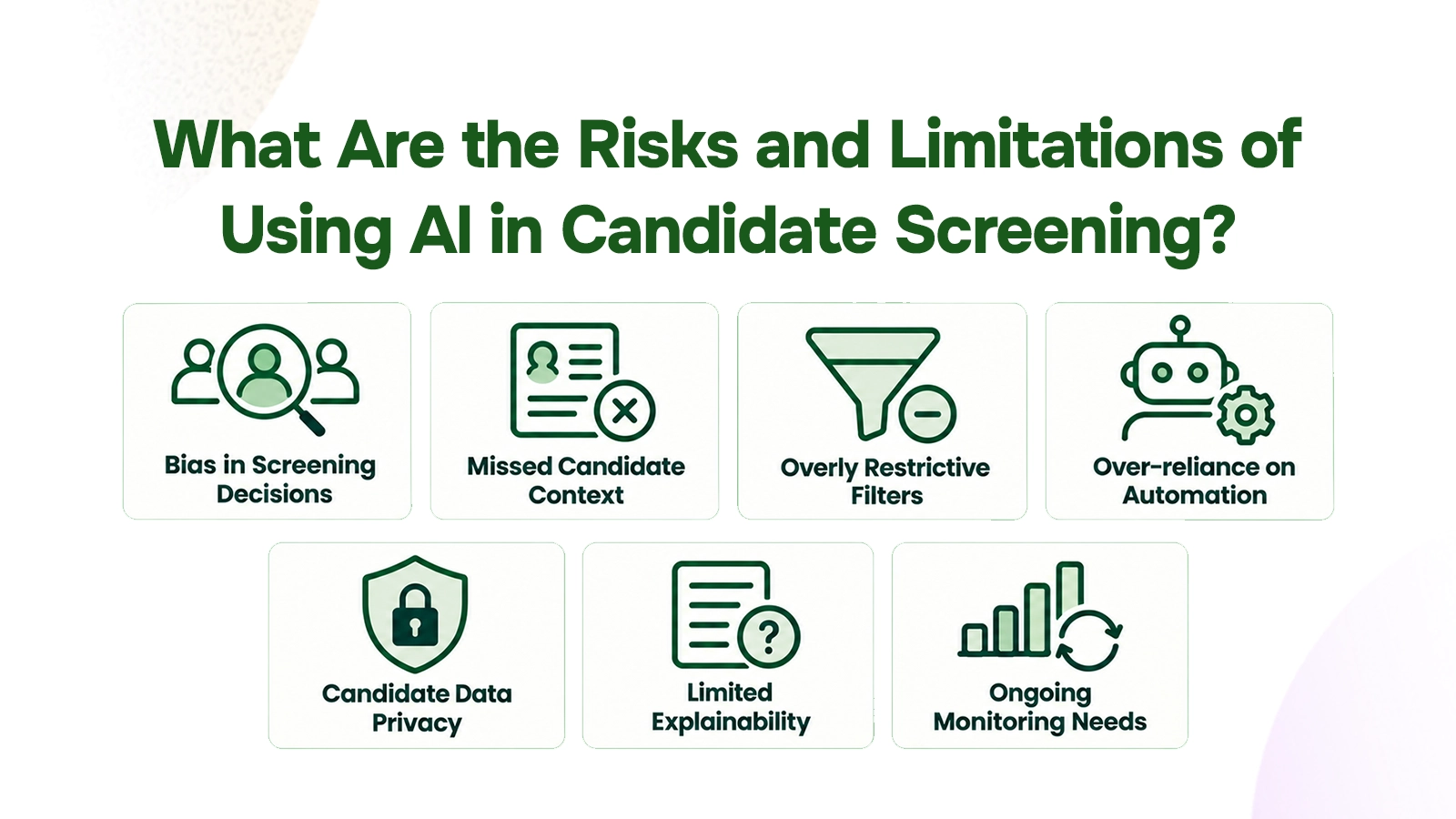
Potential bias in screening decisions: AI systems learn from the data and criteria they are trained on. If the training data or hiring criteria contain bias, the system may unintentionally favor certain candidate profiles or overlook qualified applicants.
Limited understanding of candidate context: AI analyzes resume information and identify patterns, but it may not fully understand career changes, gaps, unique experiences, or potential that is not clearly shown on a resume.
Overly restrictive screening filters: AI screening performs best when job requirements reflect the actual needs of the role. Filters that prioritize too many mandatory qualifications may narrow the talent pool and exclude candidates who can succeed in the position.
Over-reliance on automated recommendations: AI rankings and scores provide useful insights, but they should not be the only factor in hiring decisions. Recruiters still need to review candidates and consider factors beyond the screening results.
Data privacy and compliance concerns: AI screening tools process sensitive candidate information, including resumes, work history, and personal details. Organizations need proper data handling practices to maintain privacy and comply with relevant regulations.
Lack of transparency: Some AI tools do not clearly explain why a candidate was ranked higher or lower. This makes it harder for your hiring team to check results, correct mistakes, and defend hiring decisions.
Need for regular system monitoring: Hiring requirements change over time, and AI models may require updates to remain accurate. Regular reviews of screening criteria and results help ensure the system continues to support fair evaluations.
"AI systems should be fair, reliable, and accountable."— National Institute of Standards and Technology (NIST), AI Risk Management Framework
Best Practices for Using AI Screening Responsibly
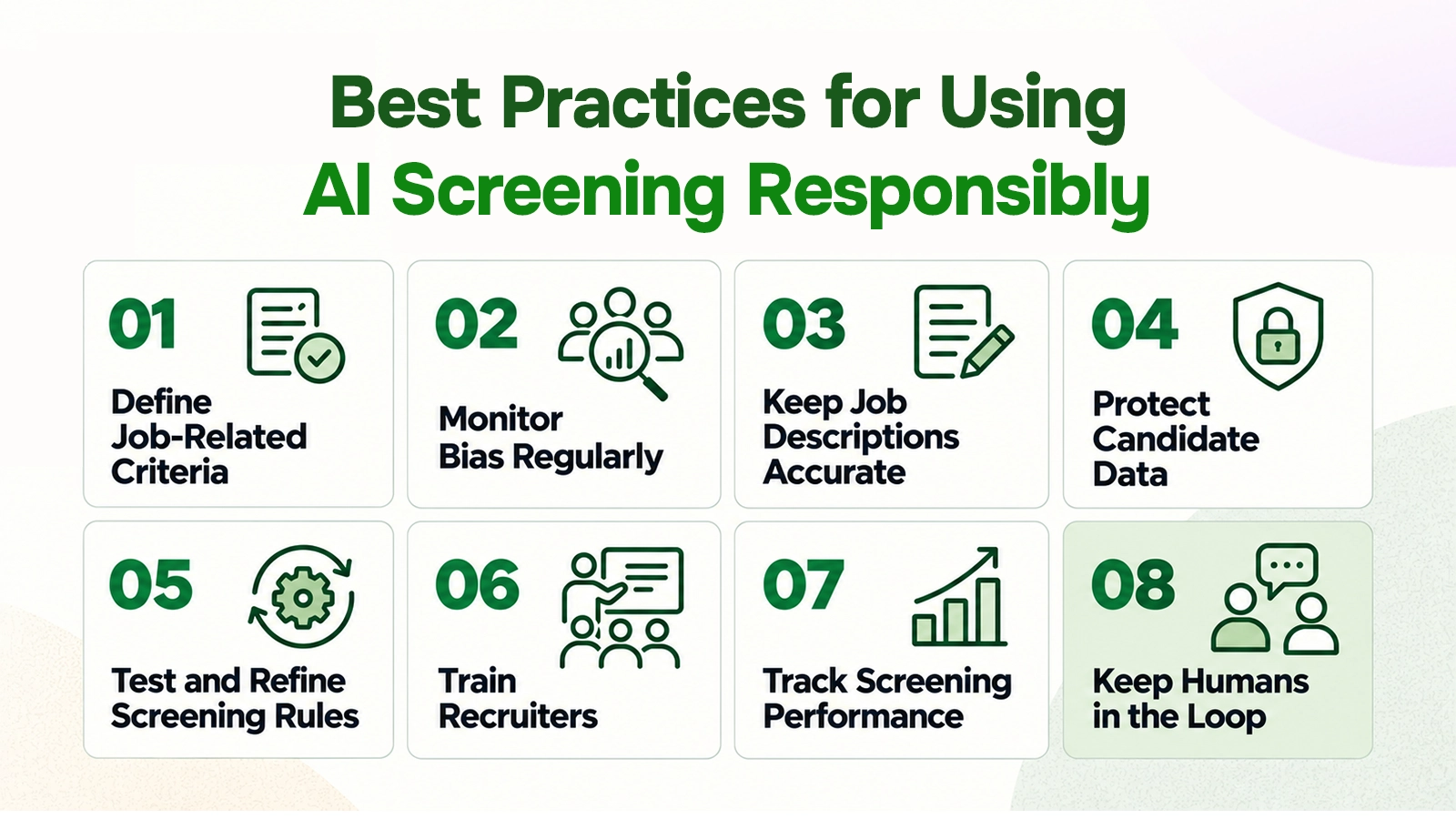
AI candidate screening delivers the best results when it supports recruiters instead of replacing them. Clear screening criteria, regular system reviews, and human oversight improve hiring and selection process while reducing compliance and fairness risks.
Define clear screening criteria: Build screening requirements around the skills, qualifications, and experience that are essential for the role. Avoid adding unnecessary filters that reduce the talent pool.
Monitor bias regularly: Review screening outcomes to identify patterns that may unfairly disadvantage certain groups. Regular bias audits and updated evaluation criteria improve fairness over time.
Keep job descriptions accurate: AI compares candidates against the job requirements it receives. So, keep your job description clear, realistic to improve matching accuracy and reduce irrelevant recommendations.
Protect candidate data: Store and process personal information securely while following applicable privacy regulations such as General Data Protection Regulations (GDPR) or local data protection laws.
Test and refine screening criteria: Hiring needs change over time. Regularly review screening filters, scoring rules, and qualification requirements to ensure qualified candidates are not excluded unnecessarily.
Train recruiters to use AI effectively: Recruiters should understand how AI generates recommendations, recognize its limitations, and know when human judgment should take priority.
Track screening performance: Measure metrics such as qualified candidate rate, screening accuracy, time-to-screen, and interview conversion rate to evaluate whether AI is improving hiring outcomes.
Keep a human in the loop: Recruiters should review AI recommendations before candidates are rejected or advanced. Set review rules for borderline scores, missing information, and situations in which the system has low confidence.
Know Whether Your AI Screening Is Actually Working
Track time-to-screen, interview conversion, and stage-by-stage drop-off in Mercury Recruit, so you can adjust criteria before good candidates slip through.
Explore AnalyticsTop Tools for AI Candidate Screening
Today's AI recruiting software offers different approaches to candidate screening. Some focus on resume analysis, while others specialize in conversational interviews, assessments, or video screening. The right solution depends on your hiring volume, recruitment process, and business needs.
1. Mercury Recruit
Best for: AI candidate screening built directly into an ATS
Mercury Recruit is the most reliable ATS platform that includes AI candidate screening. It analyzes resumes against job requirements, assigns AI to match scores, and explains each recommendation using evidence from the candidate's resume. Recruiters can screen, rank, and manage candidates from a single platform.
2. Eightfold AI
Best for: Skills-based hiring and enterprise talent intelligence
Eightfold AI is well known resume screening platform. Rather than relying on job titles or exact keywords, it identifies capabilities, adjacent skills, and career potential to recommend stronger matches. Its talent intelligence platform also supports internal mobility, making it well suited for enterprises hiring both external candidates and existing employees.
3. Manatal
Best for: AI recruitment for growing businesses and agencies
Manatal combines AI recruiting with a modern ATS and CRM, making it a practical option for growing businesses and recruitment agencies. Beyond ranking candidates, its AI Copilot answers recruiter questions, summarizes recruitment data, and surfaces insights directly inside the platform. The software also emphasizes data privacy by keeping customer data separate from AI model training.
4. hireEZ
Best for: AI-powered sourcing along with screening
hireEZ is an AI-powered recruiting platform that automates sourcing, candidate screening, outreach, and interview scheduling. Built to work alongside your existing ATS, it uses conversational AI to conduct structured phone screenings, evaluate candidate responses, generate conversation summaries, and provide job-fit analysis
5. Workable
Best for: End-to-end hiring for small and mid-sized businesses
Workable is known as the best ATS for small and mid sized businesses. Its AI assists recruiters by recommending suitable candidates, generating job descriptions, and simplifying hiring workflows without adding unnecessary complexity. The platform is especially popular among small and medium-sized businesses looking for an all-in-one recruiting solution.
Explore our complete guide to candidate screening tools and find the right solution for your hiring process.
What AI Candidate Screening Laws Should Employers Follow?
AI candidate screening is becoming more common, but its use also comes with legal responsibilities. Several countries and regions now require employers to be transparent about how AI is used during hiring and to monitor these systems for fairness.
Although the rules vary by location, the following regulations have had the biggest impact on AI screening practices.
1. EEOC Guidance (United States)
In the United States, the Equal Employment Opportunity Commission (EEOC) provides guidance on how existing employment discrimination laws apply when employers use AI in hiring.
Employers remain responsible for ensuring that their selection procedures do not discriminate against protected groups. If an AI screening system disproportionately disadvantages candidates based on protected characteristics such as race, sex, age, disability, or religion, the employer may still be held responsible.
Therefore, organizations should use job-related screening criteria, monitor selection outcomes, and ensure that AI recommendations do not replace fair hiring practices.
2. NYC Local Law 144
New York City's Local Law 144 regulates the use of Automated Employment Decision Tools (AEDTs) in hiring and promotion decisions.
Employers using covered tools must arrange an independent bias audit within one year before using the tool. They must also publish a summary of the audit results and provide candidates or employees with advance notice of the tool's use.
The law also establishes requirements concerning the data used by these tools and alternative selection processes. Employers should review the requirements carefully before using automated screening systems for positions covered by the law.
3. Illinois AI Video Interview Act
Illinois introduced the Artificial Intelligence Video Interview Act, effective January 1, 2020, to regulate employers using AI to analyze recorded video interviews.
Before asking applicants to submit video interviews, employers must:
Inform candidates that AI may analyze their video interviews.
Explain how the AI works and the general characteristics it evaluates.
Obtain candidates' consent before using AI to evaluate their interviews.
The Act also restricts sharing interview videos and requires employers to delete them within 30 days when applicants request deletion. Additional demographic reporting requirements apply when employers rely solely on AI video analysis to determine which applicants advance to in-person interviews.
This law is particularly relevant to employers using AI-powered video interview and candidate evaluation tools.
3. Colorado Automated Decision-Making Technology Act
Colorado's Senate Bill 26-189, signed into law on May 14, 2026, establishes requirements for developers and deployers of automated decision-making technology (ADMT) used in consequential decisions, including employment decisions.
The law takes effect on January 1, 2027. It introduces requirements for technical documentation, transparency, and recordkeeping. It also gives individuals rights to request access to and correction of personal data used by covered systems, as well as meaningful human review and reconsideration following certain adverse decisions.
Employers using AI to influence recruitment or other employment decisions should assess whether their systems fall within the law's scope and prepare for its requirements.
4. General Data Protection Regulation (GDPR)
The General Data Protection Regulation (GDPR) governs how organizations collect, process, store, and use personal data belonging to individuals in the European Union.
Since AI candidate screening processes personal information such as resumes, employment history, qualifications, and assessment results, employers must follow applicable GDPR requirements.
These include:
Lawful data processing: Establish a valid legal basis for collecting and processing candidate information.
Transparency: Inform candidates about how their personal data is collected, processed, and used, including relevant automated decision-making.
Data minimization: Collect only the information necessary for the recruitment process.
Storage limitation: Retain candidate information only for as long as necessary.
Data protection impact assessments: Conduct an assessment when the processing is likely to create a high risk to individuals' rights and freedoms.
The GDPR also provides safeguards for decisions based solely on automated processing that produce legal or similarly significant effects on individuals. Employers should therefore understand when human intervention and other safeguards are required.
5. EU AI Act
The European Union classifies many AI systems used in recruitment and employment as high-risk because they can influence employment opportunities and affect individuals' rights.
AI systems designed to analyze and filter applications, rank candidates, or evaluate applicants during recruitment can fall within this category.
The relevant high-risk requirements include risk management, data governance, technical documentation, recordkeeping, transparency, human oversight, and accuracy.
"Artificial intelligence is not a substitute for human intelligence; it is a tool to amplify human creativity and ingenuity." — Fei-Fei Li, Professor of Computer Science, Stanford University
Conclusion
AI candidate screening helps recruiters review applications faster, identify qualified candidates more efficiently, and maintain a more consistent screening process. However, it works best when combined with human judgment rather than replacing recruiters. With clear screening criteria, regular monitoring, the right tools, and responsible use, AI improves hiring efficiency while supporting fair and informed hiring decisions.
Since AI screening is often built into modern applicant tracking systems, choosing the right platform is just as important as choosing the right AI features.
AI Screening With a Human in the Loop
AI resume parsing, match scores, and candidate management in one ATS, so recruiters review the evidence and make the final call.
Try Mercury Recruit FreeFAQs
Frequently Asked Questions
AI screening looks for requirements mentioned in job description including related experience, qualifications, licenses, assessment performance, and evidence from screening answers. The exact factors depend on the role and the criteria configured by the employer.