
12 Proven Strategies to Improve Recruitment and Selection Process
Recruit
Recruitment Process
16 min read

Key Highlights
Improving your recruitment and selection process leads to better hires, lower costs, faster decisions, and a stronger candidate experience.
Common hiring challenges such as poor candidate quality, slow hiring, unclear job requirements, and weak communication should be identified before making improvements
To improve recruitment strategies, define roles clearly, refine screening, use structured interviews, build talent pools, track metrics, and leverage ATS and automation.
Track recruitment metrics to identify hiring bottlenecks and continuously improve your recruitment process.
Support your hiring process with ATS, AI sourcing tools, automation, analytics, and talent management tools.
Introduction
The global talent shortage has hit a 12-year high, and 72% of employers now struggle to find skilled talent with qualified candidates staying on the market for just 10 days on average. As competition intensifies, recruiters must move fast to attract and hire top talent before competitors do.
However, slow or unstructured recruitment processes can make you lose qualified talents. Likewise, delayed decisions, inconsistent evaluations, and poor communication often cause qualified candidates to drop out or accept other offers.
Ultimately, you need proper tactics to improve your recruitment process to speed up hiring and onboard the qualified talent. Therefore, in this guide, you'll learn 12 recruitment strategies to strengthen your hiring process and hire the right talent more effectively.
Why Improving Your Recruitment & Selection Process Matters
Improving the recruitment and selection process helps businesses hire stronger candidates faster while reducing costs and delays. In fact, just understanding how to optimize the hiring process can shorten the hiring cycle by up to 60% while improving the quality of hire.
Reduced bad hires: A clear recruitment process attracts the possible best fit candidates. So, your team spends less time sorting out weak applications and more time speaking with strong candidates.
Faster hiring decisions: Slow screening and delayed feedback push good candidates away. A planned process makes hiring stage clear and makes the team move with better speed and control.
Lower hiring costs: Every wrong hire adds extra costs through training, replacement hiring, and lost productivity. A better process reduces repeated hiring work and protects your budget.
Improved candidate experience: Candidates notice how your company communicates from the first job post to the final update. Clear steps, timely replies, and organized interviews make your company look reliable.
Fairer selection: Random interviews and unclear scoring lead to weak decisions. Use structured questions, skill checks, and scorecards to help your team compare candidates based on real role fit.
Stronger employer brand: 75% of jobseekers consider strong employer brand before applying. So, to create a positive impact, build trust, and smooth candidate experience, you need to make a good presence among people.
What are the Top Recruitment & Selection Problems?
Before you learn how to improve the recruitment process, you need to spot where hiring usually breaks. Most problems come from unclear planning, slow workflows, weak communication, and wrong evaluation.
Poor candidate quality: A high number of applications does not always mean you have qualified prospects. If the job description is unclear or the talent market is limited, recruiters end up filtering too many weak matches, which slows down the whole hiring process.
Slow time-to-hire: Delayed screening, interview scheduling, unstructured process, feedback makes your process feel disorganized.
Hiring bias: Favoritism/bias appears when decisions depend on personal opinion, school names, past companies, or communication style. Practice diversity hiring include Skill-based checks and shared scoring make selection fairer.
Weak employer branding: Candidates review your website, career page, and social profiles before applying. If your brand feels unclear, they may choose another company first.
Difficulty assessing skills accurately: Relying solely on resumes and unstructured interviews leads to costly mis-hires. Candidates who do well in the interview may still lack core competencies, while highly skilled talent gets overlooked simply because they don't test well in traditional conversational formats.
12 Proven Ways to Improve Your Recruitment & Selection Process
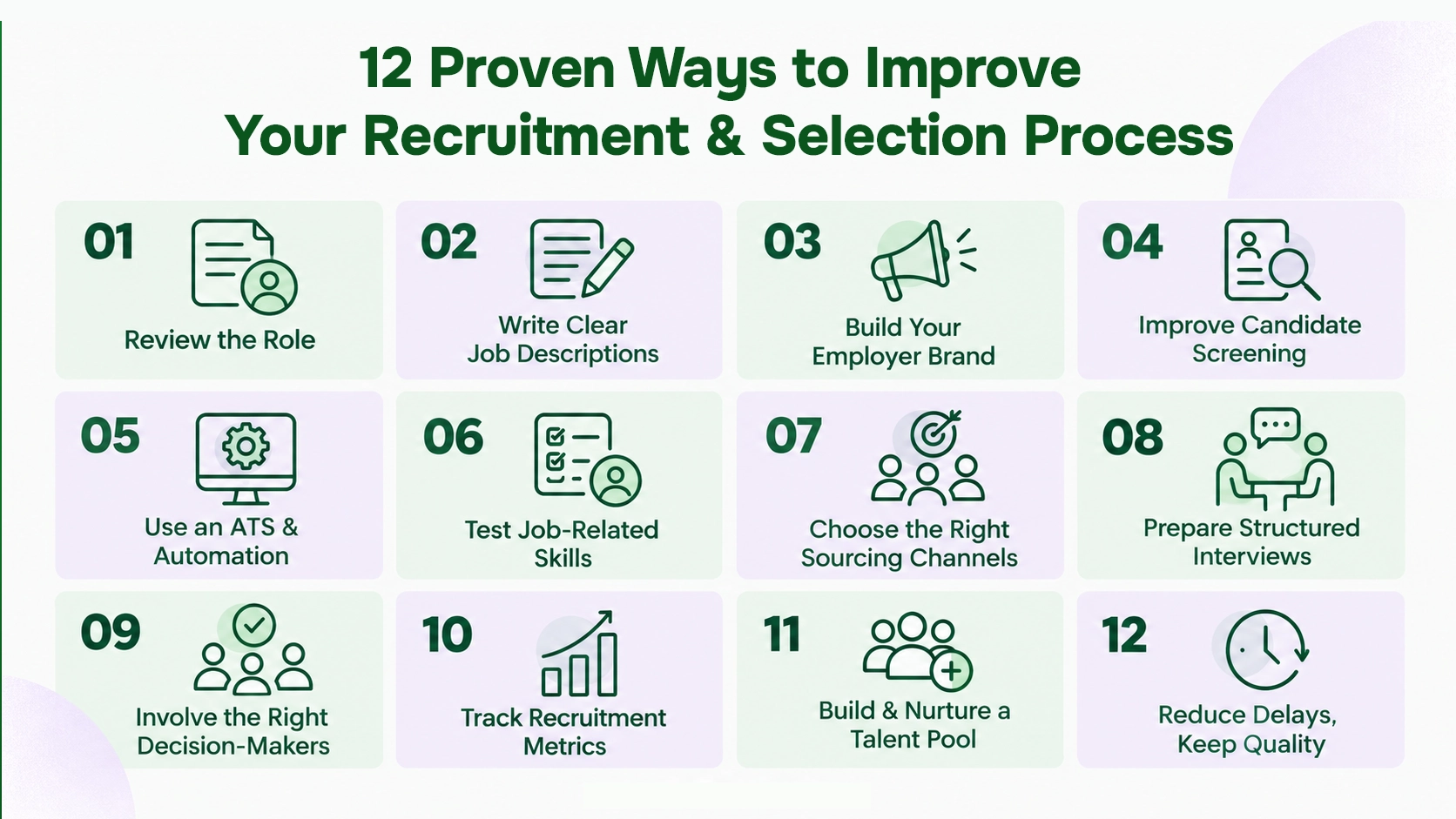
Optimizing the hiring process allows you to hire people who match the role, the team, and the company’s goals. Also, it creates better candidate experience and impact, even for those who are not selected. Here are the best proven ways to optimize your recruitment process widely used by professionals:
1. Review the Role Before You Start Hiring
Before posting a job, review whether the role is still needed in the same form. Be clear on the job title. Ask simple questions first to avoid hiring an outdated role.
Does this role still match your business needs?
Can some tasks be handled by another team?
Has the role changed since the last person was hired?
Do you need a full-time employee, part-time support, or a contractor?
Also, as a hiring managers or a recruiter, you should get a clearer picture of what the company really needs.
2. Write a Clear Job Description
After deciding on a vacancy for a position, the next step is to prepare a clear job description. If the job description is vague, candidates may not understand the role, and recruiters may struggle to identify the right fit.
Clearly define the role by outlining the key responsibilities, required skills, reporting line, work location, and essential versus preferred qualifications. Avoid adding too many reequipments and consult with the hiring manager to ensure the job description accurately reflects the role.
Furthermore, focus on using simple titles as they usually perform better because candidates search for familiar terms. For example, “Sales Development Representative” is clearer than “Growth Champion.”
To learn more about writing effective job descriptions, check out our guide, “How to Write a Job Description.”
3. Build a Strong Employer Brand
75% of candidates hesitate to accept a job from company with bad reputation even when they are unemployed. Candidates do not only look at the job. They also look at the company behind the job.
From review platforms like Glassdoor or online presence tell them what it feels like to work with you. So, its essential to show your company culture, values, team environment, benefits, career growth, and employee stories on your website and social media. Use real examples instead of generic claims.
A strong employer brand attract jobseekers to connect with your company online. It also improve trust even before the first interview even happens and increases the offer acceptance rate.
This matters even more for competitive roles. Good candidates often compare several companies before making a decision.
4. Improve Candidate Screening
Candidate screening is often one of the slowest stages of recruitment. Use phone screening, AI screening, or candidate screening tools to narrow the applicant pool and identify candidates for interviews faster.
Moreover, implement AI screening tools to automate the screening. However, do not overlook strong candidates when their resumes lack certain keywords, so you should also review skills, experience, work samples, achievements, communication ability, and overall role fit.
As for technical or skill-based roles, use practical assessments to test job-related ability. While for communication-focused roles, review writing, problem-solving, and examples from previous work.
“Hire character. Train skill.” — Peter Schutz, CEO of Porshe AG (1981 to 1987)
Want to automate your screening process? Explore our guide on the best candidate screening tools to choose software that fits your hiring needs.
5. Use an ATS and Automation
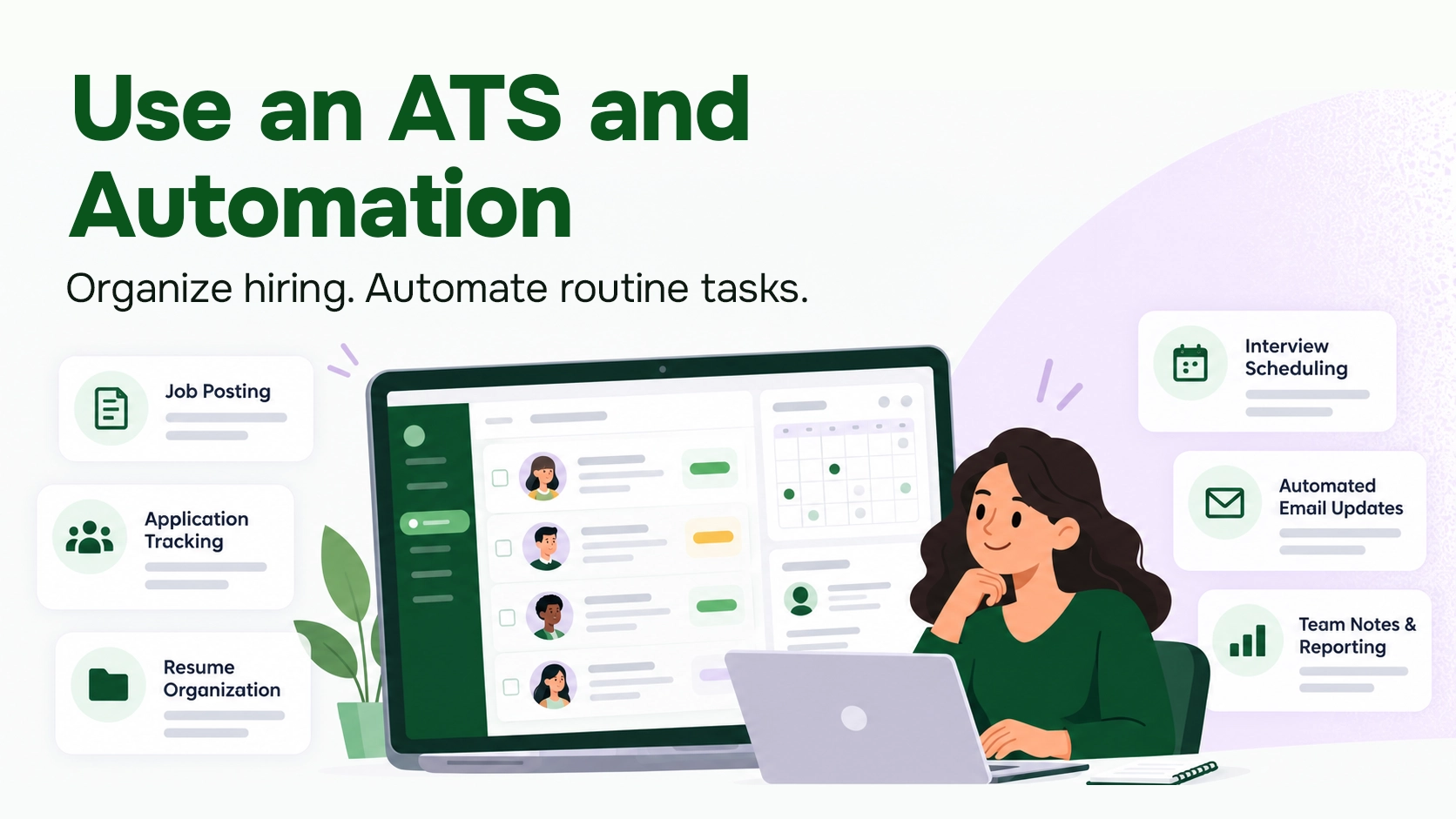
An Applicant Tracking System (ATS) helps with job posting, application tracking, resume organization, interview scheduling, email updates, team notes, and reporting. So, try to incorporate automation to reduce repetitive work like data entry and follow ups.
An ATS can make hiring faster, with 86.1% of users reporting an increase in hiring speed. For example, ATS centralizes application confirmations, interview reminders, status updates, and rejection emails. You can also automate job requisitions and onboarding.
Review automated screening rules often, especially when using AI-based tools. However, if your system filters candidates unfairly, you may miss good applicants. Therefore, include humans in final hiring decisions and keep AI in check.
Automate the Busywork, Not the Judgment Calls
Centralize job postings, screening, interview scheduling and candidate updates in one workspace.
Open Mercury Recruit6. Use Skills Tests and Assessments
Depending on the role, you can use writing tests, coding tasks, sales roleplays, case studies, job simulations, or problem-solving exercises. These tests should be short, relevant, and directly connected to the work.
Use AI and automation to assign assessments depending on the roles. Ensure to keep assessments practical and respectful of their time. Do not make candidates complete long unpaid projects as it impacts the candidate's experience.
Skills-based selection reduces guesswork and gives hiring teams clearer evidence before moving prospects forward in the pipeline.
Learn how to set up assessments and evaluate candidates easily with Mercury Recruit, all in one place.
7. Use the Right Sourcing Channels
Improve your candidate sourcing strategies. Use market mapping to understand where your ideal candidates are and then try the right sourcing channels as per need. Meanwhile, you should also maintain a candidate database to store details of the applicant, so you can quickly reconnect when suitable roles become available.
Moreover, post job vacancies on platforms where your ideal candidates are most active. Use niche job boards, LinkedIn, and relevant online communities to reach qualified talent. Also, create a company career page, and make simple application processes to enable qualified candidates to apply directly.
Additionally, use employee referrals and networking to access trusted candidates. Build connections through industry groups, events, and professional communities. Plus, instead of waiting for direct applicants, implement active and passive sourcing to recruit them for the hard-to-fill vacancies.
Explore our blog on candidate sourcing tools and know how to improve your sourcing efforts and build a stronger talent pipeline.
8. Prepare for Interviews Properly
Create a structured interview process before meeting candidates. Decide which skills, behaviors, and experience each interviewer will assess. Use the same core questions for candidates applying for the same role.
Also, use a uniform scoring system to judge candidates based on the same criteria instead of personal preference and avoid biasness.
9. Involve the Right People in Hiring Decisions
Ensure to include hiring managers, team leads, and key team members at the right stage as per talent acquisition stage. As every person has a different specialization, it's essential to involve them to choose the candidates.
For example, the hiring manager screen candidates' relevant experience and basic requirements, while a senior developer assesses technical skills. Then, HR evaluates communications, salary expectations, and overall fit.
However, too many people can slow down the process. So, choose only the people who are needed, and make sure each person has a clear role in the decision.
10. Track Recruitment Metrics
Track hiring metrics to understand what is working and what needs improvement in your recruitment process. Key metrics include time to hire, cost per hire, source of hire, candidate drop-off rate, offer acceptance rate, interview pass rate, and quality of hire.
With recruitment software, you can easily track hiring metrics, including cost per hire, drop off rate, success rate, and more. These metrics help you identify bottlenecks and make informed decisions.
For example, they show which job boards attract the best candidates, where applicants drop out of the process, which roles take the longest to fill, and which hiring stages cause delays.
Learn how Mercury Recruit helps you optimize your hiring process with real-time analytics and notifications, giving your team instant actionable insights and alerts when it matters most.
Turn Your Hiring Data Into Faster Decisions
Get real-time analytics and alerts the moment a hiring stage starts to slow down.
Explore Analytics in Mercury Recruit11. Build and Nurture Talent Pool
Choose the right ATS, then create and maintain a talent pool to store strong candidates who are not hired immediately but may be suitable for future roles. Then, segment candidates based on skills, location, experience level, job interest, or interview stage.
Regularly update candidate profiles with clear notes, so your team understands their suitability for future opportunities. Re-engage with relevant and pre-screened candidates when new roles open instead of searching for the candidate from scratch.
12. Reduce Time to Hire Without Sacrificing Quality
If your hiring process takes too long, the qualified candidate will accept another offer. Review your recruitment funnel and find where candidates wait for the longest.
Set clear feedback deadlines, limit unnecessary interview rounds, use interview scheduling tools, and prepare salary ranges early. However, you should not be rushing to speed up process and weaken hiring quality as a bad hire cost more than the cost-to-hire.
Also, don’t rely too heavily on ATS filters, as they may sometimes exclude suitable candidates. Use scorecards, structured interviews, and skill checks so your team can make faster decisions without choosing the wrong candidate.
"I'd rather interview 50 people and not hire anyone than hire the wrong person."
Jeff bezos, CEO of Amazon (LinkedIn)
How to Measure Recruitment Process Improvement?
You can measure recruitment process improvement by comparing the same hiring KPIs before and after making changes. The aim is to see whether your process has become faster, more cost-effective, and better at bringing in suitable candidates.
Along with the numbers, suggestions from managers and candidates helps you understand whether the overall experience has improved.
Follow these steps to check whether your recruitment process is improving:
Choose the right hiring KPIs: First, define metrics that match your recruitment goals. For example, use time to hire to measure speed, cost per hire to track spending, and quality of hire or new-hire retention to assess hiring results.
Track the same KPIs: After making changes to your recruitment process, measure the same KPIs over a similar period. While keeping the timeframe consistent, see whether the changes are producing better results.
Compare the results: Next, compare the new data with your previous results. Look for improvements such as shorter hiring times, lower costs, fewer candidate drop-offs, higher offer acceptance, and stronger new-hire performance.
Collect feedback: Along with the data, remember to ask recruiters, hiring managers, and candidates about their experience. Their responses help you spot communication gaps, delays, or process issues that numbers may not show.
Review and adjust: Finally, review your results monthly or quarterly. Keep the changes that work, revise the areas that still cause problems, and continue tracking progress over time.
What are the Tools to Improve Recruitment Process?
[Image: illustrate the list of tools, 'Tools to Improve Recruitment']
The right recruitment tools help your team manage hiring faster and with fewer mistakes. They keep candidates, feedback, interviews, and reports in one place, so the process becomes easier to track. Tools used to improve recruitment are as given below:
1. Applicant Tracking System (ATS)
An ATS is a system designed to manage and streamline the recruitment process. It centralizes job opening, automate resume screening, and maintains applicant details.
Around 70% of large companies currently use an ATS as it is optimizing the hiring process.
Recruiters can manage interview notes, hiring team feedback, and application status from a single platform. Additionally, an ATS also offers crucial features like assessment, AI candidate screening, interview scorecards, and reporting.
For example: MercuryRecruit, Greenhouse, Breezyhr
2. AI Screening Tools
AI candidate screening tools help you review applications more efficiently through automated comparisons between candidate profiles and job requirements. They screen CVs, analyze skills, qualifications, and experience, then use keyword and semantic matching to identify the most suitable candidates.
However, they are intended to support recruiters rather than replace them, so final hiring decisions should always rely on human judgment to ensure fairness and accuracy. The results are used to rank and score applicants, making the shortlisting process faster and more consistent.
Some of the best AI candidate screening tools are: HireVue, Eightfold.ai, Paradox
3. Interview Scheduling Tools
Interview scheduling tools like Calendly, GoodTime, Google Calendar, simplifies one of the most time-consuming parts of recruitment, coordinating interviews. Instead of exchanging multiple back and forth emails, candidates choose available time slots based on recruiters' and hiring managers' calendars.
Many tools also send automatic reminders, calendar invitations, and rescheduling updates. This keeps interviews organized, reduces scheduling delays, minimizes no-shows, and keeps the hiring process moving smoothly.
4. Assessment Tools
Assessment tools test role-related skills before final selection. It evaluates candidates based on the skills required for the role rather than relying solely on resumes or interviews. They automatically assign assessments based on the job role, or recruiters choose the most suitable tests for the position.
Depending on the role, candidates may complete writing tests, coding challenges, aptitude tests, sales roleplays, case studies, or job simulations. Some assessments are scored automatically, while others are reviewed by recruiters or hiring managers, providing a more comprehensive evaluation of each candidate's abilities.
Sparkly HR, TestGorilla, and Criteria Corp are dedicated assessment platforms for recruitment agencies. However, ATS platforms such as Mercury Recruit also let you upload assessments and use the results to evaluate candidates.
5. Recruitment Analytics Tools
Recruitment analytics tools provide valuable insights into hiring performance by collecting and analyzing recruitment data. They make it easier to identify bottlenecks, monitor hiring trends, and evaluate what's working throughout the recruitment process.
Common metrics include time to hire, cost per hire, source of hire, quality of hire, offer acceptance rate, and candidate drop-off. By tracking these metrics, recruiters can make data-driven decisions and continuously optimize their recruitment strategy.
Recruitment softwares like MercuryRecruit, Manatal are known for their advanced analytics features. These features are
6. Talent Pool Management Tools
Talent pool management tools enable recruiters to build and maintain a database of qualified candidates for future hiring needs. Instead of starting every hiring campaign from scratch, you can quickly reconnect with candidates who have already been screened.
Plus, these tools organize resumes, skills, interview notes, and communication history in one place. Many also support application categorization, passive candidate tracking, and automated follow-ups, making it easier to fill open positions with qualified talent.
For example, Beamery, Avature, Bullhorn, and Mercury Recruit
If you want to know more about talent pool to gather and build a ready to hire talent pipeline, then check our guide on How to build a talent pool.
Conclusion
Improvement in recruitment and selection process starts with a clear and optimized hiring workflow. When your team defines the role properly, writes compelling job posts, screens candidates fairly, and uses structured interviews, hiring decisions becomes easier and more reliable. Additionally, you can also use the ATS platform to centralize and speed up your applicant's tracking.
Among the many ATS platforms available, Mercury Recruit is one of the most reliable solutions that centralizes and organizes candidates during recruitment. With AI-powered features, Mercury Recruit automates up to 70% of hiring tasks, improves hiring quality, and reduces time to hire.
Recruitment software that actually helps you recruit
Mercury Recruit automates hiring tasks, improves hiring quality, and reduces time to hire.
Book A Demo