
What Is a Talent Pool? How to Manage One for Future Hiring
Recruit
Talent Pool
14 min read
Key Highlights
A talent pool is a broad candidate database for future needs; a pipeline moves specific candidates toward one role.
Pools draw from past applicants, silver-medalists, passive candidates, and referrals — and cut sourcing time on repeat hires.
Strong pools need accurate, compliant records built through defined criteria, sourcing, and clear segments.
Nurturing means segmented, relevant outreach, and the right software centralizes that data in one place.
Track profile quality, response rate, and pool-sourced hires, not just pool size.
Introduction
Finding qualified candidates only after a vacancy opens can leave you sourcing under pressure and reviewing applications from the beginning.
A talent pool gives you a more proactive approach by keeping promising candidates organized for current and future opportunities.
When you build candidate relationships before an urgent vacancy appears, you can begin your search with people who already know your organization or have demonstrated relevant skills.
This approach supports a more consistent recruitment process without treating every previous applicant as an active candidate.
In this blog, you will learn what a talent pool is, how it differs from a talent pipeline, who you should include and how to manage it effectively.
What Is a Talent Pool?
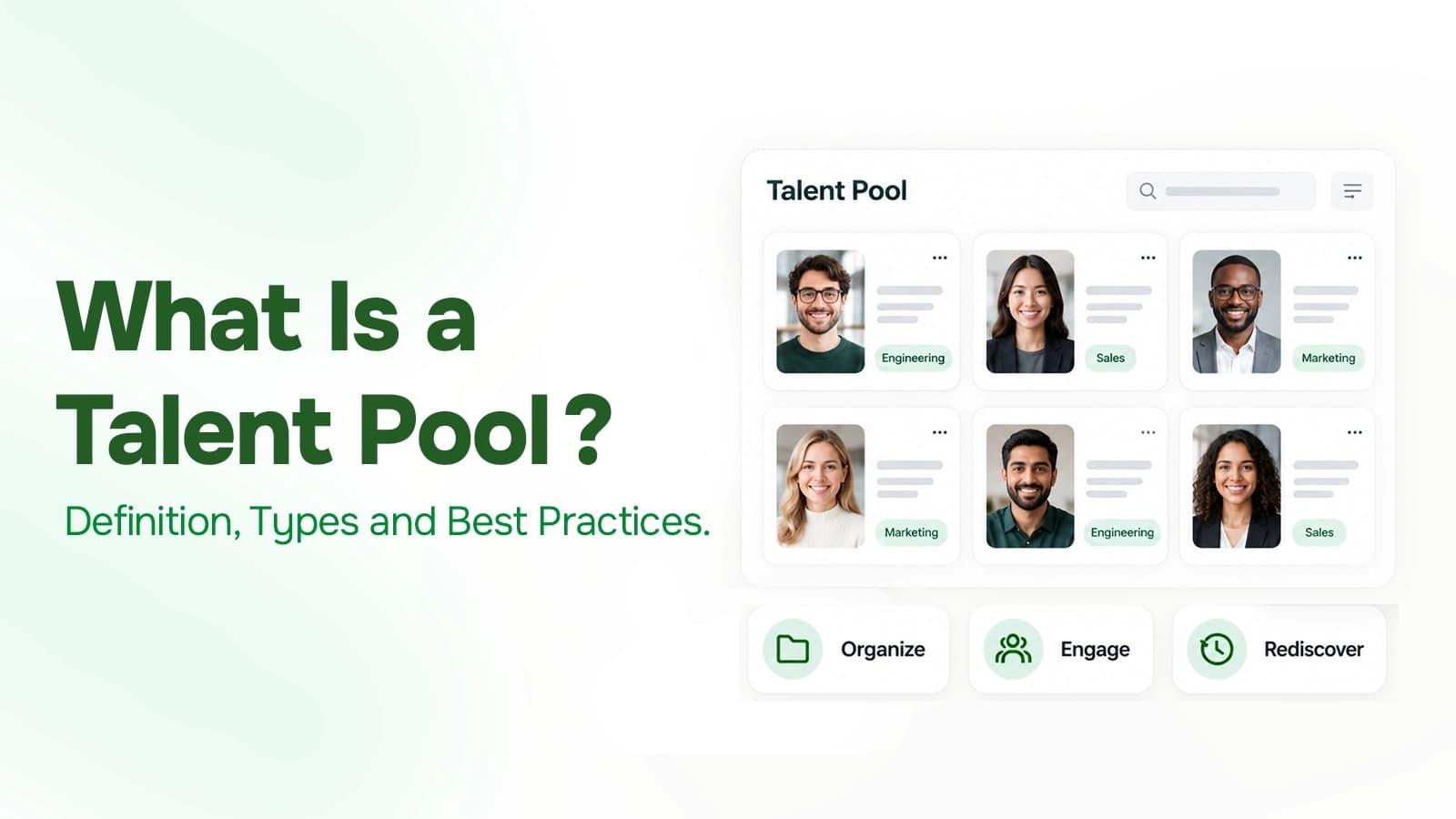
A talent pool is an organized group of potential candidates whose skills, experience or interests match your current or future workforce needs.
It gives you a searchable source of people you can revisit instead of beginning every recruitment campaign with an empty shortlist.
Your pool can include previous applicants, passive candidates, sourced professionals and internal employees.
This broader reach matters because passive candidates represent an estimated 39% of available talent, according to Achievers Workforce Institute.
A useful talent pool is more than a folder of old résumés. It contains current candidate details, previous interactions, and meaningful skill-based segments.
LinkedIn reports that skills-based hiring can expand potential talent pools by up to 10 times, helping recruiters identify qualified people who may be overlooked when searches rely mainly on job titles, degrees or previous employers.
The strongest pools keep this information current and preserve candidate relationships, making it easier to reconnect when a suitable role becomes available.
How a Talent Pool Differs From a Talent Pipeline
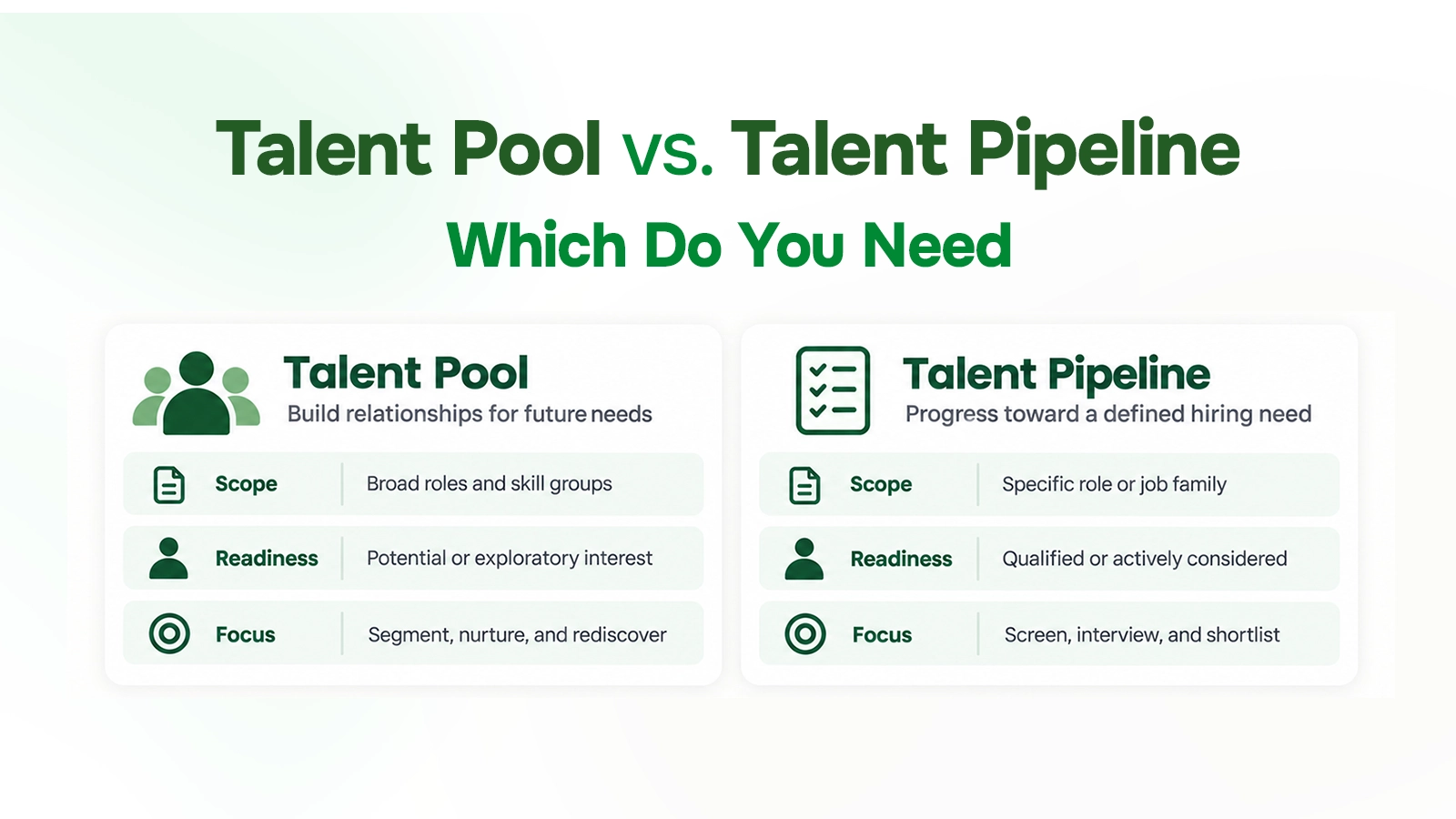
The distinction below explains how a talent pool and talent pipeline support different stages of your recruitment strategy.
A talent pool is a broad group of people who could fit future opportunities, while a talent pipeline contains candidates moving toward a particular role, job family or planned requirement.
Someone can remain in your pool for months and enter a pipeline when an appropriate vacancy becomes available.
The following table compares the two concepts by purpose, scope, timing and candidate readiness.
Comparison Area | Talent Pool | Talent Pipeline |
Main purpose | Preserve access to potential candidates | Move candidates toward a defined hiring need |
Scope | Broad roles, departments or skill categories | A specific role, job family or vacancy |
Candidate status | Interested, sourced or previously assessed | Contacted, qualified or actively considered |
Time horizon | Medium- to long-term | Current or near-term |
Typical activity | Segmentation, nurturing and rediscovery | Screening, interviewing and shortlisting |
Candidate commitment | May be low or exploratory | Usually opportunity-specific |
Which Talent Pools Should You Create?
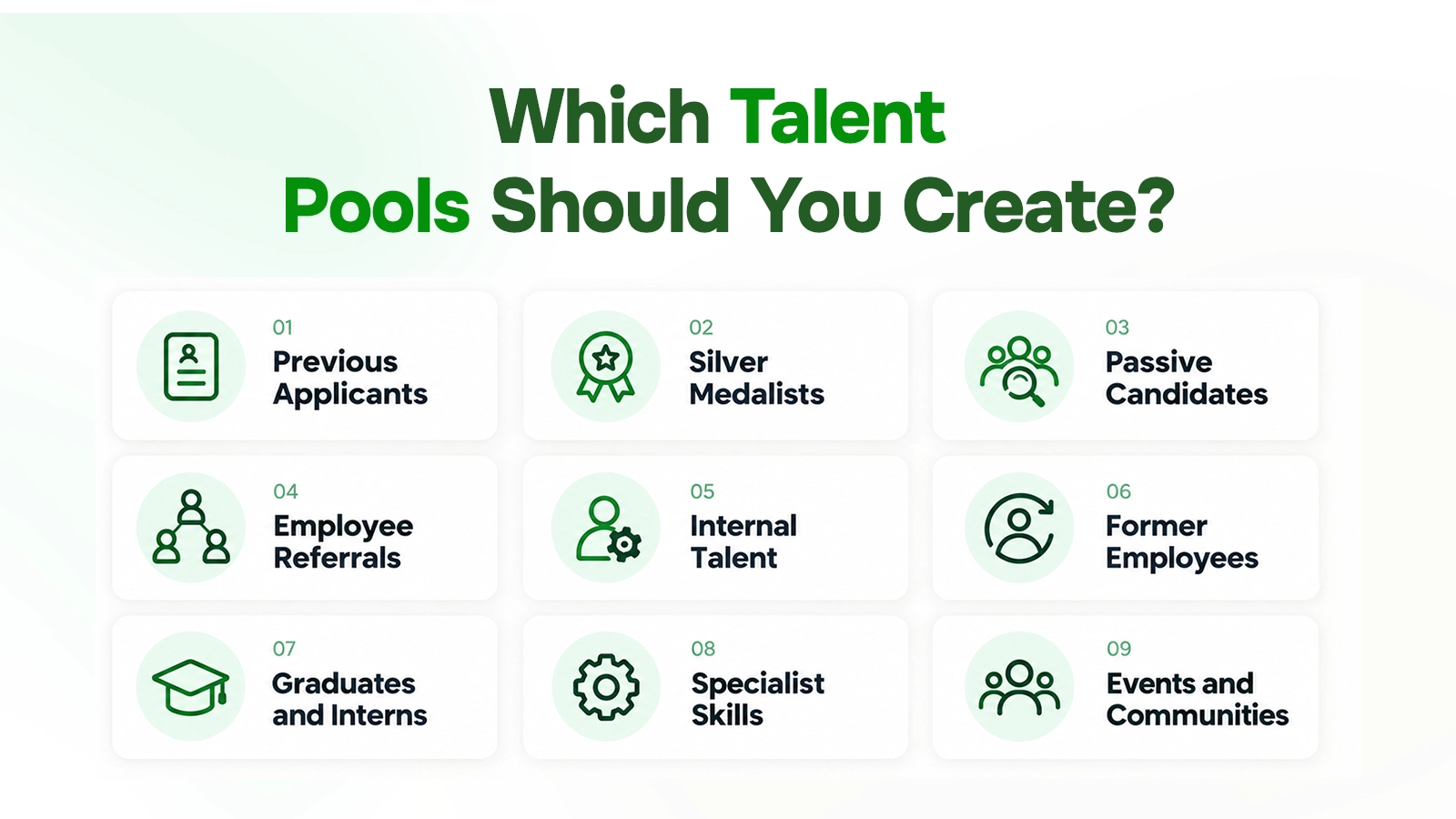
You can create talent pools around the skills, relationships and workforce needs that are most relevant to your organization.
The following types help you organize people according to how you found them and how they support future hiring.
Previous applicant pool: This group includes people who applied before and may fit another role, even when they were not selected initially.
Silver-medalist pool: These are strong finalists who reached an advanced stage but lost to another qualified candidate.
Passive candidate pool: This group contains professionals who are not actively applying but would consider a suitable future opportunity.
Employee referral pool: These candidates enter through recommendations and already understand part of your organization or culture.
Internal talent pool: Current employees with transferable skills or development potential can support internal mobility and succession planning.
Former employee pool: Alumni who left on good terms may return with additional experience, skills or industry knowledge.
Graduate talent pool: Students, interns and recent graduates can support recurring entry-level or development programs.
Specialist skill pool: You can group people with difficult-to-find skills, technologies, certifications, industries or languages.
Event and community pool: People you meet through webinars, career fairs and professional groups show relevant interest before a vacancy exists.
You do not need a separate pool for every candidate source. Choose categories that reflect your recurring hiring needs, then use tags and filters for more detailed segmentation.
You should also review whether your criteria exclude capable candidates unnecessarily. A skills-focused approach can widen your pool beyond people with a particular job title, employer or educational background.
“The current, mainstream hiring process is not particularly well-designed to find talent.”— Johnny Campbell, CEO and Co-Founder, SocialTalent
Why Talent Pools Matter for Smarter and Faster Hiring
A well-managed talent pool helps you respond to hiring needs with more context, stronger relationships and less duplicated sourcing work.
The following benefits show how a structured pool can improve immediate recruitment and longer-term workforce planning.
You can begin with known candidates: Instead of searching only through external channels, you can rediscover people who have already applied, engaged, or been assessed.
You preserve previous recruitment work: Interview notes, evaluations and conversations remain useful when another suitable role becomes available.
You can reconnect with strong finalists: Silver-medalist candidates require less initial qualification because you already understand their strengths and suitability.
You can engage passive candidates gradually: Relevant communication gives people time to understand your organization before you approach them about a specific role.
You can support recurring hiring: Pools are particularly useful when you repeatedly recruit for similar positions, departments, locations or skill sets.
You can improve succession planning: Internal pools help you identify employees who could develop into business-critical or leadership roles.
Silver-medalist candidates are especially valuable because they have already invested time in your hiring process and passed several evaluation stages.
However, previous qualification does not mean someone is still available or interested. You need to check their current goals, experience, and expectations before moving them into a new shortlist.
Your ability to re-engage candidates also depends on how they remember your organization. Clear communication and credible employer branding make candidates more likely to recognize the value of a future opportunity.
“Silver medalists sitting in your applicant tracking system [ATS] have already been pre-vetted. They are clearly qualified.”— Shannon Pritchett, Head of Marketing and Community, hireEZ
Keep Every Interview Note for Next Time
Past evaluations stay on each profile, ready when a new role opens.
What Goes Into a Strong and Searchable Talent Pool?
A useful talent pool combines relevant people with accurate information about their skills, interests, history and potential fit.
The following subsections explain which candidate groups you can include and what information you should retain.
1. Candidate Sources
You can build a talent pool from several recruitment channels while recording each candidate's source and future relevance.
The following sources can help you create a balanced pool rather than depending on a single recruitment channel:
Previous applicants and interview finalists
Sourced passive professionals
Employee referrals
Career fair and recruitment event contacts
Internship and graduate programme applicants
Professional communities and networking groups
Former employees and contractors
Current employees interested in internal opportunities
People who submit speculative applications
A structured candidate sourcing strategy helps you determine which channels should feed your pool.
Additionally, passive candidate sourcing can expand your reach beyond active applicants, especially for difficult-to-fill roles.
2. Candidate Information
Candidate records should provide enough context for hiring decisions without collecting unnecessary personal information.
The following information can make profiles easier to search, assess, and update:
Name and reliable contact details
Location and work authorization where relevant
Skills, experience and qualifications
Preferred roles or job families
Candidate source and date added
Previous applications and interview outcomes
Recruiter notes and evaluation history
Communication preferences
Previous engagement and follow-up history
Consent, privacy-notice status and retention date
Candidate data must remain accurate, limited, and legally managed.
The UK Information Commissioner’s Office explains in its recruitment and data-protection guidance that organizations must protect candidate rights when collecting, retaining and deleting recruitment information.
A large candidate database is not automatically a useful talent pool. Its value comes from relevant, current, and searchable records that help you make informed hiring decisions.
How to Build a Talent Pool That Supports Future Hiring
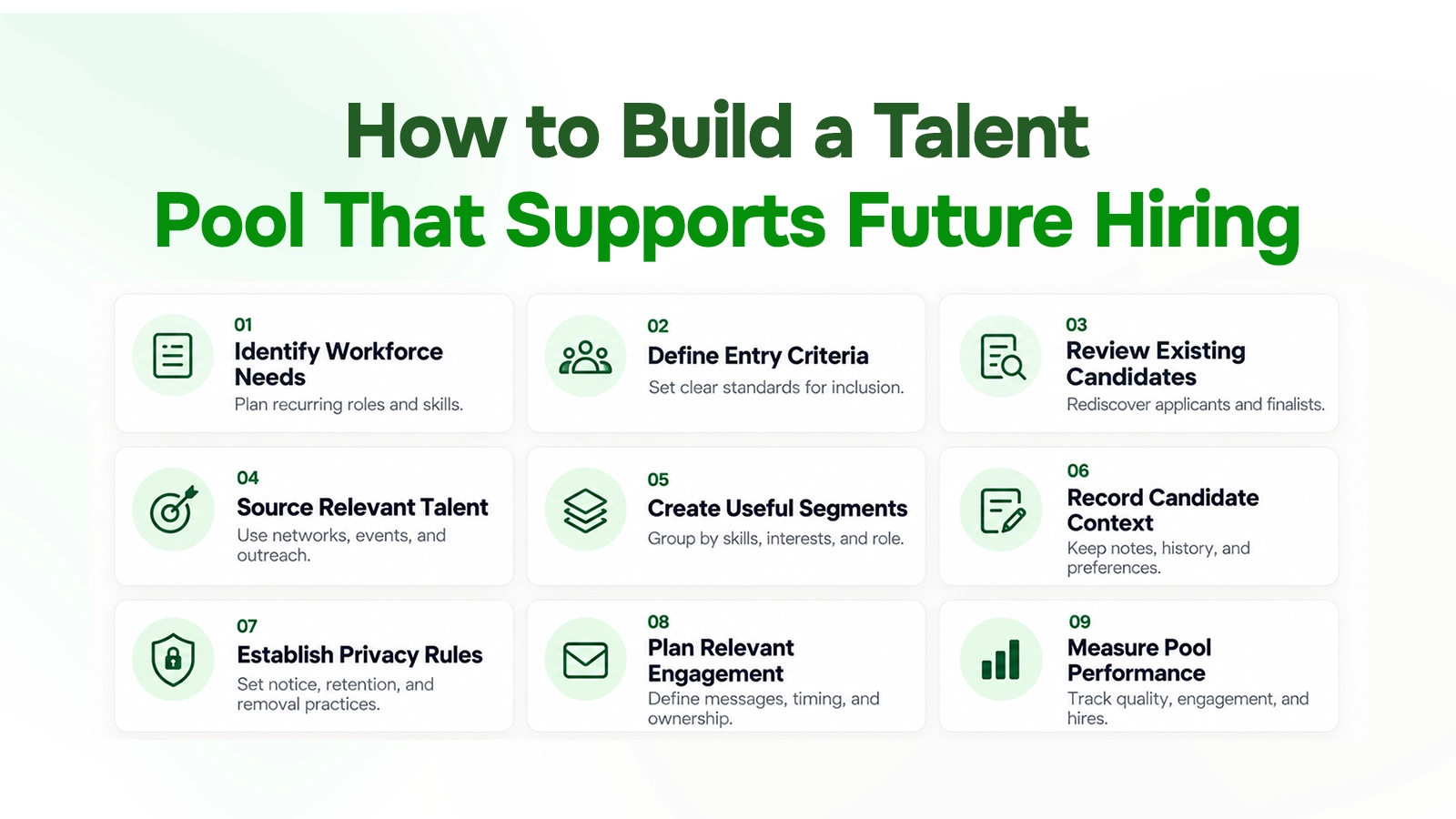
You build a talent pool by defining future workforce needs, identifying relevant sources, and organizing candidate information for meaningful reuse.
The following steps provide a practical structure you can adapt to your recruitment priorities.
Identify recurring workforce needs: Review the roles, skills, departments and locations you recruit regularly or expect to need later.
Define pool entry criteria: Decide what makes someone relevant enough to include, such as skills, experience, assessments or demonstrated interest.
Review your candidate database: Begin with previous applicants, shortlisted candidates, referrals, and people who reached advanced interview stages.
Add people through active sourcing: Use professional networks, events, communities and targeted outreach to expand beyond existing records.
Create useful segments: Group people by job family, skills, seniority, location, interests or availability rather than placing everyone in one list.
Record candidate context: Save previous interactions, evaluations and preferences, so future outreach does not feel disconnected.
Establish privacy rules: Define how you provide notices, update records, manage preferences, and remove information you no longer need.
Create an engagement plan: Decide what you will communicate, how often you will contact each segment and who owns the relationship.
Measure pool performance: Track profile quality, engagement, rediscovery, shortlist movement and hires connected to the pool.
For a more detailed implementation process, use this guide on how to build a talent pool to turn these steps into a repeatable workflow.
Turn Your Candidate Database into Searchable Pools
Create custom pools, tag candidates by skill, and find them anytime.
Explore Talent PoolHow to Manage and Nurture a Talent Pool
Managing a talent pool means keeping candidate information useful while maintaining relevant relationships over time.
The practices below help you keep candidates engaged without sending generic messages that make your pool feel like a mailing list.
Segment before communicating: Send vacancies and updates according to role interests, skills, location, seniority or career stage.
Respect candidate preferences: Let people control the types of communication they receive and make it easy to update those preferences.
Provide relevant value: Share suitable vacancies, events, career resources, or company updates that match the candidate segment.
Use previous context: Refer to earlier conversations or applications when appropriate, so candidates understand why you are contacting them.
Keep records current: Ask candidates to update major changes in experience, availability, location, or job interests.
Reassess candidate fit: Someone who was unsuitable two years ago may now have new skills, and an old record may no longer reflect their goals.
Coordinate recruiter ownership: Record who contacted each person, what was discussed and what follow-up was agreed.
Remove outdated information: Delete or anonymize records when you no longer have a valid reason to retain them.
These practices work best when communication feels relevant to the individual rather than automated for the entire talent pool.
Personalized outreach helps candidates understand why they are being contacted and is more likely to feel useful than a generic message.
The value of this approach is supported by LinkedIn’s outreach analysis. Based on tens of millions of recruiter InMails sent between May 2021 and April 2022, LinkedIn found that individually sent InMails achieved response rates approximately 15% higher than bulk InMails.
Technology can support these activities, but it cannot replace thoughtful candidate relationships.
The way you keep candidates engaged also shapes the broader candidate experience.
Even when no vacancy is available, relevant and honest communication influences whether someone remains interested in your organization.
“The best way to build your talent pipeline is to care about your candidates. Every single one of them.”— Elizabeth Onishuk, Former Talent Acquisition Manager, Workable
How Software and Tools Help You Manage Talent Pools
Talent pool software helps you centralize candidate profiles, segment groups, preserve interaction history, and move suitable people into active recruitment workflows.
The following capabilities help you distinguish an effective system from a spreadsheet or disconnected resume archive:
Searchable and filterable candidate profiles
Custom talent pools, tags and segments
Application, assessment and interaction history
Duplicate-record management
Targeted candidate communication
Scheduled follow-ups and reminders
Candidate consent and preference records
Movement between pools, vacancies and pipelines
Recruiter notes and team collaboration
Engagement and sourcing reports
Together, these capabilities make talent pool management software more useful than static files or isolated candidate records.
The right system should help recruiters maintain accurate records, find suitable candidates quickly, and connect talent pools with the wider recruitment workflow.
As an Applicant Tracking System, Mercury Recruit brings candidate records, talent pools and recruitment communication into one platform.
You can manually add candidates to the talent pool, giving them control over how profiles are categorized and organized.
Once added, you can preserve previous notes and evaluations and move suitable candidates into active roles without recreating their profiles.
Build a Ready-to-Engage Candidate Database
Organize, re-engage, and move promising candidates into new roles.
Book A DemoCommon Talent Pool Mistakes to Avoid for Better Hiring Results
Talent pools lose value when candidate records accumulate without clear ownership, segmentation, or an engagement purpose.
The following mistakes can turn a useful recruitment resource into an outdated candidate archive.
Adding everyone without entry criteria: An oversized pool makes it harder for recruiters to identify suitable candidates and reduces confidence in the quality of the records.
Treating the pool as static storage: Saving resumes without updating, segmenting or contacting people does not create an engaged talent community.
Using vague categories: Labels such as “good candidate” do not explain someone’s skills, interests, seniority or possible role fit.
Contacting candidates only when you need them: One-sided communication makes your relationship feel transactional.
Sending identical messages to every segment: Generic outreach ignores differences in skills, goals, location, and readiness.
Ignoring previous interactions: Asking people to repeat information they have already provided creates unnecessary friction.
Keeping candidate data indefinitely: Old records increase privacy risk and cause recruiters to rely on inaccurate information.
Failing to assign ownership: Without responsibility, communication can become inconsistent, duplicated, or completely absent.
Measuring only pool size: A smaller pool that produces conversations and qualified shortlists is more useful than a large inactive database.
The following table shows the measurements you can use to evaluate whether your pool is supporting recruitment outcomes.
Measurement | What It Shows | Practical Use |
Profile completeness | Whether records contain useful information | Identify profiles that need updating |
Valid contact rate | Whether candidates can still be reached | Remove or correct outdated details |
Response rate | Whether communication remains relevant | Improve messaging and segmentation |
Rediscovery rate | How often previous candidates are reconsidered | Measure reuse of existing recruitment work |
Shortlist conversion | How often pool candidates reach a shortlist | Evaluate candidate quality |
Pool-sourced hires | How many hires originated from the pool | Measure direct recruitment value |
You should review these measurements together rather than using one figure in isolation.
A growing database has limited value if recruiters cannot find suitable candidates, contact them, or move them into active hiring processes.
Conclusion
A talent pool gives you a structured way to maintain relationships with people who could support future hiring needs.
It becomes valuable when you define who belongs in it, preserve useful context, and keep communication relevant.
Start by identifying recurring roles and skills, then review the qualified people already present in your candidate database. Segment those records, assign ownership, and establish clear engagement and retention practices.
As your pool develops, measure more than its total size. Profile quality, candidate responsiveness, rediscovery, shortlist movement and pool-sourced hires will show whether it is helping you recruit more effectively.
FAQs
Frequently Asked Questions
A talent pool in recruitment is an organized database of people who fit current or future opportunities.