
Steps to Choose the Right Applicant Tracking System for Your Business
Recruit
How to
9 min read
Key Highlights
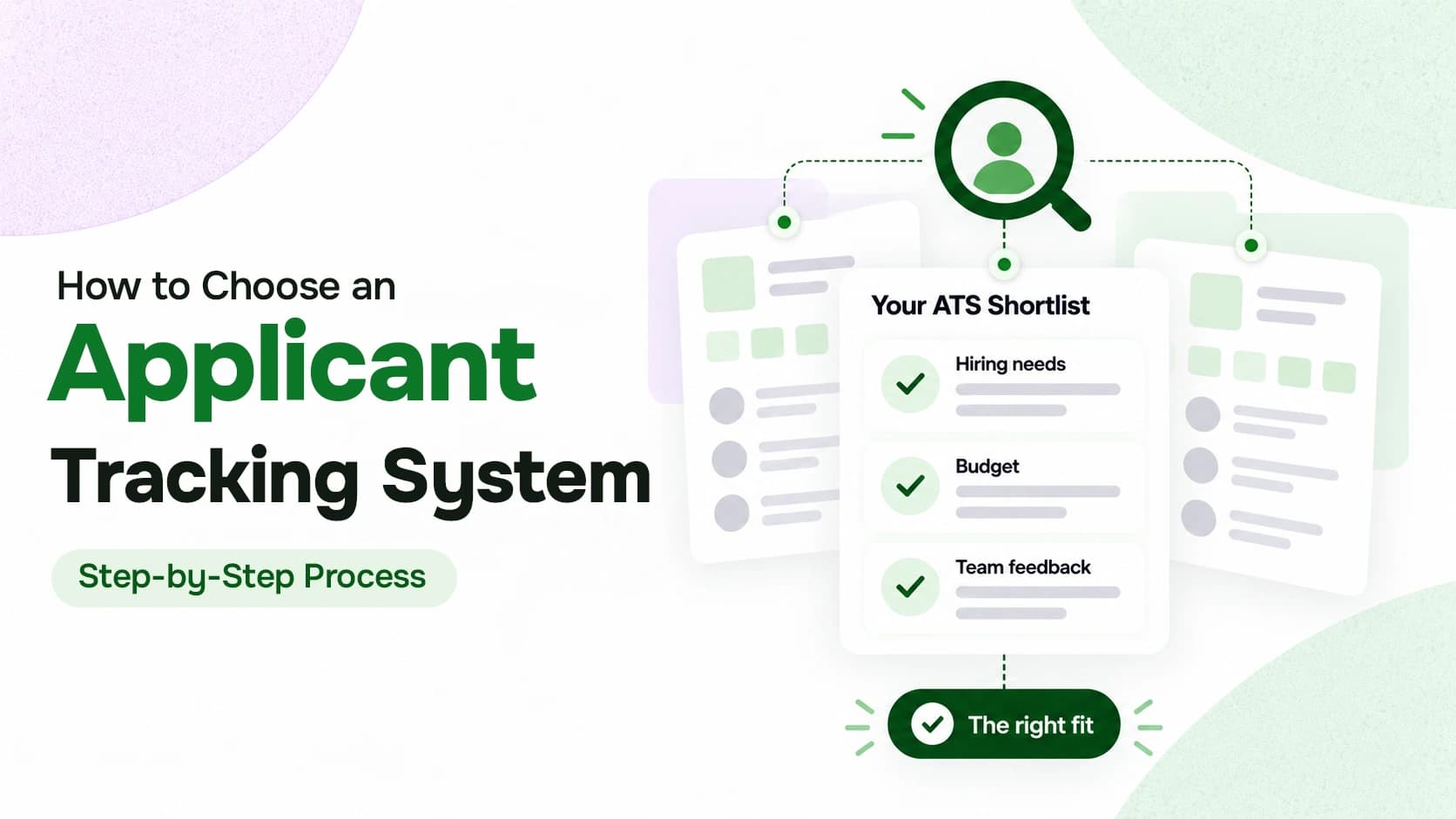
Choosing the right ATS starts with understanding your hiring needs, budget, and future growth.
Evaluate ATS platforms based on features, pricing, integrations, scalability, compliance, and user experience.
Demos, free trials, and team feedback help you choose the right platform with confidence.
The right ATS improves hiring efficiency, collaboration, candidate experience, and long-term recruitment success.
A structured selection process helps you avoid costly mistakes and invest in the right ATS.
Introduction
Most companies spend weeks evaluating Applicant Tracking Systems (ATS), pick one that looks good in a demo, and then spend the next year working around its limitations.
Part of the problem is that not all ATS platforms are built the same. Some are designed for large enterprises with complex hiring processes, while others are better suited for startups, small businesses, and growing teams.
The real issue is not the software; it is the process of choosing it. Without a clear framework, it is easy to get distracted by flashy features you will never use and underestimate what your team actually needs.
This guide will walk you through exactly how to choose an applicant tracking system, what to look for in an ATS, and the key factors that help you make the right investment for your business.
Why Choosing the Right ATS Matters?
An ATS is recruiting software that manages your entire recruitment process from one platform. It handles job posting, application collection, resume parsing, candidate pipeline management, interview scheduling, team collaboration, and recruitment analytics.
But choosing an ATS is not just a software decision; it directly affects how fast you hire, how well your team collaborates, and how much your recruitment process costs over time.
Imagine your business receiving 200 applications for a single role. Without an ATS, recruiters may spend hours manually reviewing resumes, tracking applicants in spreadsheets, and coordinating interviews through email.
With the right ATS, candidate sourcing, resume screening, interview scheduling, and candidate pipeline management happen with a structured workflow.
Here is why getting the right ATS matters:
Faster hiring
Lower recruitment costs
Better candidate experience
Stronger team collaboration
Long-term scalability
The right ATS makes hiring something your business is genuinely good at. The wrong one creates poor adoption, missed candidates, and an eventual platform switch that costs time and money you did not plan for.
How to Choose Applicant Tracking System: Step-by-Step Process
Choosing an ATS becomes much easier when you have a clear process to follow.
Instead of comparing numerous platforms at once, these steps help you narrow down your options based on what actually matters for your business.
Step 1: Understand Your Current Hiring Needs
Before you start comparing platforms, get clear on what challenges you’re trying to solve.
Ask yourself:
How many roles do you typically hire each year?
How many applications do you receive per position?
Who is involved in the hiring process?
Which recruitment tasks consume time?
Your answers will tell you what problems you actually need to solve. If recruiters spend hours manually reviewing resumes and candidate screening, then workflow automation should be a priority.
If communication delays are the main issue, look for tools that improve collaboration and candidate engagement.
The clearer your hiring goals are, the easier it becomes to evaluate ATS options.
Step 2: Identify Your Must-Have Features
Once you know your challenges, translate them into the features your ATS needs to have.
Common ATS features:
Candidate pipeline management
Interview scheduling
Hiring manager collaboration
Job board distribution
Then, separate the common features into two categories:
Must-have features: essential for your hiring process
Nice-to-have features: useful but not critical
This helps you focus on practical business needs rather than getting distracted by features you’ll rarely use.
Check Mercury Recruit Against Your Must-Haves
Candidate sourcing, resume parsing, workflow automation, and reporting, built for growing teams.
See the FeaturesStep 3: Know Your Budget and What You Are Really Paying For
ATS pricing varies widely; some platforms charge per user, some per job posting, some as a flat monthly fee.
Understanding the pricing model matters as much as the number itself.
Before you commit, keep these in mind:
Hidden costs: Always ask what is included in the base price. Integrations, reporting, and additional users often cost extra.
Pay-per-job pricing: Works for low-volume hiring but becomes expensive if you are hiring multiple roles at once.
Scalable plans: Make sure pricing grows reasonably with your business, not dramatically.
Free trials: Always use them. A platform that looks great in a demo feels very different in real use.
Step 4: Evaluate Integration Requirements
ATS does not work in isolation. It needs to connect with the tools your team already relies on. Therefore, before committing to a platform, ensure it integrates with:
Job boards you use for candidate sourcing tools
Your HRIS (Human Resource Information System) or HR (Human Resource) management platform
Communication tools like Slack, Microsoft Teams, or email
Calendar tools for interview scheduling
Assessment platforms if you use skills testing in your hiring process
Onboarding software for a smooth transition from hire to employee
Step 5: Consider Scalability and Future Growth
The ATS you choose today should support your business several years from now.
Many organizations select software based only on current hiring needs and later discover that the system struggles to support larger teams or higher recruitment volumes.
Think about your future plans:
Will hiring increase significantly?
Are you expanding into new locations?
Will additional managers need platform access?
Do you expect to automate more recruitment activities?
Scalable recruiting software grows with your business and reduces the need for expensive system changes later.
Step 6: Review Compliance and Data Security
Your ATS stores sensitive candidate information such as personal details, resumes, assessment results, and communication history. That comes with legal responsibilities you cannot ignore.
Make sure the platform you choose:
Complies with GDPR and data compliance relevant to your region
Has clear data retention and deletion policies for candidate records
Provides audit trails so hiring decisions can be documented and justified
Stores data securely with proper access controls and encryption
Step 7: Understand the Data Migration Process
If you are switching from an existing ATS or moving data from spreadsheets, you need to plan for data migration.
A smooth migration process saves significant time and prevents valuable candidate information from being lost.
Step 8: Request Demos and Free Trials
A demo shows you what a platform can do. The best way to evaluate an ATS is to see it in action. During demos or free trials, test common tasks such as:
Creating job postings
Reviewing applications
Scheduling interviews
Sharing candidate feedback
Generating reports
Test Mercury Recruit with Your Own Hiring for 15 Days
Create job postings, review applications, and schedule interviews.
Step 9: Assess User Experience and Adoption
ATS only delivers value if your team uses it consistently. Poor user experience leads to low adoption, which means the same hiring problem.
Therefore, look for a platform that feels intuitive and requires minimal training.
Step 10: Make Your Final Decision
By this point, you have defined your needs, evaluated features, checked integration, reviewed compliance, tested the platform, and gathered your team’s feedback. Now it’s time to decide.
A thoughtful selection process today saves your time, money, and hassle in the future.
Tips to Select the Right ATS for Your Business
Once you have followed the above steps, keep these in mind before making your final decision:
Involve your Team Early: The people who will use the ATS every day, recruiters, hiring managers, and HR, should be comfortable with the platform before making the final call. They will spot practical issues, provide a top-down evaluation of gaps, and early buy-in leads to better adoption once the platform is live.
Take Advantage of Demos and Free Trials: Take full advantage of demos and free trials before committing to an ATS. A demo shows what the platform can do, while a free trial reveals whether your team will actually use it. Test it with real hiring scenarios, involve daily users, and pay close attention to where friction arises.
Compare Value, not Just Price: The cheapest ATS is rarely the most cost-effective option. A platform that saves your recruiters hours each week, shortens time-to-hire, and scales with your business delivers measurable value, even with a higher cost. Evaluate what you gain, not just what you spend.
Read the Contract Carefully: Understand the minimum commitment period, what happens to your data if you leave, and what the renewal terms look like. These details matter more than most buyers realize until it is too late.
Look at the Support Experience, Not Just the Product: Even the best software can run into issues. When it does, the vendor’s response time and effectiveness matter. Evaluate available support channels, typical response times, and customer feedback. Good support matters more than buyers realize, until something goes wrong.
Think about Onboarding and Implementation: Getting started with a new ATS shouldn’t feel like a project of its own. Before committing, ask the vendor about setup time, onboarding support, and whether technical assistance is required. The goal is to get hiring quickly, not spend months figuring out how the system works.
Built for Teams That Want to Hire Well, Not Just Fast
Get a platform your recruiters will actually use, with room to grow as your hiring scales.
Book A DemoConclusion
There is no one-size-fits-all applicant tracking system.
A platform that works perfectly for a large enterprise may be too complex for a growing business, while a basic ATS may not support a company that's planning to scale its hiring efforts.
Therefore, do not rush it, but do not overthink it either. Define what you need, test your shortlist, listen to your team, and commit to the platform that fits where your business is going.
If you follow the steps in this guide, you will not just find an ATS that works; you will find one that fits.
FAQs
Frequently Asked Questions
The most valuable ATS features include candidate management, interview scheduling, workflow automation, analytics, integrations, and compliance tools.