
Applicant Tracking System Pricing: What an ATS Really Costs in 2026
Recruit
Applicant Tracking System
11 min read
Key Highlights
ATS pricing isn't standardized; similar tools can cost wildly different amounts depending on size, hiring volume, and features.
ATS pricing ranges from free or $20/month for small teams to $10,000 - $50,000+ / year for large enterprises
Five pricing models shape your cost: pay-per-user, pay-per-vacancy, headcount-based subscription, and quote-based
The advertised fee is rarely the full cost, as setup, data migration, add-ons, and support all add to the total cost of ownership.
15 top ATS tools compared by pricing model, cost range, and best-fit use case.
Mercury Recruit offers transparent tiered pricing: Starter ($150), Standard ($209), and Premium ($419) per month.
Introduction
Choosing an applicant tracking system is not just about features. It is a cost decision that affects hiring speed, recruiter workload, and long-term recruitment efficiency.
ATS pricing is not simple; two tools that look similar can have very different pricing based on users, hiring volume, features, and support. Some charge a flat monthly fee, while others add costs for setup, integrations, or extra usage.
This makes it harder for businesses to choose right ATS. So, either they overspend on features they do not need or choose a cheaper system that fails when hiring demand grows. Therefore, this guide breaks down the ATS pricing for you to estimate the real cost, not just the advertised price.
How Much Does an ATS Typically Cost
ATS pricing usually ranges from free or around $20 per month for small businesses to $10,000 to $50,000+ per year for large enterprises. There is no single fixed price, as the cost depends on company size, hiring needs, and features.
1. Small Businesses and Startups
For smaller businesses or startups with 1 to 50 employees, ATS pricing usually starts from basic plans that are either free or around $20 to $150 per month. These plans often include limited job postings, basic candidate tracking, and a small number of users.
Budget is only half the decision — compare the best ATS for small business to see what each price tier actually includes.
2. Growing and Mid-Sized Teams
For growing and mid-sized teams with 50 to 250 employees, the cost typically ranges from $150 to $800 per month. These systems usually include more advanced features like automation, integrations with job boards, reporting dashboards, and higher user limits.
3. Large Enterprises
For large enterprises with 250 or more employees, ATS pricing is often custom and can range from $10,000 to $50,000+ per year depending on scale. These systems are built for complex hiring structures, multiple departments, compliance needs, and high-volume recruitment.
Enterprise pricing tracks complexity, not headcount alone — our guide to enterprise applicant tracking systems covers what actually drives a custom quote.
Cost Comparison of Top ATS
ATS pricing is not standardized, and most vendors do not publish fixed rates. Some offer clear subscription plans, while others only provide custom quotes based on company size, hiring volume, and required features. The table below compares how the top tools are priced, along with their typical cost range.
ATS | Pricing Model | Typical Cost Range | Best For |
Tiered subscription | $150 to $419 per month (custom for enterprise) | Startups to high-volume teams | |
Subscription based | $360 to $719+ per month | Small to mid-sized teams | |
Quote based | Custom pricing | Mid-sized and enterprise companies | |
Quote based | Custom pricing depending on scale | Fast growing organizations | |
Tiered subscription | $0 to $75 per user/ month | Small businesses and startups | |
Employee based pricing | $10 to $25 per user/ month | Companies using HR suites | |
Tiered subscription | $350 to $549 per month | Small businesses on a budget | |
Tiered subscription | $0 to $529 per month | Small teams wanting a free tier | |
Tiered Subscription | Custom pricing | Growing teams focused on collaboration | |
Manatal | Tiered subscription | $15 to $55 per user/month | Small teams and recruitment agencies |
Note: ATS pricing changes often, so confirm current rates on each vendor's page before deciding.
Price is one column of many, see the best applicant tracking systems in 2026 compared on features, not just cost.
See Where Mercury Recruit Fits on Price
Compare plans built for teams your size.
Common ATS Pricing Models
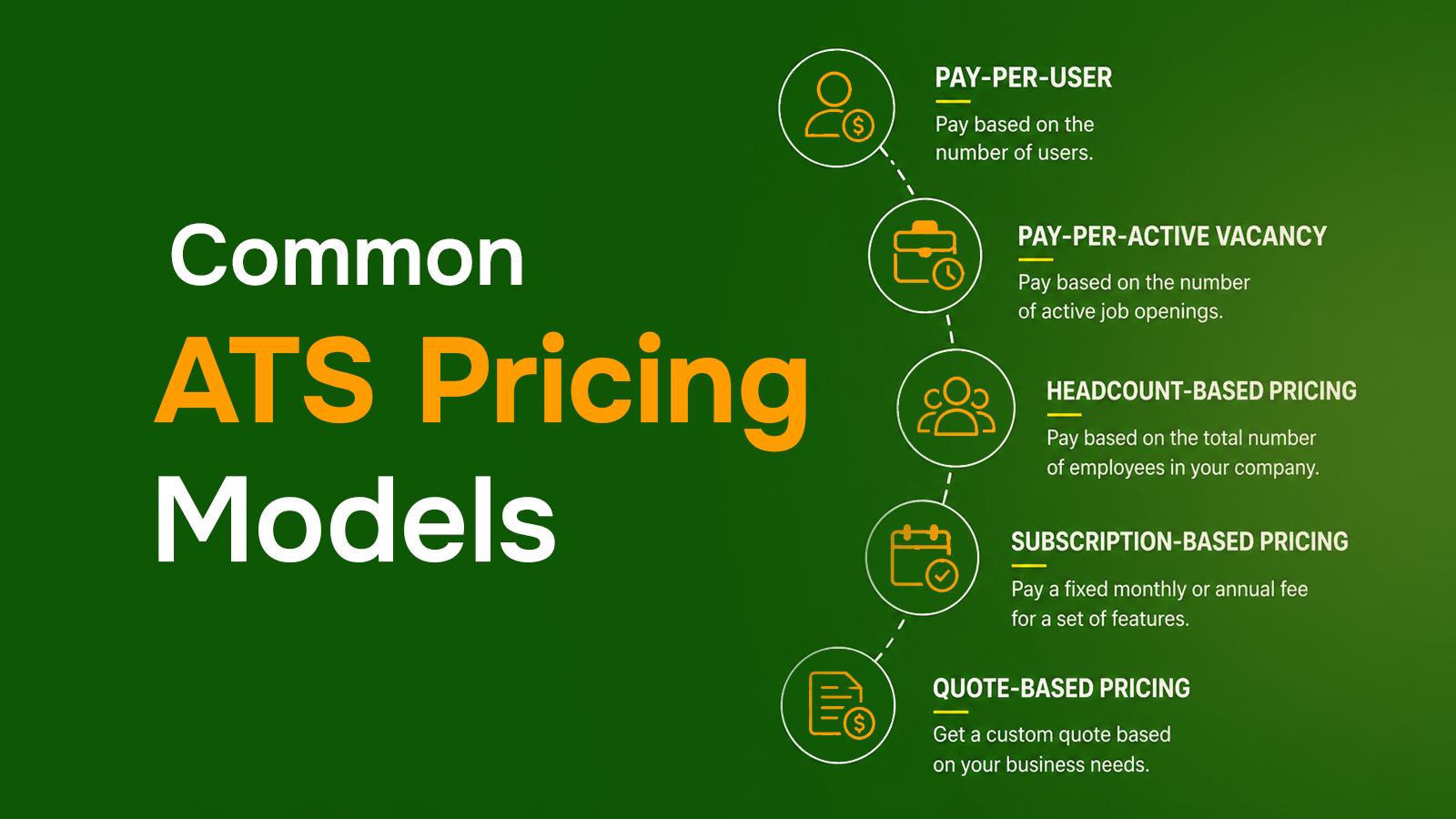
Applicant tracking systems use different pricing models depending on how the software is structured and the type of customers they serve. These pricing models directly impact how much a company pays overtime, so understanding them is important before choosing a system.
1. Pay-Per-User Pricing
In this model, companies are charged based on the number of users who access the system. Each recruiter, hiring manager, or HR staff member may require a paid license.
This model is simple and predictable at the start. However, costs can grow quickly as the hiring team expands. It is best suited for small teams that expect stable or slow growth in hiring activity.
2. Pay-Per-Active Vacancy
In this model, pricing is based on the number of active job openings in the system at any given time. This approach is useful for companies that hire in cycles rather than continuously. It allows businesses to pay only when they are actively recruiting.
However, during high hiring periods, costs can increase without warning. Companies with frequent or large-scale hiring may find this model less predictable over time.
3. Headcount-Based Pricing
Here, the cost is determined by the total number of employees in the organization rather than just ATS users. This model is often used by enterprise level companies because it scales in line with company size.
While this model is easier to align with long term growth, it may feel expensive for smaller teams that do not fully use the system across the entire organization.
4. Subscription-Based Pricing
This is one of the most common pricing models in the ATS market. Companies pay a fixed monthly or annual fee in exchange for access to a set of features and usage limits.
Subscription based pricing is popular because it is easy to budget and does not change frequently. The main advantage of this model is its predictability, and limitation is that essential features are sometimes locked behind higher priced plans.
5. Quote-Based Pricing
In this model, there is no public pricing available. Businesses must contact the vendor to get a custom quote based on their requirements.
Pricing is usually determined by factors such as company size, hiring volume, number of users, required integrations, and level of support. This model is common in enterprise ATS platform where hiring processes are complex and require customization.
What Factors Affect ATS Pricing
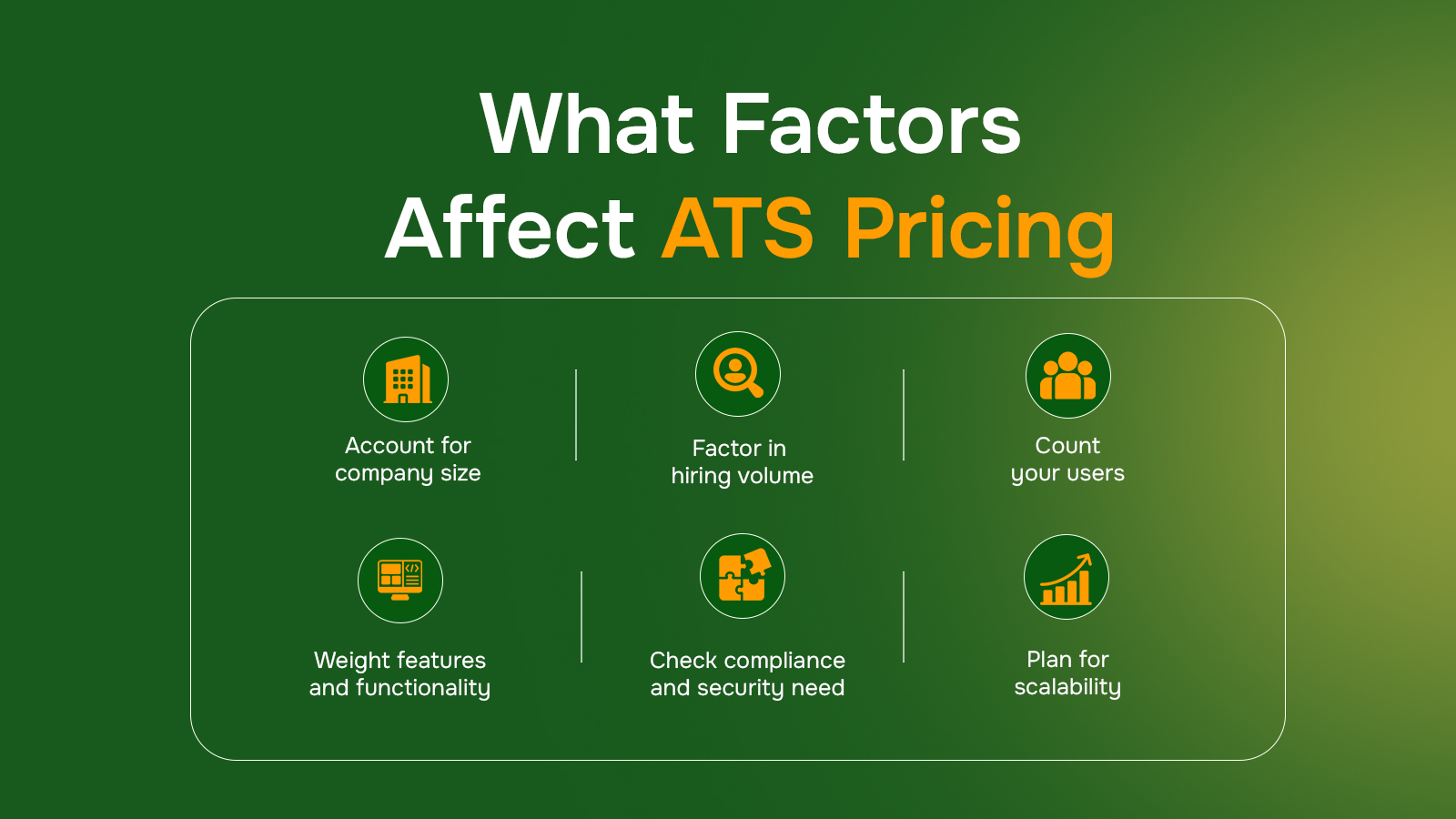
ATS pricing can vary significantly between vendors because every organization has different hiring needs. While some businesses only need basic candidate tracking, others require advanced automation, analytics, and enterprise-level functionality. A few key factors that drive the difference are mentioned below:
Account for company size: Larger organizations typically require more users, more complex workflows, and greater system capacity, which often leads to higher ATS costs.
Factor in hiring volume: Companies that recruit frequently or manage large numbers of applications usually require more robust systems than organizations with occasional hiring needs.
Count your users: Many ATS providers charge based on the number of recruiters, hiring managers, and HR professionals using the platform. As the user count grows, costs may increase accordingly.
Weight features and functionality: More advanced features mean a higher price. Automation, AI screening, scheduling, and analytics typically cost more than basic candidate tracking and job posting.
Consider customization needs: Organizations with unique hiring processes may require custom workflows, approval structures, or reporting dashboards, which can affect pricing.
Check compliance and security needs: Businesses operating in regulated industries may need additional security features, audit controls, and compliance tools that contribute to overall ATS costs.
Scalability and growth needs: Many companies invest in ATS platforms that can support future growth. Solutions designed to accommodate larger teams, higher hiring volumes, and expanding operations may come at a higher price point.
Hidden Costs to Watch For
When evaluating applicant tracking system pricing, many businesses focus only on the subscription fee and overlook the extras that affect the total cost of ownership (TCO). These extra costs are not part of the base price, but they can raise your total spend significantly.
Check for implementation fees: Some ATS providers charge a one-time fee for setup, workflow configuration, and system onboarding. Larger or more complex setups may cost more.
Ask about data migration: Transferring candidate data, job history, and records from an old system may require additional support and cost depending on complexity.
Budget for training and onboarding: While basic training may be included, advanced or instructor-led onboarding sessions are often paid services, especially for larger teams.
Watch for add-on features: Features like automation, analytics, AI screening, and video interviewing may not be included in the base plan and can increase total cost.
Factor in integrations: Connecting the ATS with HR tools, payroll systems, or assessment platforms may require additional setup or licensing fees.
Account for premium support: Faster support, dedicated account managers, or consulting services are often available only in higher-priced plans.
Consider customization costs: Custom workflows, reports, or system changes may require extra development work and increase implementation costs.
Plan for scaling costs: As companies grow, costs may increase due to more users, higher hiring volumes, or upgraded plans during renewal.
Integration costs depend entirely on what you're connecting. Our guide to ATS integrations covers what to connect and what it typically costs.
Get Pricing With No Surprises
Mercury Recruit shows exact costs upfront | What you see is what you pay.
Get a Custom QuoteHow to Calculate ROI on your ATS Spend
ROI tells you whether an ATS is worth the investment by weighing total benefits against total costs. A common way to calculate it is:
ROI = (Value Gained – ATS Cost) / ATS Cost * 100
On the cost side, add up everything, not just the subscription fee:
Subscription fees
Setup and implementation costs
Training expenses
Add-ons and integrations
This gives you the total cost of ownership rather than the base price alone. On the value side, count the gains the ATS delivers:
Time saved on hiring tasks
Lower recruitment agency costs
Faster hiring process
Improved recruiter productivity
For example, if an ATS costs $6,000 per year and saves $15,000 through reduced hiring effort and agency fees, you ROI is:
ROI = (15,000 – 6,000) / 6,000 * 100 = 150%
This means the business earns $1.50 for every $1 spent on the ATS.
Mercury Recruit Pricing Overview
Mercury Recruit uses a tiered pricing structure designed to accommodate different hiring needs, from small teams to larger organizations. It offers three standard plans with transparent monthly pricing, plus a custom Enterprise option.
Plan | Price (Per month) | Best suited for | What’s included |
Starter | $150 | Startups and small teams | Core ATS capabilities for managing job postings, candidates, and essential recruitment workflows |
Standard | $209 | Growing hiring teams | More hiring capacity and advanced automation for managing larger and more active recruitment workflows |
Premium | $419 | Larger and high-volume teams | Advanced recruitment capabilities, analytics, AI functionality, and greater control for complex hiring needs |
Enterprise | Custom pricing | Organizations with complex or high-volume hiring | A customized setup based on the organization’s scale, hiring requirements, and other business needs |
The three standard plans provide a clear progression as hiring needs become more complex. Starter focuses on core applicant tracking, while Standard adds greater capacity and automation. Premium is designed for organizations that need more advanced capabilities and control, while Enterprise provides a customized option for larger or more complex hiring operations.
Ready to See Exact Pricing for Your Team?
Talk to us and get a plan recommendation based on your hiring volume.
Book A DemoConclusion
Applicant tracking system pricing can vary significantly depending on company size, hiring volume, features, and the pricing model used by the vendor. When evaluating ATS pricing, it is important to look beyond the advertised fee and focus on factors like implementation cost, data migration, add-on features, and long-term scalability.
Understanding these expenses upfront helps businesses build an accurate recruitment budget and avoid unexpected costs later. The best ATS platform isn’t the cheapest; it is the one that delivers the strongest return and grows with you.
Mercury Recruit offers transparent, tiered pricing built to do exactly that. Sign up for 15-day free trial and learn how it improves the overall hiring cycle.