
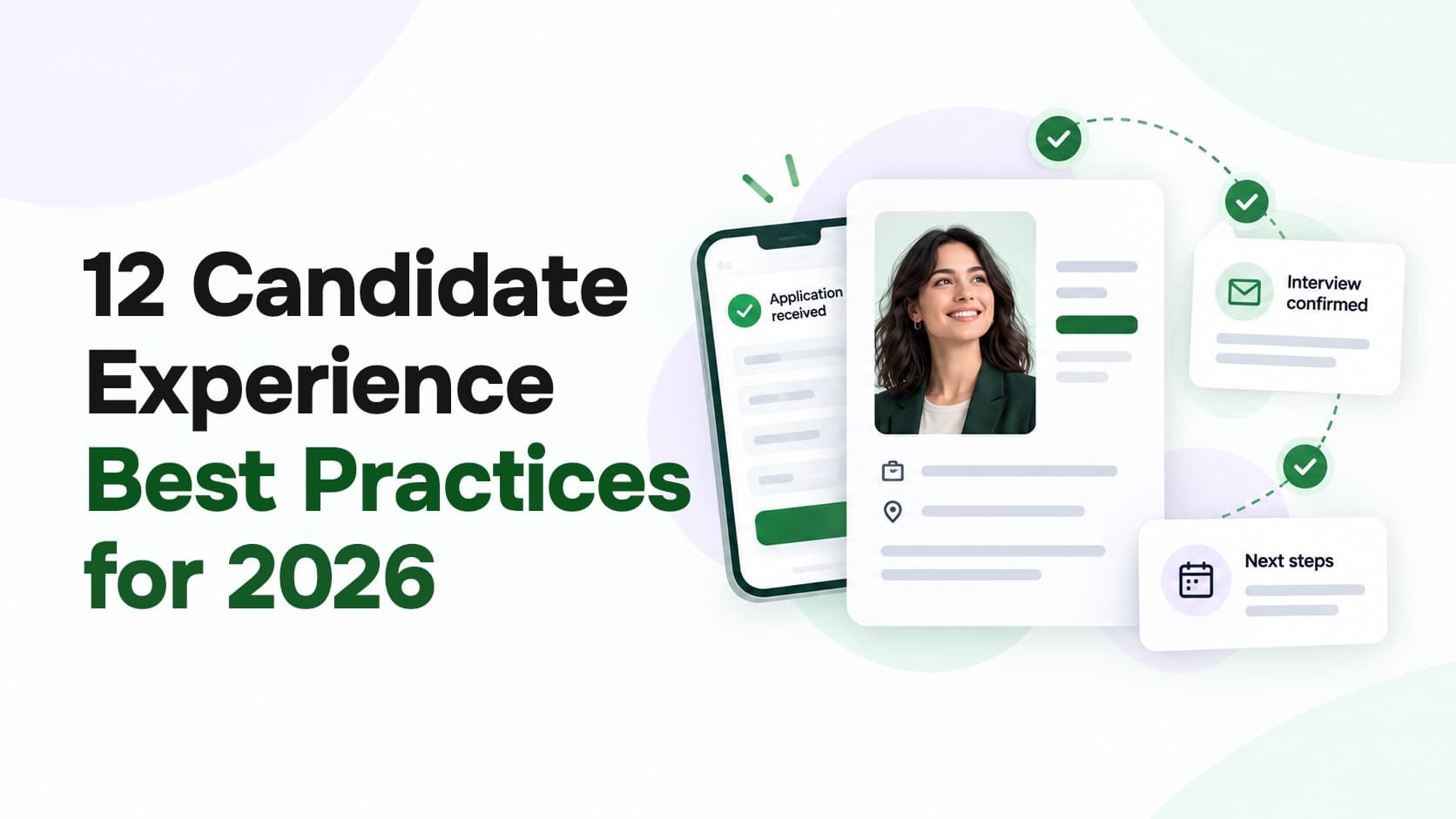
12 Candidate Experience Best Practices to Improve Your Hiring Process
Recruit
Candidate Experience
13 min read
Key Highlights
Clear expectations help candidates decide whether a role fits before they apply.
Short, mobile-friendly applications reduce friction and unnecessary applicant drop-off.
Consistent updates prevent candidates from feeling ignored during slower hiring stages.
Structured interviews create a fairer and more predictable experience.
Candidate surveys reveal process problems that internal teams frequently overlook.
Introduction
A candidate submits an application, receives an automated confirmation, and then hears nothing for three weeks.
Even if the company eventually schedules an interview, the silence has already shaped how that person views the employer.
The best candidate experience practices prevent this kind of uncertainty. They create a clear, respectful, and consistent journey from the first job-page visit to the final hiring decision.
That matters because candidates judge more than the open role. They assess your communication, organization, transparency, and respect for their time throughout the entire recruitment process.
Poor experiences drive qualified applicants away, while thoughtful ones strengthen trust even when the candidate is not hired.
In this blog, you will learn 12 practical candidate experience best practices, how an ATS can support them, and which metrics you can use to measure their impact.
What are the Candidate Experience Best Practices?
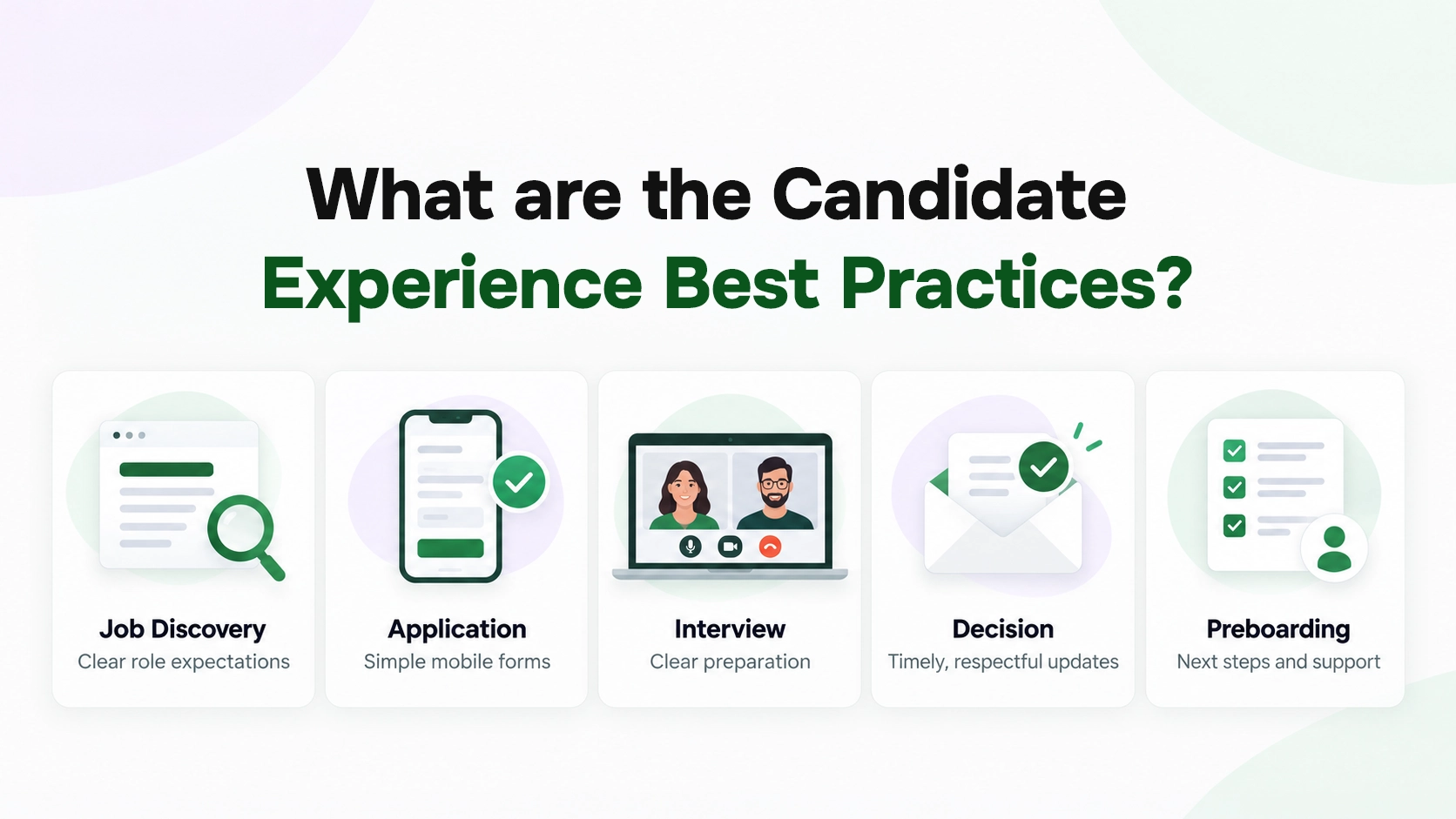
Candidate experience best practices are repeatable actions that make the hiring process clear, accessible, respectful and consistent for every applicant.
They cover every interaction a person has with your organization, including the job description, application form, screening stage, interviews, follow-ups, rejection communication, offer process and preboarding period.
That full scope is also what separates candidate experience from employer branding. Employer branding shapes expectations, while candidate experience shows whether the hiring process meets them.
Candidates remember whether recruiters communicated clearly; interviewers arrived prepared, and hiring decisions were handled respectfully.
That's why candidate experience is important for hiring performance and employer reputation alike, not just for filling one role.
12 Candidate Experience Best Practices That Work
The strongest candidate experience strategies remove uncertainty and unnecessary effort. Each practice below addresses a specific point where candidates commonly lose confidence or disengage.
1. Set Expectations in Every Job Description
A useful job description tells candidates what they will do, how success will be measured, and what the hiring process involves.
Use plain language to describe responsibilities, required skills, reporting relationships, work arrangements, and salary information where possible.
Separate essential qualifications from preferences so suitable applicants do not exclude themselves from nonessential requirements.
Include a short hiring-process summary, such as:
Application review
Initial screening call
Skills assessment
Structured interview
Final decision
This transparency helps candidates understand the commitment before applying and reduces avoidable questions later.
2. Show Candidates What the Role Is Really Like
A realistic job preview gives candidates a balanced view of the role instead of presenting only its most attractive features.
Explain the typical workload, key challenges, performance expectations, team structure, and working conditions.
You can support this with a short employee video, a sample workday, role-specific FAQs, or examples of projects the new hire will handle.
Realistic information improves self-selection. Candidates who continue are more likely to understand the position, while those seeking something different can withdraw before both sides invest more time.
According to the 2024 Greenhouse Candidate Experience Report, 53% of surveyed employees believed the responsibilities advertised during recruitment differed significantly from the reality of the job.
That finding reinforces the need for accurate role previews rather than overly polished promises.
3. Remove Unnecessary Application Steps
Application friction occurs when candidates must complete repetitive, confusing or irrelevant tasks before they can express interest.
Start by completing your own application as a candidate would. Remove duplicate questions, unnecessary account creation, lengthy questionnaires and fields that request information already included in the résumé.
A first-stage application normally needs only the information required to determine whether the person should move forward. More detailed documents and assessments can wait until they become relevant.
Review your candidate screening requirements as part of this process. Screening should help identify suitable applicants without making every candidate complete work that the hiring team never reviews.
4. Make Applications Work on Mobile Devices
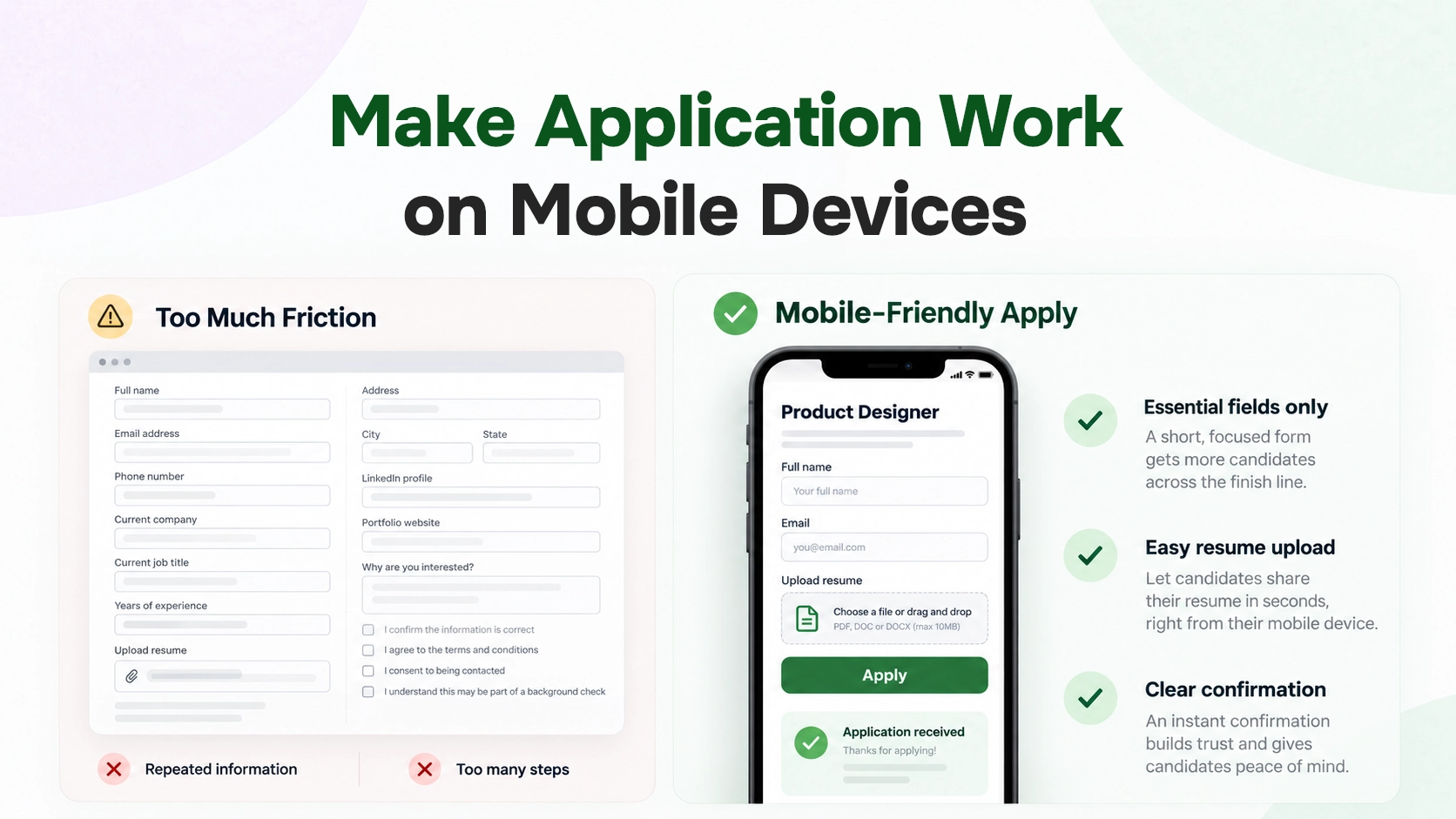
A mobile-friendly application process allows candidates to find a role, read its requirements, and submit an application without switching devices.
Use readable text, large form fields, simple navigation and resume-upload options that work with cloud storage. Avoid long free-text responses, complex password rules, and forms that restart when the browser closes.
Test the complete process on multiple screen sizes rather than assuming a responsive career page solves every issue. The application form, assessment links, and confirmation messages must all work properly on mobile.
LinkedIn’s guidance on creating an accessible candidate experience recommends requesting only essential application information and allowing mobile candidates to submit a resume, LinkedIn profile, or portfolio easily.
5. Confirm Every Application Immediately
An immediate confirmation tells candidates that their information arrived successfully and sets the first communication expectation.
The message should include:
The role applied for
The expected review period
The next possible step
A contact method for technical problems
A clear statement about whether every applicant will receive a decision
Avoid sending a generic “we will be in touch” email with no timeline. Even an approximate review window gives candidates more useful information than silence.
While automated confirmation emails improve response speed, they should still sound respectful, provide relevant details, and acknowledge the candidate's application.
Automate Confirmations Without Sounding Automated
Send stage-specific confirmations and updates from customizable templates.
6. Establish a Clear Communication Cadence
A communication cadence defines when candidates receive updates, who sends them, and what each message should contain.
To make that cadence effective, set clear response standards for each stage.
For example, confirm applications immediately, send interview details at least two business days in advance, and provide a post-interview update by the date promised.
When a decision is delayed, remember that no update is still an update. Tell candidates what changed and when they should expect the next message.
This prevents them from interpreting silence as rejection or disorganization.
The 2024 Greenhouse Candidate Experience Report found that 52% of candidates had experienced employer ghosting. It also reported that 79% would consider applying to the company again if they received feedback after an unsuccessful interview.
“Factors in how employers act during the hiring process like whether they’re communicative, how transparent they’re being and whether they respect candidates’ time directly determine their ability to hire and retain top talent.”— Daniel Chait, CEO, Greenhouse
7. Prepare Candidates for Every Interview
Clear interview logistics allow candidates to focus on the conversation instead of worrying about where to go, who they will meet, or how they will be assessed.
Every interview invitation should explain:
Date, time and time zone
Location or meeting link
Expected duration
Interviewer names and roles
Interview format
Topics or competencies being evaluated
Any preparation or technology requirements
A contact for last-minute problems
For onsite interviews, include directions, parking details, accessibility information, and the arrival process.
Likewise, for virtual interviews, confirm the platform and provide a backup contact if the connection fails.
8. Use a Consistent Interview Structure
A structured interview process gives candidates a fairer experience by asking comparable questions and applying the same evaluation criteria.
Define the competencies required for the role, create questions linked to those competencies, and use a shared scorecard. Interviewers should also record evidence before discussing the candidate as a group.
However, consistency does not require a cold or scripted interaction. Interviewers can still ask relevant follow-up questions while keeping the core assessment comparable.
This structured interview process also helps prevent candidates from receiving conflicting information from different interviewers.
9. Communicate Unexpected Delays Transparently
Hiring delays damage candidate experience most when employers leave them unexplained.
Tell active candidates as soon as an approval, interview or decision timeline changes.
Also, briefly explain the situation without exposing confidential internal details, provide a revised date, and keep the promised update even if the process remains unresolved.
A useful delay message could say:
“Our final interviews are taking longer than planned, so we now expect to confirm the next step by Thursday. Your application remains under consideration, and we will update you again by that date.”
This message is more credible than disappearing until the team reaches a decision.
Know When a Candidate Has Waited Too Long
Get alerts for delayed stages and missed follow-ups before candidates notice.
Explore Alerts10. Give Timely and Respectful Rejections
A rejection should close the process clearly instead of leaving candidates to infer the outcome.
Once the decision is final, send rejection emails promptly. Thank the candidate for the time invested, state the outcome directly and avoid empty phrases that suggest the decision was closer than the evidence supports.
For candidates who completed the interviews, communication should be more tailored. Where company policy allows, provide concise, job-related feedback that helps them understand the decision.
However, do not promise to retain someone for future opportunities unless your team has a real process for doing so. A respectful rejection email is better than a vague promise that produces no future contact.
11. Personalize High-Value Candidate Touchpoints
Personalization matters most when a candidate has invested significant time or reached a decisive stage.
Use the candidate’s name, reference the specific role, and acknowledge relevant discussions. After an interview, a recruiter might mention the project the candidate described or answer a question raised during the conversation.
Automation still supports routine communication, but templates should adapt to the stage and situation.
A rejected applicant who completed four interviews should not receive the same message as someone screened out before human review.
Ultimately, personal attention does not require writing every message from scratch. It requires identifying where context changes how communication feels.
12. Collect Feedback and Improve the Process
Candidate surveys show how the hiring process feels from outside the organization.
Send a short survey after meaningful stages such as application, interview, rejection, or hire. Keep it easy to complete and ask questions that lead to action.
Useful survey questions include:
Was the role explained clearly?
Was the application easy to complete?
Did you know what to expect at each stage?
Were interviewers prepared and respectful?
Did you receive updates when promised?
What should we improve?
Once the responses are collected, review the candidate experience feedback by role, recruiter, department, and hiring stage.
This level of analysis helps identify where the experience breaks down, since a company-wide average hide a company-wide average can hide a weak interview or rejection stage behind a strong application process.
How an ATS Supports Candidate Experience
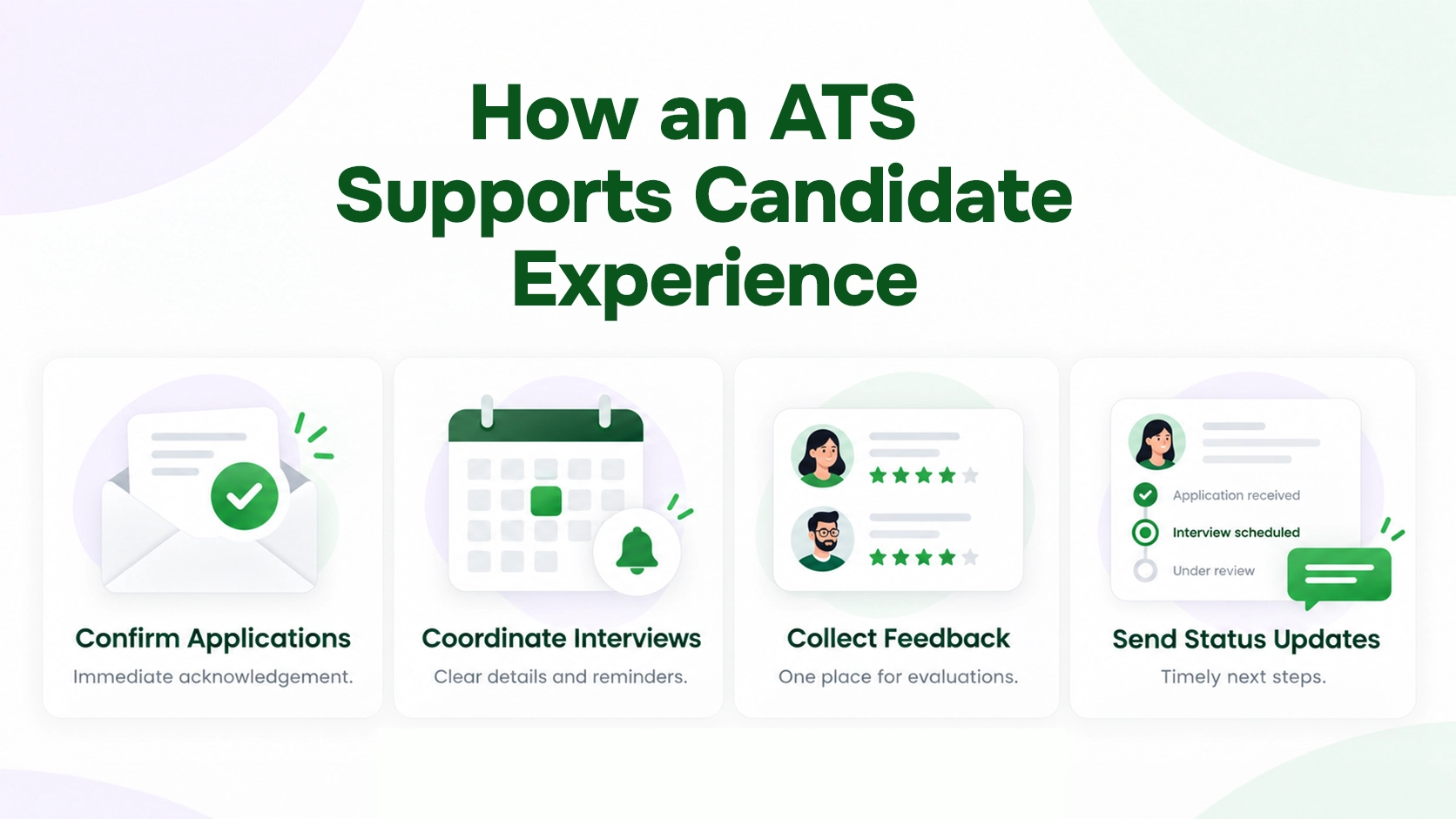
An Applicant Tracking System (ATS) supports candidate experience by standardizing communication, organizing hiring stages, and reducing the manual work that causes missed updates.
Rather than replacing thoughtful communication, an ATS enables hiring teams to deliver it consistently and at scale.
The system can support these practices through:
Automated confirmations: Send immediate acknowledgements when candidates apply or move between stages.
Customizable pipelines: Define clear hiring stages and prevent applicants from becoming lost between team members.
Centralized communication: Keep candidate messages, notes, and actions connected to one profile.
Interview coordination: Organize events, reminders, and stage-related actions.
Collaborative feedback: Collect evaluations in one location, so decisions do not depend on scattered messages.
Analytics and alerts: Identify delayed stages, missed actions, and process bottlenecks.
Candidate portals: Give applicants a clearer way to apply, communicate, and follow progress.
Mercury Recruit brings these capabilities together through centralized candidate management, allowing hiring teams to manage applications, evaluations, messages, and actions from one platform.
How to Measure Candidate Experience
You can measure candidate experience by tracking candidate feedback, recruitment process metrics, and hiring outcomes across every stage of the hiring journey.
Rather than relying on a single satisfaction score, evaluate each stage independently to identify where candidates experience delays, communication gaps, or unnecessary friction.
The table below outlines the key candidate experience metrics, what each one reveals, and where it should be measured:
Metric | What It Reveals | Where to Measure It |
Application completion rate | Whether the application creates excessive friction | Career site and application form |
Candidate response rate | Whether communication remains engaging and timely | Screening and interview stages |
Stage withdrawal rate | Where candidates choose to leave the process | Each hiring stage |
Time between updates | Whether communication standards are being met | Entire recruitment workflow |
Interview satisfaction | Whether interviews feel prepared, fair and respectful | After interviews |
Offer acceptance rate | Whether expectations and final terms remain aligned | Offer stage |
Candidate Net Promoter Score (cNPS) | Whether candidates would recommend the hiring process | After rejection or hire |
Reapplication intent | Whether unsuccessful candidates remain open to future roles | Post-rejection survey |
Candidate Net Promoter Score (cNPS) measures how likely candidates are to recommend your hiring process to others.
However, the score alone does not explain why candidates feel that way, so review it alongside written survey feedback.
Next, compare the results over time and segment them by role, department, recruiter, and hiring stage.
This helps uncover specific weaknesses that an overall average hide, such as scheduling delays in one department or inconsistent communication during screening.
Use these findings to prioritize improvements, assign responsibility, and determine whether each change produces a better candidate experience.
Candidate Experience Checklist
Use this candidate experience checklist to review each open role before and during recruitment:
The job description explains responsibilities and expectations clearly.
The role includes a realistic preview of the work.
The application requests only necessary information.
The complete application works on mobile devices.
Every applicant receives immediate confirmation.
Candidates know the expected hiring timeline.
Recruiters send updates when timelines change.
Interview invitations include full logistics and preparation details.
Interviewers use consistent questions and scorecards.
Rejection emails are sent promptly and respectfully.
Interviewed candidates receive appropriate personalization.
Candidate surveys are reviewed and assigned follow-up actions.
Hiring metrics are segmented by role, stage, and team.
Treat this as an operating checklist rather than a one-time project.
The best candidate experience changes as hiring volume; technology and candidate expectations evolve.
Create a More Consistent Candidate Journey
Centralize communication, hiring stages, and team feedback in one ATS.
Book A DemoConclusion
Improving candidate experience does not require extravagant gestures. It requires a process that communicates clearly, respects people’s time, and delivers what the employer promised.
Begin with the stages where candidates experience the most uncertainty. Shorten unnecessary application steps, define a communication cadence, prepare interviewers, and close every application with a clear decision.
Then use surveys and workflow metrics to confirm whether those changes work.
The goal is not to satisfy every candidate with the outcome, but to create a great candidate experience where each person understands the process and feels professionally treated.
FAQs
Frequently Asked Questions
They are repeatable methods for making recruitment clear, accessible, timely, fair and respectful from application through final decision.