
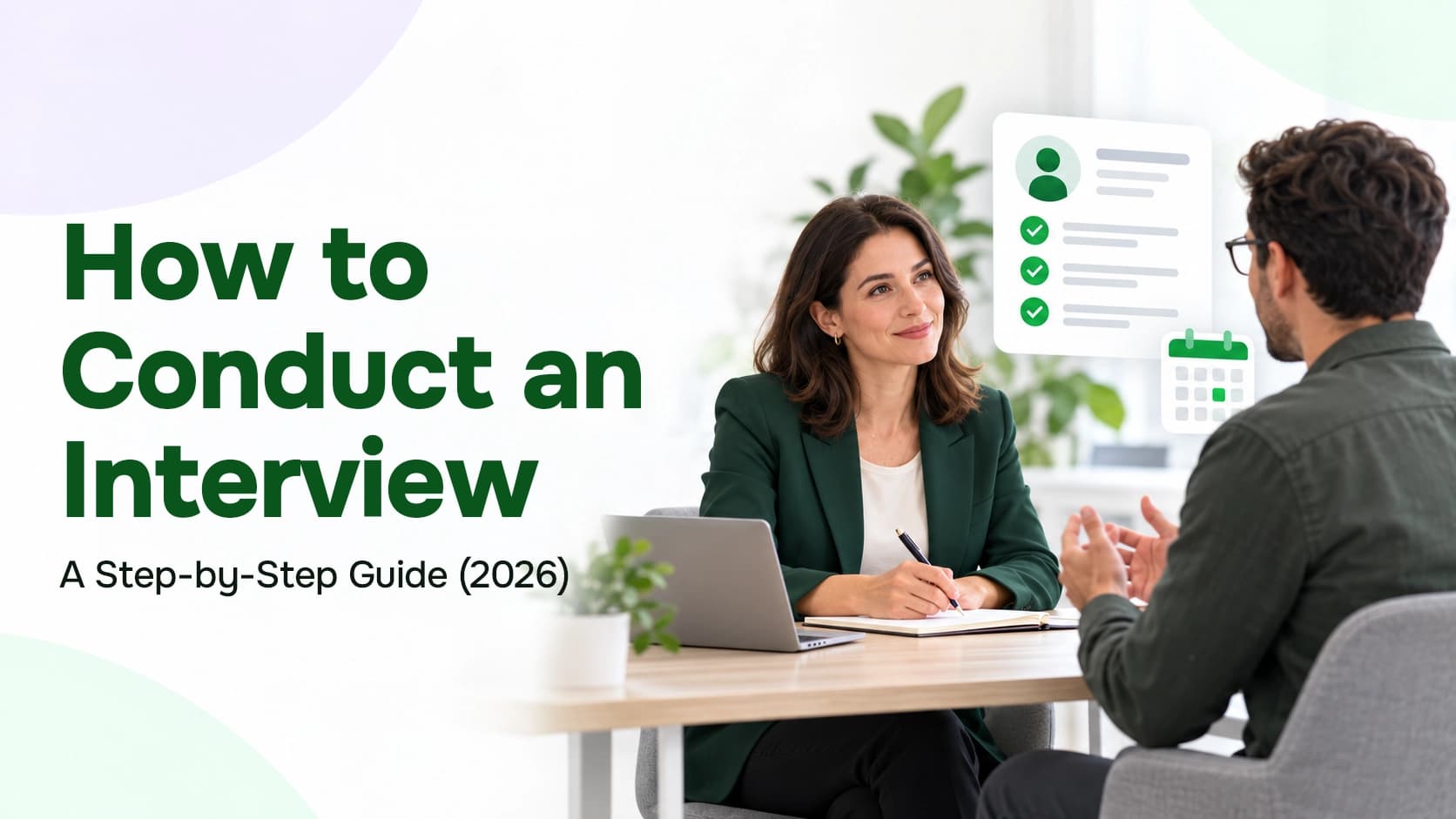
How to Conduct an Interview: 10 Steps for Fair & Effective Hiring
Recruit
Job Interview
16 min read
Key Highlights
Effective interviews measure job-related competencies through consistent questions and predefined scoring criteria.
Interview preparation should cover questions, scorecards, panel roles, scheduling, accessibility, and candidate communication.
Behavioral questions examine past actions, while situational questions explore responses to realistic future problems.
Interviewers should evaluate each candidate independently before discussing scores with the wider panel.
Clear next steps and timely follow-up protect candidate trust and keep the hiring process moving.
Introduction
You have probably heard that interviewers make up their minds in the first 90 seconds.
Research tells a different story: most hiring managers take at least five minutes, and many take fifteen minutes before deciding anything.
The bigger problem is what happens during that time. Many interviewers enter without clear criteria, ask whatever comes to mind, and leave with opinions instead of evidence.
Learning how to conduct an interview means turning that loose conversation into a structured part of the recruitment process.
With clear job criteria, relevant questions, active listening, and fair evaluation, you give every candidate a better chance and make hiring decisions easier to compare.
This guide explains how to prepare for an interview, ask effective questions, evaluate candidates fairly, avoid common mistakes, and manage the follow-up process.
What Makes an Effective Interview?
An effective interview includes job-related questions, consistent evaluation criteria, and clear evidence to assess whether a candidate can perform the role.
Yet many companies still rely on informal conversations rather than a defined interview process. Research shows that 44% of organizations are still running unstructured interviews, with no fixed questions and no shared way to score answers.
Likewise, one study found that close to 4 in 10 candidates get rejected based on things like confidence or tone.
That's not a small gap; it's the difference between hiring the right person and just hiring whoever interviewed best.
A strong interview has five characteristics:
Job relevance: Ask questions that connect directly to the role’s responsibilities, required skills, and real workplace challenges.
Consistency: Ask every candidate the same core questions so your hiring team can compare answers fairly.
Clear scoring: Define what a weak, average, and strong answer looks like before the interview starts.
Two-way communication: Give candidates enough information about the role, team, and expectations so they can judge the opportunity too.
Documented decisions: Record notes and scores clearly so the hiring team understands why each candidate moved forward or was rejected.
“The goal of our interview process is to predict how candidates will perform once they join the team.”- Laszlo Bock, Former Senior Vice President of People Operations at Google
Checklist Before the Interview: Get Every Detail Ready
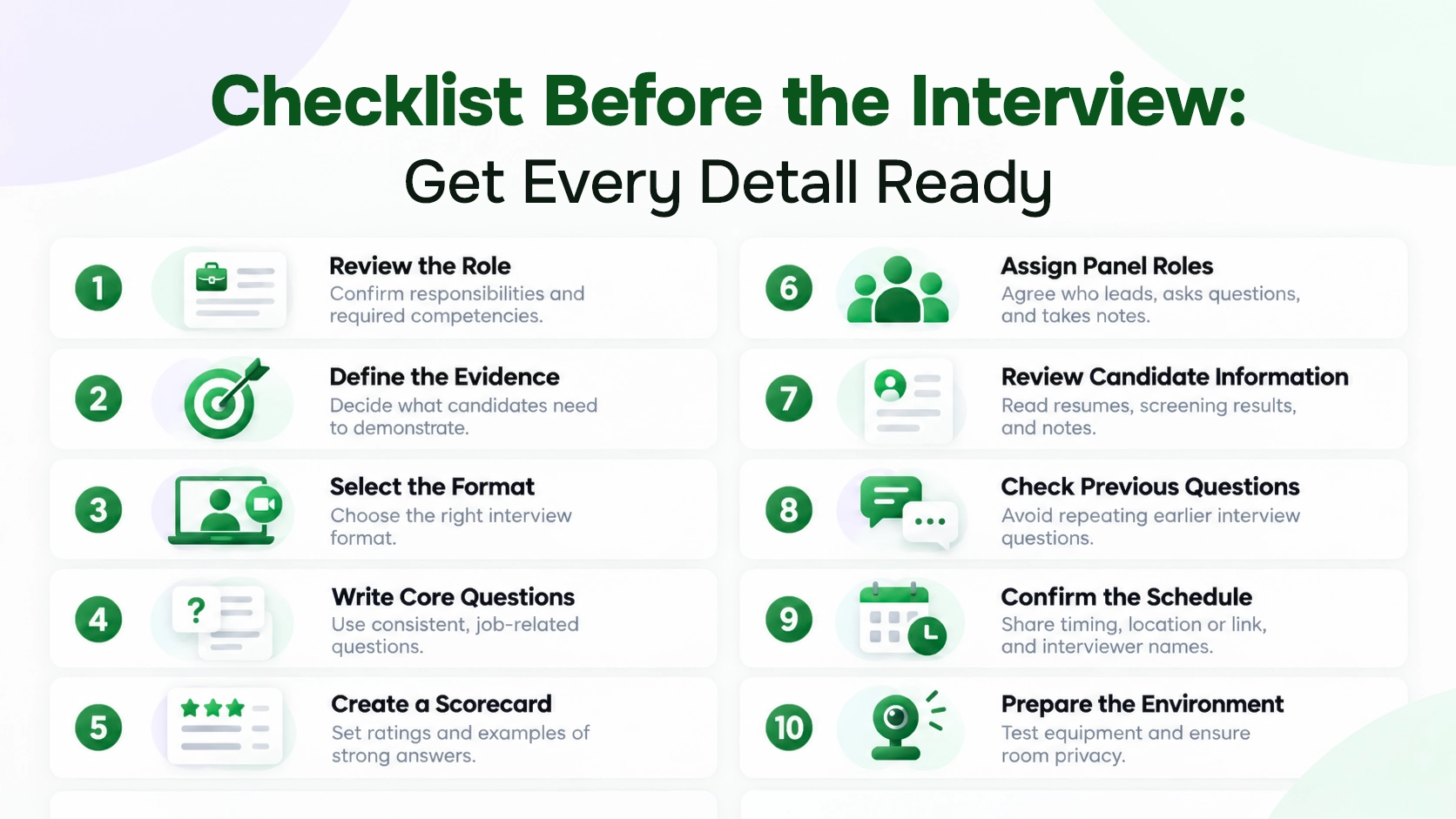
Before an interview, the hiring team should prepare the role criteria, questions, scorecard, interview format, panel responsibilities, schedule, and candidate communication.
Clear interview preparation also improves the candidate’s experience. LinkedIn reported that 48% of candidates responded positively when they received interview information in advance, including details about the process and interviewers.
Interview preparation begins after candidate screening, identifies applicants who meet the basic requirements.
Use this checklist before meeting the candidate:
Review the role: Confirm the essential responsibilities, outcomes, and required competencies.
Define the evidence: Decide what candidates must demonstrate during the interview.
Select the format: Choose a one-to-one, panel, phone, video, technical, or case interview.
Write core questions: Prepare the same job-related questions for every candidate.
Create a scorecard: Add rating criteria and examples of strong responses.
Assign panel roles: Decide who will lead, ask each question, take notes, and explain the role.
Review candidate information: Read the resume, application, screening results, and previous interview notes.
Check previous questions: Avoid making candidates repeat the same answers across multiple rounds.
Confirm the schedule: Share the time, duration, format, location or meeting link, and interviewer names.
Prepare the environment: Test audio, video, internet access, room privacy, and presentation equipment.
Walk Into Every Interview Fully Briefed
See each candidate’s resume, screening results, and earlier interview notes on one profile in Mercury Recruit, so no one asks the same question twice.
How to Conduct an Interview: 10 Steps to Follow
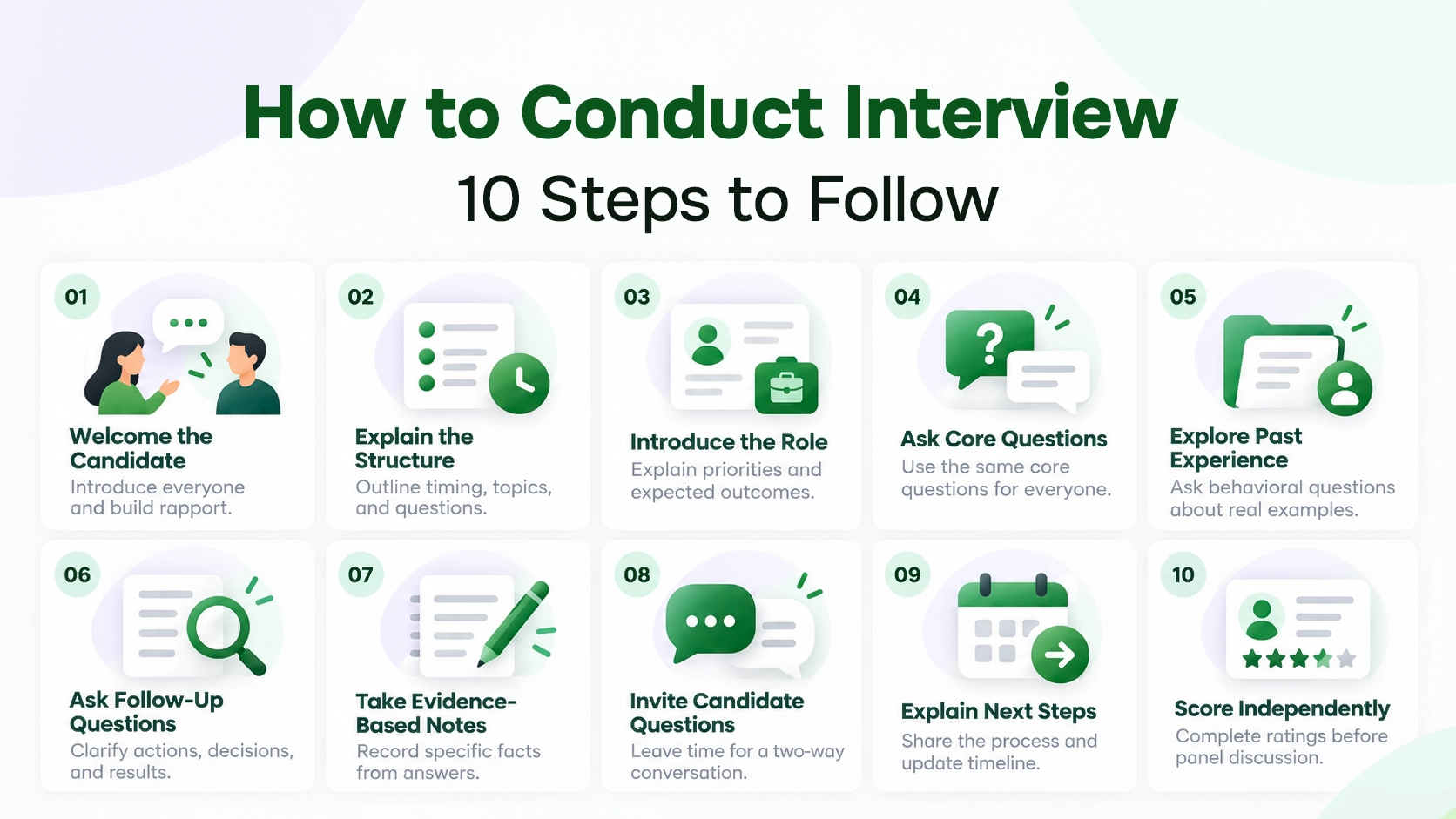
Conducting an effective interview involves guiding the conversation, asking consistent questions, gathering relevant evidence, and evaluating each candidate against the same criteria.
Once the preparation is done, the interview itself is pretty straightforward. Here's how to conduct an interview from start to finish:
Step 1: Welcome the Candidate and Build Rapport
Start by greeting the candidate, introducing everyone on the call, and confirming that the audio and video are working.
You can reduce tension with a brief, neutral opening before moving into the assessment.
For example, say, “Thanks for joining us. Can you hear and see everyone clearly?”
If the interview is in person, confirm that the candidate is comfortable before you begin.
Step 2: Explain the Interview Structure
Tell the candidate how long the interview will last, what topics you will cover, and when they can ask questions.
You should also explain whether the interview includes screen sharing, a task, or a second interviewer joining later.
For example, say, “We have 45 minutes, including ten minutes for your questions at the end.”
A clear structured interview process helps the candidate give more focused answers.
Step 3: Introduce the Role and Its Priorities
Give a short explanation of the role, the team, and the main outcomes expected from the person you hire.
You should also clarify whether the position is remote, hybrid, or office based.
Focus on the responsibilities that will help the candidate understand your questions.
For example, explain the role’s priorities for the first three months instead of giving a long company presentation.
Step 4: Ask the Same Core Questions
Use the same core interview questions for every candidate applying for the role.
This makes it easier for you to compare answers and reduces the influence of personal preference.
You can still ask different follow-up questions when an answer needs clarification.
For example, every candidate for a sales role might answer the same question about handling a missed target.
Step 5: Use Behavioral Interview Questions
Ask candidates to describe how they handled real situations in previous roles.
Behavioral questions help you understand what the candidate did, why they did it, and what result they achieved.
For example, ask, “Tell me about a time you had to resolve a disagreement within your team.”
You can use the STAR framework to check whether the answer covers the situation, task, action, and result.
Step 6: Ask Relevant Follow-Up Questions
Use follow-up questions to uncover the candidate’s individual contribution and decision-making process.
You should keep each follow-up connected to the competency you are assessing.
For example, ask, “What was your specific responsibility?” or “How did you measure the result?”
During an online interview, leave a brief pause before responding, so connection delays do not cause interruptions.
Step 7: Take Evidence-Based Notes
Record specific facts from the candidate’s answers instead of writing general impressions.
During an interview, your brain naturally forms judgments such as, “This person seems very organized,” or “They do not seem like a hard worker,” but these reactions are not reliable evidence.
For example, write, “Reduced missed deadlines from six per month to one,” rather than, “Seems organized.”
Evidence-based notes make your scorecard and panel discussion more reliable.
Step 8: Give the Candidate Time to Ask Questions
Reserve time for the candidate to ask about the role, team, management style, and working arrangements.
You should answer clearly and avoid treating every question as another hidden test.
For example, a remote candidate may ask about communication tools, working hours, or equipment support.
When you do not know an answer, tell the candidate that you will confirm it during the follow-up.
Step 9: Explain the Next Steps
Tell the candidate what will happen after the interview and when they should expect an update.
You should explain whether another interview, assessment, or reference check is required.
For example, say, “We will complete our review by Friday and contact you by Monday.”
For an online process, explain how any assessment links or documents will be shared.
Step 10: Score the Interview Independently
Complete your scorecard immediately after the interview while the answers are still fresh.
Each interviewer should submit their ratings before discussing the candidate with the wider panel.
For example, score technical ability, communication, and problem-solving separately instead of giving one overall rating.
This keeps the final decision focused on evidence rather than the strongest opinion in the meeting.
“Recruiters and hiring managers need to look at the interview, not just from the employer's perspective but also from the job seekers'.”— John VanderSande, recruiter and supervisor at WinterWyman
Independent Scores, Before the Panel Talks
Give every interviewer the same scorecard in Mercury Recruit and compare ratings side by side once all feedback is in.
Explore EvaluationTypes of Interviews: Structured, Unstructured, and Panel
Interviews can be categorized based on factors such as question format, scoring method, number of interviewers, and the type of evidence being assessed.
Different interview formats serve different purposes, so you should choose the one that matches the stage of hiring and the evidence you need.
Below, we compare three of the most common interview types and their key features to help you choose the right format for your hiring process:
Key feature | Structured interview | Unstructured interview | Panel interview |
Question format | Uses the same core questions for every candidate. | Questions change based on how the conversation develops. | Several interviewers ask planned questions during one meeting. |
Scoring method | Uses a predefined scorecard or evaluation rubric. | Relies more heavily on notes, impressions, and informal judgment. | Each panel member scores assigned competencies or questions. |
Consistency | Produces highly comparable answers across candidates. | Produces less consistent evidence between candidates. | Creates consistency when panel roles and questions are assigned in advance. |
Best use | Suitable for fair comparison and most formal hiring decisions. | Better suited to informal discussions or exploratory conversations. | Useful when several teams or specialists need to assess the same candidate. |
Main risk | Can feel rigid when interviewers read questions without natural follow-up. | Increases the risk of bias, missed competencies, and uneven evaluation. | Can overwhelm candidates or create duplicate questions without clear coordination. |
Beside these three common formats, you can the following interview formats as well:
Phone interview: A short audio-only conversation used to confirm basic qualifications, availability, and interest.
Video interview: An online meeting used to assess candidates remotely and coordinate interviews across locations.
Technical interview: A role-specific assessment that tests the candidate’s technical knowledge and problem-solving ability.
Case interview: A structured exercise that asks the candidate to analyze and respond to a realistic business problem.
Work-sample interview: A practical assessment in which the candidate completes a task similar to the work required in the role.
Group interview: A format in which several candidates participate together, usually to assess teamwork and communication.
Exit interview: A conversation with a departing employee used to understand their experience, reasons for leaving, and possible workplace improvements.
To learn more about how to conduct an exit interview, read our complete guide to exit interviews.
What Interview Questions Should You Ask a Candidate?
The best interview questions help you understand how a candidate thinks, works, solves problems, and responds to realistic situations.
Instead of asking broad or predictable questions, connect each question to a specific skill or responsibility required for the role.
The exact questions should reflect the role, but most interview guides combine several question types.
1. Behavioral Questions
Behavioral questions ask candidates to explain how they handled a real situation in the past.
They help you assess whether the candidate has already demonstrated the competency you are looking for.
Examples:
Tell me about a time you had to resolve a disagreement within your team.
Describe a project that did not go according to plan. What did you do?
Give an example of a difficult decision you made with limited information.
Tell me about a time when you received critical feedback. How did you respond?
2. Situational Questions
Situational questions present a realistic problem and ask the candidate how they would respond.
They are useful when the candidate has not faced the exact situation before or when you want to assess judgment and problem-solving.
Examples:
You notice that a team member is struggling but has not asked for help. What would you do?
Two urgent tasks have the same deadline. How would you prioritize them?
A team member repeatedly misses an important handoff. What would you do?
You notice an error shortly before a final submission. How would you handle it?
3. Role-Specific Questions
Role-specific questions test the knowledge, judgment, or technical skills required for the position. These questions should reflect the tasks the candidate will perform if hired.
For example, when interviewing a digital marketing manager:
Which metrics would you use to measure the success of a paid advertising campaign?
How would you respond if campaign costs increased while conversions declined?
How would you divide a limited budget across search, social media, and retargeting?
What steps would you take before launching a campaign for a new product?
How would you explain poor campaign performance to a client or senior manager?
4. Motivation and Expectation Questions
These questions help you understand what the candidate wants from their next role and whether the opportunity matches their expectations.
Examples:
What are you looking for in your next position?
Which parts of this role interest you most?
What type of management support helps you perform well?
What expectations do you have regarding progression?
Avoid vague questions such as “What is your greatest weakness?” when they do not connect to a defined criterion.
You can also review these candidate screening questions when designing questions for earlier hiring stages.
How to End an Interview and What to Do Afterwards
After completing the main interview process, it is time to close the conversation clearly and move into evaluation.
The final few minutes shape how the candidate remembers the experience, so avoid ending with a vague timeline or rushed goodbye.
Before ending, ask:
Is there anything relevant to the role that we have not discussed and that you would like us to consider?
After the interview:
Complete the scorecard.
Submit notes before panel discussion.
Compare evidence against the hiring criteria.
Record the decision and rationale.
Contact the candidate within the promised timeline.
Schedule the next stage or send a respectful rejection.
Retain interview records according to company policy and applicable law.
While the hiring team makes a decision, don't cut off communication. You should follow up within the promised timeline, even if the final outcome is still pending.
Talent Board data reported by LinkedIn found that when employers explained the next steps and followed up within the promised timeline, positive candidate-experience ratings increased by 49% in Asia-Pacific and 52% in North America.
A short update shows respect for the candidate’s time and helps maintain a positive candidate experience.
“Never leave them guessing about what you're doing or where candidates are in the process.”— Catherine Jaeger, Recruiting Manager at Compass
Common Interviewing Mistakes and How to Avoid Them
Interview mistakes affect more than evaluation quality. In a LinkedIn survey of more than 14,000 professionals, 65% said a poor interview experience made them question whether they wanted the job.
Here are the biggest mistakes to watch out for and how to fix them:
Making Decisions Too Early: First impressions can influence how you interpret everything the candidate says afterward. Avoid this by completing the full interview and scoring every competency before forming a final opinion.
Talking More Than the Candidate: When you spend too much time explaining the company or role, you leave less time to assess the candidate. Keep your introduction brief and let the candidate do most of the talking during the evaluation.
Asking Different Core Questions: Changing the main questions for each candidate creates an uneven assessment. Ask everyone the same core questions and use follow-up questions only when you need clarification.
Confusing Confidence with Competence: A confident speaker may interview well without having the strongest skills, while a quieter candidate may provide better evidence. Focus on the quality and relevance of the answer rather than delivery style alone.
Asking Personal or Discriminatory Questions: Do not ask about age, disability, religion, marital status, pregnancy, family plans, ethnicity, or other protected characteristics. Keep every question connected to the role, its responsibilities, and legitimate working requirements.
Relying on “Culture Fit”: Culture-fit decisions can favor candidates who resemble the current team rather than those who can perform the job. Assess specific behaviors such as collaboration, accountability, adaptability, and respectful communication instead.
Failing to Document the Decision: Without clear notes and scores, interview discussions can drift toward memory and personal preference. Record the evidence behind each rating and hiring recommendation immediately after the interview.
Tools That Support a Structured Interview Process
A structured interview process can be supported by tools for scheduling, candidate management, standardized questions, scorecards, panel feedback, communication, and reporting.
The right tools help you keep interviews consistent, organized, and easier to evaluate across multiple candidates.
Interview scheduling tools: Help you coordinate interview times, time zones, reminders, and meeting links.
Video interview platforms: Allow you to conduct remote interviews and involve panel members from different locations.
Interview question templates: Give each interviewer a consistent set of role-specific questions to follow.
Scorecards and evaluation rubrics: Help you rate every candidate against the same competencies and scoring criteria.
Candidate profiles: Keep resumes, screening results, notes, and interview history in one place.
Panel feedback tools: Allow interviewers to submit independent scores before discussing the candidate together.
Communication templates: Standardize interview invitations, reminders, follow-ups, and rejection messages.
Interview analytics: Help you identify delays, inconsistent scoring, and weak points in the interview process.
Managing these tools separately can create disconnected records, repeated administrative work, and gaps between interview stages.
This is where an ATS such as Mercury Recruit brings the process together. It helps your hiring team manage candidate profiles, coordinate interviews, track hiring progress, and keep candidate communication organized.
Run Every Interview Stage From One Platform
Keep scorecards, panel feedback, and candidate updates in one place, so every interview is consistent and every decision is documented.
Try Mercury Recruit FreeConclusion
Conducting an interview isn't about relying on gut feelings or personal charisma; it's about following a structured method.
If you follow the simple steps mentioned above, you will turn a stressful guess work into a clear, reliable and fair hiring process.
Additionally, it saves time, avoids costly mistakes, and helps you confidently choose the best person for your team.
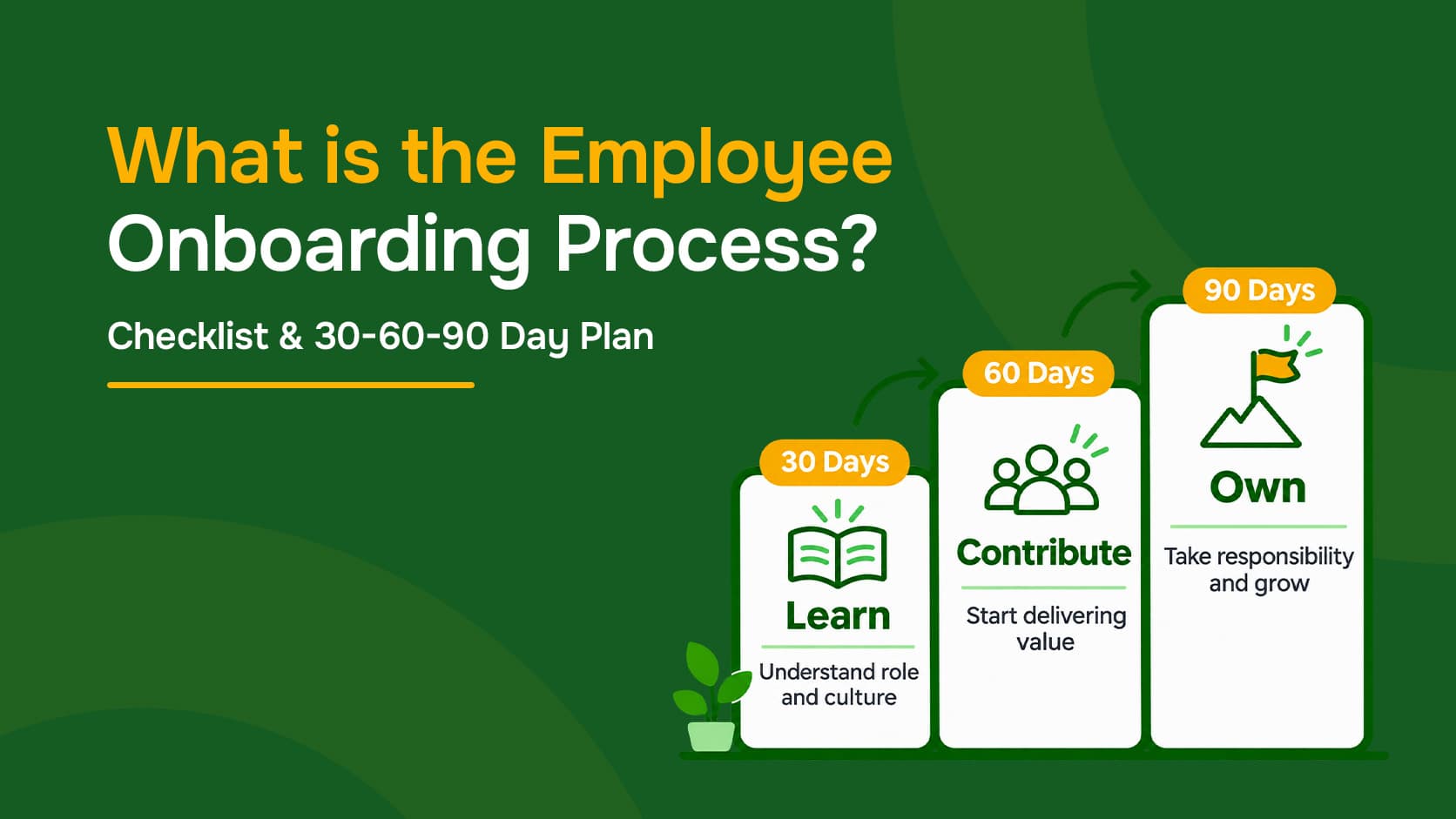
Once the chosen candidate accepts the offer, the hiring process should transition into a structured employee onboarding process, that supports a strong start.
FAQs
Frequently Asked Questions
Prepare the criteria and questions, open the meeting, ask and probe consistently, answer candidate questions, close clearly, score responses, and follow up.