
How to Conduct an Exit Interview: Questions, Template & Best Practices
Recruit
Job Interview
15 min read

Key Highlights
An exit interview is a structured conversation with a departing employee to understand their experience and reasons for leaving.
A well-conducted exit interview creates a positive offboarding experience, protects your employer brand, and keeps the door open for future boomerang employees.
To conduct an exit interview effectively, know your employee beforehand, choose the right interviewer, create a comfortable environment, and ask open-ended questions.
The best exit interview questions cover reasons for leaving, job responsibilities, management, workplace culture, career growth, compensation, and final feedback.
Avoid common mistakes such as asking leading questions, interrupting employees, or collecting feedback without taking action.
Introduction
An employee's resignation doesn't just leave an open position; it also leaves unanswered questions.
Without a well-conducted exit interview, organizations lose the chance to understand why employees leave, uncover workplace issues, and identify changes that could improve retention. Once that opportunity passes, honest feedback is far harder to recover.
Unfortunately, many organizations fail to make the most of it. According to the Gartner 2025 CHRO Talent Strategy Survey, only 10% of Chief Human Resources Officers (CHROs) say their organization is highly effective at managing the employee departure stage.
In this guide, you'll learn how to conduct an exit interview effectively, the best questions to ask, and practical ways to turn employee feedback into meaningful workplace improvements.
What is an Exit Interview?
An exit interview is a structured last meeting with an employee who has decided to leave the company. It usually takes place after employee put their resignation and during the employee's final days of notice period and gives them a chance to share honest feedback about their overall experience.
Most organizations assign HR or a neutral interviewer instead of the manager, making employees more comfortable sharing honest feedback.
An exit interview focuses on the employee's perspective. HR asks questions about the reason for leaving, the work environment, management, career growth, company culture, and anything that could have improved their experience.
Unlike the stay interview, the goal isn't to change the employee's decision. It's to understand why they are leaving, identify patterns across multiple exits, and use those insights to improve retention for future employes, workplace culture, and employee experience.
Note: There is no legal requirement for employers to conduct exit interviews. Likewise, employees are not obligated to participate unless an employment agreement explicitly states that an exit interview is required.
Why Does Exit Interviews Matter to Your Company?
Exit interviews give you a clear understanding of why employees leave and what needs to be improved. Rather than relying on assumptions, you collect honest feedback that supports better decisions across retention, management, and the overall employee experience.
Identify the real reasons employees leave: Exit interviews uncover recurring issues, such as career growth, leadership, compensation, workplace culture, or workload. As a result, you gain evidence-based insights instead of relying on assumptions.
Improve retention and employee experience: Honest feedback highlights gaps in leadership, onboarding, training, and day-to-day management. This makes it easier to address recurring concerns, improve employee experience, and reduce avoidable turnover.
Reduce organizational risk: Honest feedback often uncovers workplace concerns that might otherwise go unnoticed. Early action reduces the likelihood of similar issues affecting your team in the future.
Strengthen your employer brand and alumni network: A respectful offboarding experience leaves a positive final impression. In turn, former employees are more likely to recommend your organization, provide referrals, or return as boomerang employees when the right opportunity arises.
How to Conduct an Exit Interview Effectively?
To conduct an exit interview, prepare for discussion beforehand, choose a neutral interviewer, and plan the meeting at the right time. Then, create a comfortable and confidential environment, and listen actively while taking meaningful notes.
1. Prepare in Advance
Before you attend the exit interview, review the employee's role, responsibilities, performance history, resignation letter, and any concerns they have already shared. This gives you the context to ask relevant questions instead of relying on a generic questionnaire.
Next, prepare a list of questions, but don't use it like a script. Always leave a room to ask follow-up questions when employees mention something important.
2. Choose the Right Interviewer
The person asking the questions matters just as much as the questions themselves. Employees are more likely to share honest feedback when they speak with someone; they see as neutral party. That's why HR professionals are usually the best choice to conduct an exit interview.
According to LinkedIn, 70% of U.S. employees would consider leaving their job because of their manager. So, if management concerns contributed to the employee's resignation, avoid assigning their direct manager to lead the conversation.
Moreover, Gallup also reported that 24% of departing employees experienced a negative reaction from their manager after resigning, which discourages them from sharing honest feedback.
3. Schedule the Exit Interview at the Right Time
After preparing for the discussion, schedule the exit interview during an employee's final week, ideally a few days before their last working day. Employees have enough distance to reflect on their experience while still remembering important details.
However, avoid leaving the interview until the employee's final day. They may be occupied with handovers, returning company assets, and completing other exit formalities. Also, set exit interview time for around 30–60 minutes for the interview, so the conversation doesn't feel rushed.
4. Create a Confidential Yet Comfortable Environment
A private setting makes it easier for employees to share honest feedback. Choose a quiet place where there won't be interruptions or distractions.
Before asking questions, explain the purpose of the exit interview to the offboarding employee. Let them know that the goal is to learn from their experience and improve the workplace, not to question their decisions and answers.
Additionally, reassure employees that their feedback will remain anonymous whenever possible and encourage them to speak openly from the beginning. Setting these expectations early builds trust and makes them feel more comfortable while sharing their perspective.
5. Send an Exit Survey
Before the interview takes place, send an exit survey to collect the employee's initial feedback. Employees often give more thoughtful answers when they have time to reflect instead of responding on the spot.
Review the survey before the meeting and use the responses to guide the discussion. This allows you to explore important topics in more detail rather than spending time on questions the employee has already answered.
6. Listen Actively and Take Meaningful Notes
Once the employee starts sharing their thoughts, focus on listening more than speaking. Even if the feedback is difficult to hear, avoid interrupting or defending company decisions. Instead, ask follow-up questions when you need more context.
As you listen, record the key concerns, specific examples, and practical suggestions the employee shares. Well-organized notes make it easier to identify recurring patterns across multiple exit interviews and turn feedback into meaningful improvements.
7. End the Conversation Professionally
End the conversation with appreciation for the employee's honesty and contributions to the organization. Before they leave, explain what happens next and how their feedback will support future workplace improvements.
The way employees leave matters as much as how they join. Just as a positive candidate experience attracts talent, a respectful departure experience strengthens your employer brand and keeps the door open for referrals, future hires, and boomerang employees.
8. Review the Feedback and Act
The interview doesn't end when the meeting is over. Review the notes alongside feedback from other departing employees and look for recurring themes.
Most importantly, act on what you learn. Updating policies, improving management practices, or addressing workplace concerns gives employees confidence that their feedback leads to meaningful change.
Want to improve your interviewing skills? Read our guide on how to conduct an interview to learn practical techniques for asking better questions and creating productive conversations.
Keep the Door Open for Former Employees
Save departing high performers to a talent pool in Mercury Recruit, so you can reconnect when the right role opens again.
Explore Talent Pool FeaturesWhat are the Best Exit Interview Questions to Ask?
The quality of an exit interview depends on the questions you ask. Rather than following a fixed script, ask questions that encourage employees to share honest experiences and explain the reasons behind their answers.
While the exact questions may vary depending on the employee's role and reason for leaving, most exit interviews cover the following areas.
1. Questions About the Reason for Leaving
These questions help you understand what influenced the employee's decision to resign. They also reveal whether the departure was caused by personal circumstances, career goals, management, compensation, or workplace issues.
Examples:
What made you decide to leave the company?
When did you first start thinking about leaving?
Was there a specific event that influenced your decision?
2. Questions About the Job Role
These questions explore whether the employee's responsibilities matched their expectations and whether they had the resources needed to succeed.
Examples:
Did your role meet your expectations?
Which parts of your job did you enjoy the most?
Which responsibilities did you find most challenging?
Did you have the tools and resources needed to do your job well?
3. Questions About Career Growth
Examples:
Did you have enough opportunities to learn and grow?
Did you see a clear path for career progression?
Were your skills used effectively in your role?
What development opportunities would have encouraged you to stay?
4. Questions About Management
Manager relationships often influence employee satisfaction and retention. These questions help identify strengths as well as areas were leadership needs improvement. However, ensure the answer to be anonymous, otherwise employees might hesitate.
Examples:
How would you describe your relationship with your manager?
Did you receive enough guidance and support?
What could your manager have done differently to better support you?
Did you receive regular and constructive feedback?
5. Questions About Workplace Culture
Culture affects how employees feel about their work and the organization. These questions indicate how employees felt in the workplace beyond their daily responsibilities.
Examples:
How would you describe the company culture?
Did you feel respected and included at work?
What did you enjoy most about working here?
If you could change one thing about the workplace, what would it be?
6. Questions About Compensation and Benefits
Use these questions to understand whether pay, benefits, recognition, or rewards influenced the employee's decision to leave and whether improvements in these areas could create a better employee experience.
Are you satisfied with your salary and benefits?
Did you feel your compensation reflected on your responsibilities and performance?
Were there any benefits or incentives you wish the company had offered?
Did compensation or benefits influence your decision to leave?
7. Closing Questions
As the interview comes to an end, give employees one final opportunity to share anything that hasn't been discussed. Closing questions often uncover valuable insights that may not have come up earlier in the conversation.
What could we have done differently to encourage you to stay?
Would you consider working for our company again in the future? Why or why not?
Would you recommend our company to others as a place to work? Why or why not?
Is there anything we haven't discussed that you'd like to share?
Free Exit Interview Template
A structured interview template keeps exit interview process consistent and makes it easier to compare feedback across employees. While you can adjust the questions based on the role or situation, every interview should cover the same key topics.
Convert this into image
Employee Information | |
Employee Name | __________________ |
Job Title | __________________ |
Department | __________________ |
Manager | __________________ |
Date of Interview | __________________ |
Last Working Day | __________________ |
Interview Conducted By | __________________ |
Reason for Leaving
1. What is your primary reason for leaving the organization?
2. Was there a specific event that influenced your decision?
Job & Responsibilities
3. Did your role match your expectations? Why or why not?
4. Which part of your job did you enjoy the most?
5. What challenges did you face in your role?
Management & Work Environment
6. How would you describe your relationship with your manager?
7. Did you receive enough support and feedback?
8. How would you describe the company's culture and work environment?
Career Growth & Benefits
9. Did you have enough opportunities to learn and grow?
10. Were you satisfied with your compensation and benefits?
Final Feedback
11. What could we have done to encourage you to stay?
12. Would you consider working here again in the future? Why or why not?
13. Is there anything else you'd like to share?
HR Notes
Key Takeaways
Action Items
How to Analyze Exit Interview Data?
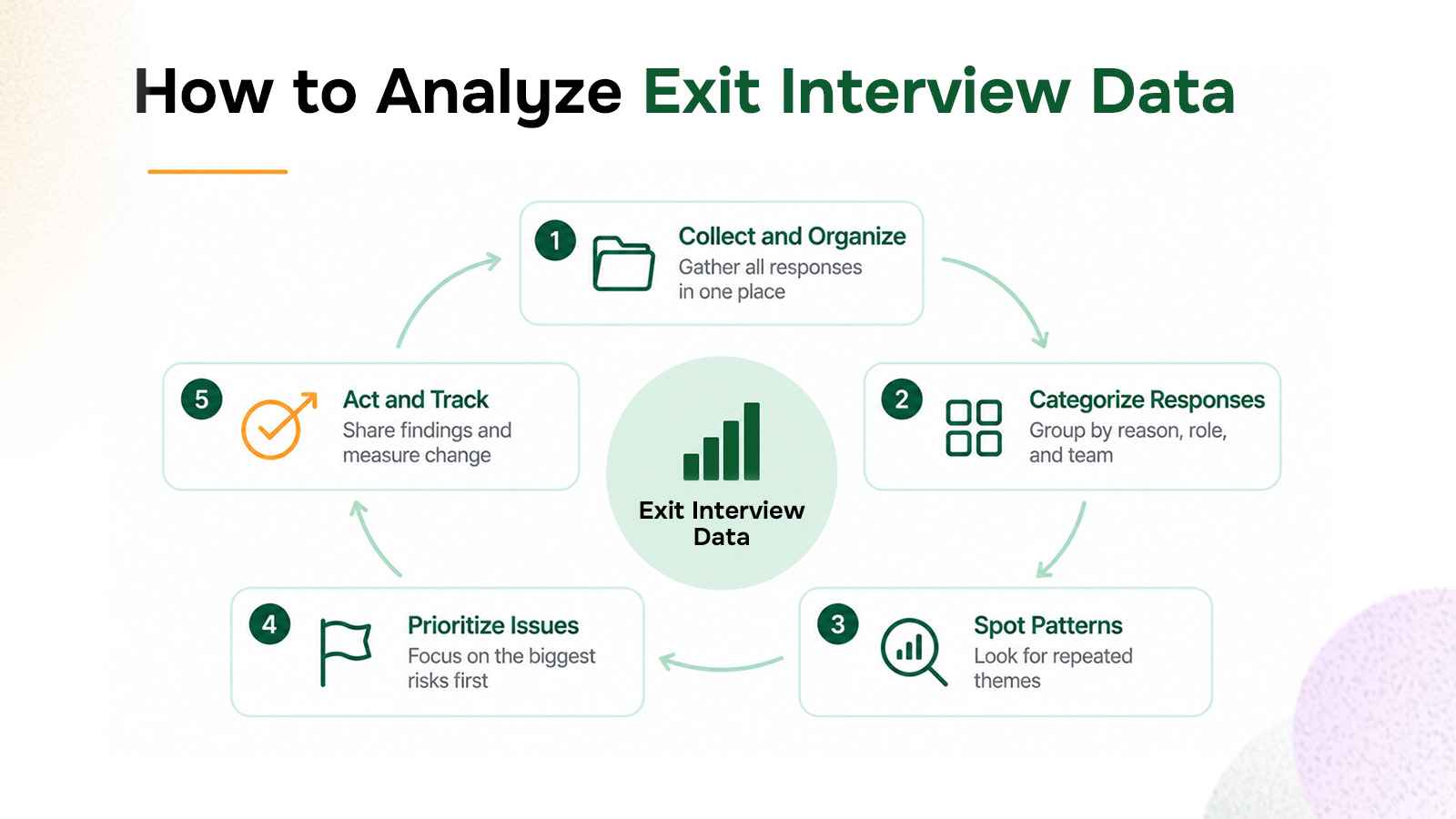
To analyze exit interview data, collect all exit interview responses, group similar feedback together, and compare the results to identify recurring patterns across your organization.
Step 1: Define Your Objective
First, decide what you want to learn from the data. A clear objective keeps your analysis focused and prevents you from drawing conclusions that aren't supported by the feedback.
For example, you may want to know the primary reason people are leaving, why turnover is increasing in a particular department, or why new hires resign during their first year.
Step 2: Gather All Exit Interview Responses
Next, collect every exit interview completed during your chosen reporting period, such as the past six or twelve months. If your organization also uses exit surveys, combine those responses to create a single dataset.
Record key information in a spreadsheet or HR analytics platform, including the employee's department, job title, manager, tenure, primary reason for leaving, and notable comments. Include both qualitative feedback, such as written responses, and quantitative data, such as survey ratings, whenever available.
Step 3: Organize and Categorize the Data
Group similar responses into common themes before looking for patterns. Organize the data to make it easier to compare feedback across different employees instead of reviewing each interview individually.
Use categories such as:
Category | Example Feedback |
Compensation & Benefits | "My salary and benefits weren't competitive." |
Management & Leadership | "I didn't receive enough support or feedback from my manager." |
Career Growth | "There weren't enough opportunities for promotion." |
Work-Life Balance | "The workload was too demanding." |
Company Culture | "Communication between teams was poor." |
Work Environment | "I didn't have the tools needed to do my job effectively." |
Step 4: Identify Trends and Validate Your Findings
Look for patterns that appear across multiple interviews rather than focusing on individual comments. Review manager feedback and employee responses based on department, manager, location, employee tenure, and voluntary versus involuntary exits to identify where turnover is concentrated.
Next, compare those findings with other HR metrics, such as employee turnover rate, retention rate, manager-level retention, employee engagement survey results, and exit interview completion rate. When different data sources point to the same issue, you can investigate it with greater confidence.
Step 5: Turn Insights into Action
Prioritize the patterned issues and develop an action plan to address them. Depending on your findings, you may need to:
Review compensation and benefits.
Strengthen manager training and coaching.
Expand career development opportunities.
Address workload and work-life balance concerns.
Improve communication and workplace culture.
What are the Common Mistakes to Avoid During an Exit Interview?
Even a well-planned exit interview can lose its value when common mistakes undermine honest feedback. Avoiding these pitfalls helps you collect more reliable insights and turn employee feedback into meaningful workplace improvements.
Getting defensive or argumentative: Some feedback may be difficult to hear, especially if it involves leadership or workplace culture. Listen objectively, ask clarifying questions, and avoid defending company decisions during the conversation.
Ignoring employee feedback: Exit interviews lose their value when feedback is collected but never reviewed or acted upon. Share recurring issues with leadership and use the insights to improve policies, management practices, and employee retention.
Making participation mandatory: Employees should feel free to decline an exit interview. If you are requiring participation or linking it to final pay, benefits, or other employment obligations, it may create legal and compliance concerns.
Rushing the conversation: A hurried interview often results in vague answers and missed insights. So, set aside enough time for employees to explain their experiences and discuss important concerns in detail.
Using inconsistent questions: Asking different questions in every interview makes it difficult to identify patterns across teams or departments. A consistent set of exit interview questions produces more reliable data over time.
Interested in running more effective interviews? Check out our detailed guide to structured interviews and learn how to create a fair, consistent interview process.
Conclusion
A well-planned exit interview process leaves you with more than feedback; it leaves you with opportunities to improve. However, the quality of the feedback solely depends on how you conduct the exit interview.
So, ask thoughtful questions, listen without judgment, and create a space where employees feel comfortable sharing honest feedback. Over time, these conversations will help you make better decisions, improve your workplace, and create better experience for both current and future employees.
If you're looking to improve your overall recruitment process, don't overlook the value of a well-conducted exit interview. The feedback you gather today can shape better hiring and retention decisions tomorrow.
Turn Exit Insights Into Better Hires
Use what you learn from departing employees to write clearer job requirements, screen more consistently, and fill open roles faster.
Try Mercury Recruit FreeFAQs
Frequently Asked Questions
The purpose of an exit interview is to understand why an employee is leaving and gather honest feedback about their experience. It helps organizations identify recurring workplace issues, improve employee retention, strengthen workplace culture, and make informed decisions to enhance employee experience.