
10 Benefits of an Applicant Tracking System
Recruit
Applicant tracking system
11 min read
Key Highlights
An ATS centralizes applications, interviews, communication and hiring workflows in one place.
Automation removes the repetitive work, screening, scheduling, follow-ups, that slows hiring down.
The clearest gains land in time-to-hire, cost-per-hire, candidate experience and team collaboration.
Built-in analytics and compliance records turn hiring from a series of judgement calls into a measurable process.
Mercury Recruit combines AI screening, automation, integrations and talent pools on one platform.
Introduction
Recruitment is never one task at a time. There are interviews to schedule, candidates to chase, hiring managers to align, and offers to get out, usually across four or five open roles at once, all in the same week.
Most HR teams are handling that with tools that were never built for it: a spreadsheet of candidates, a shared inbox, and a calendar with too many invitations in it. It works until it doesn't. A strong candidate goes cold. A hiring manager never sees the feedback. A role sits open a month longer than it needed to.
The benefits of an applicant tracking system are mostly about closing those specific gaps. An ATS holds applications, candidate profiles, interview stages, team feedback and candidate communication in one system, so work that used to live in someone's head or inbox happens on its own.
This guide covers the ten benefits HR teams notice first, what each one looks like in a real hiring week, and how to tell which ones your process actually needs.
What Is an Applicant Tracking System?
An applicant tracking system is recruitment software that manages hiring from the moment a job is posted to the day an offer is signed. Recruiters and hiring managers work from one shared record instead of separate spreadsheets, inboxes, and note apps.
Every ATS does four things, and all ten benefits below trace back to one of them:
Collects: Applications from every source land in one database, parsed into consistent fields.
Organizes: Candidates sit in named stages, so status is a fact rather than a guess.
Automates: Confirmations, reminders, status updates and rejections emails get sent automatically.
Reports: Time to hire, cost per hire and source performance get counted, not estimated.
For the full picture on how an ATS works step by step, and the types available read our complete guide to applicant tracking systems.
Do You Actually Need One?
ATS earns its cost at a specific point, not from day one. You're probably past that point if any of these is true of your team right now:
More than two roles are open, and you can't say from memory who is at which stage.
A candidate has gone over a week without hearing from you, and nobody has noticed.
Interview feedback arrives as replies to an email thread, verbally, or not at all.
Someone asks how long hiring takes, and you count it by hand.
You've re-advertised a role while a qualified applicant from the last round sat in an old spreadsheet.
If two or more of those sound familiar, the benefits below are describing problems you already have.
Small and growing teams usually cross that threshold somewhere between the third and fourth simultaneous role, this comparison of the best ATS for small business covers the platforms built for that stage. Growing teams hiring across several locations hit it sooner, because alignment breaks before volume does.
Not Sure You Need One? Try It Free
See candidates, tasks and next steps in one place.
What are the Benefits of an Applicant Tracking System for HR
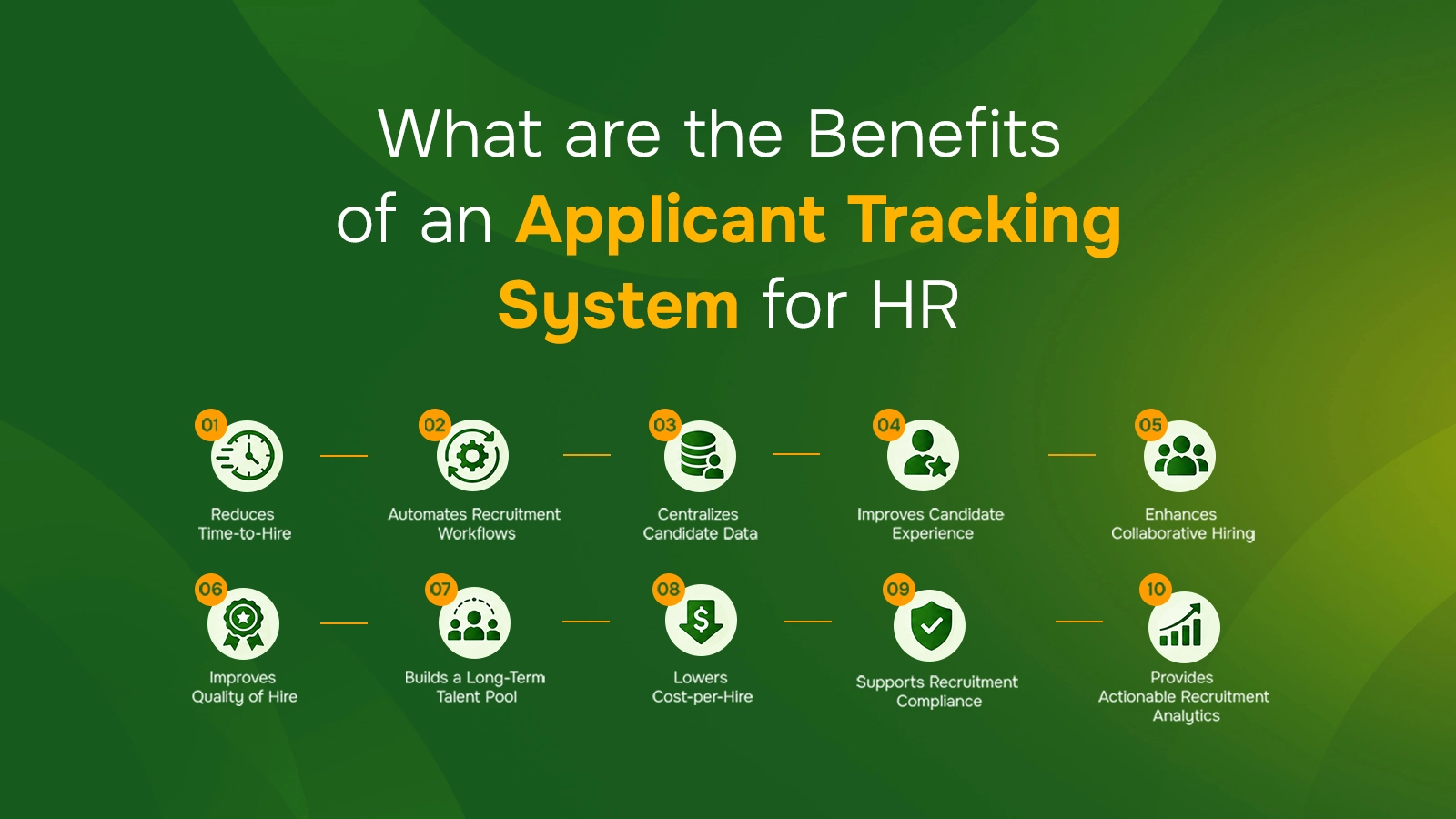
Here are the 10 most impactful benefits HR teams experience after switching to an ATS:
1. Reduces Time-to-Hire
An ATS shortens the recruitment cycle by automating manual tasks. Recruiters often spend hours sorting resumes, sending emails, and scheduling interviews.
An ATS automates much of this work, allowing recruiters to focus on evaluating candidates rather than managing administrative tasks.
For instance, instead of manually reviewing 500 resumes, an ATS automatically identifies candidates who meet specific qualifications and moves them to the next stage.
This reduces delays and helps organizations fill positions faster.
Automation is one lever of several — here are 9 fixes that actually reduce time to hire, and how to tell which one your process needs.
2. Automates Recruitment Workflows
Workflow automation eliminates repetitive recruiting tasks, such as:
Sending application confirmations
Interview reminders
Candidate status updates
Offer letter workflows
Internal approval requests
An ATS automates these actions based on predefined rules, improving productivity across the entire HR team.
When a candidate submits an application, the system instantly sends a confirmation email and moves the candidate into the appropriate hiring stage pipeline.
This not only improves efficiency but also creates a smoother experience for both recruiters and applicants.
Not everything should be automated, our guide to recruitment automation covers what to automate first and where to keep a human in the loop.
3. Centralizes Candidate Data
ATS stores all candidates' information in one place, making recruitment easier to manage and track.
Without a centralized system, candidate details often end up scattered across emails, spreadsheets, and different platforms. This can make it difficult to locate information, collaborate with hiring managers, or track hiring progress.
An ATS creates a single database where recruiters access resumes, interview notes, communication history, and evaluation feedback. Everyone involved in hiring works from the same information, reducing confusion and improving decision-making.
Having centralized candidate data also makes it easier to revisit past applicants when new opportunities become available.
4. Improves Candidate Experience
ATS helps recruiters stay connected with candidates through automated updates, interview reminders, and timely follow-ups.
This keeps candidates informed throughout the hiring process, rather than leaving them wondering what happens after they submit an application.
Likewise, many systems also provide mobile-friendly application processes, making it easier for candidates to apply from any device.
To illustrate, instead of waiting weeks without hearing back, candidates receive immediate confirmation that their application has been received and updates as they move through the hiring process.
A positive candidate experience strengthens employer branding and increases offer acceptance rates.
Candidate experience is a measurable outcome, not a feeling, see what candidate experience is, its stages, and how to improve it.
5. Enhances Collaborative Hiring
ATS makes collaboration easier by bringing recruiters, hiring managers, and interviewers together on a single platform.
Without a shared system, hiring feedback often gets scattered across spreadsheets and email threads, leading to delays, miscommunication, and missed updates.
An ATS solves this by providing a centralized space where hiring teams can review candidate profiles, leave comments, share interview feedback, and evaluate applicants together.
With everyone working from the same information, teams can collaborate more efficiently and make faster, more consistent hiring decisions.
6. Improves Quality of Hire
ATS helps hiring teams make better and more consistent hiring decisions by providing a structured way to evaluate candidates.
Instead of relying solely on individual opinions, recruiters and interviewers can assess applicants using standardized screening criteria, interview scorecards, and candidate comparison tools.
This creates a fair and consistent evaluation process, making it easier to compare candidates based on their skills, experience, and qualifications.
With everyone following the same evaluation framework, hiring teams can identify the strongest candidate with greater confidence and make more informed hiring decisions.
7. Builds a Long-Term Talent Pool
ATS helps companies maintain a database of qualified candidates for future opportunities.
Not every strong applicant gets hired immediately. Many become silver medalists, high-potential applicants who performed well throughout the hiring process but weren't selected.
Instead of losing contact with these candidates, an ATS allows recruiters to organize and store applicant information in a searchable talent pool.
Recruiters can revisit previous applicants whenever new positions become available.
Over time, this reduces sourcing efforts and helps organizations fill roles faster using existing talent pipelines.
A talent pool only pays off if it's maintained. Here's how to build a talent pool and keep it warm between roles.
8. Lowers Cost-per-Hire
An ATS lowers cost-per-hire by reducing the time, effort, and resources required to fill open positions.
Hiring expenses quickly add up through job advertising, recruiter hours, agency fees, and productivity losses caused by vacant roles. The longer a position remains open, the more these costs increase.
An ATS reduces these expenses by automating repetitive tasks, minimizing administrative work, and shortening the hiring process.
For example, filling a critical role in 30 days instead of 60 days reduces both direct recruitment costs and productivity losses.
As a result, businesses spend less on recruitment while maintaining the quality of their hires.
9. Supports Recruitment Compliance
ATS improves compliance by standardizing hiring processes and securely managing candidate information.
Recruitment involves collecting sensitive personal data and following employment laws, equal opportunity regulations, and data protection requirements.
Managing this information manually increases the risk of errors, inconsistent hiring practices, and missing records.
An ATS addresses these challenges by creating standardized hiring workflows, securely storing candidate data, and maintaining detailed recruitment records.
As a result, HR teams can demonstrate compliance more easily, protect candidate data, and reduce the legal risks associated with recruitment.
10. Provides Actionable Recruitment Analytics
ATS provides valuable recruitment insights that help organizations make better hiring decisions.
Without reliable recruitment data, it’s difficult to identify what’s working and where improvements are needed.
An ATS tracks key hiring metrics and generates reports that provide valuable insights.
Here are some common metrics:
Time to hire
Cost per hire
Source of hire
Candidate conversion rates
Interview-to-offer ratio
Quality of hire
If analytics show that one job board consistently delivers higher-quality candidates, recruiters can invest more resources into the channel.
These insights help organizations make smarter, data-driven hiring decisions and continuously improve their recruitment strategy.
See These Benefits In Your Own Workflow
Bring jobs, candidates, interviews and team feedback together in one clear workspace.
Explore Mercury RecruitHow Mercury can Provide You These Benefits
Many applicant tracking systems help streamline hiring, but not all of them are built to handle the challenges of modern recruitment.
Mercury Recruit goes beyond basic applicant tracking by combining recruitment automation, AI-powered hiring tools, candidate assessments, analytics, and talent management on a single platform.
1. AI-Powered Candidate Matching and Screening
Mercury uses AI to simplify candidate screening and matching.
By analyzing applicant profiles against job requirements, the platform helps recruiters quickly identify suitable candidates, reduce manual review time, and focus on engaging top talent.
2. Transparent and Scalable Pricing
Many recruitment platforms come with complex pricing structures and hidden costs as your hiring needs grow.
Mercury offers transparent pricing, allowing organizations to choose an ATS that fits their recruitment requirements without unexpected expenses.
This makes it easier to plan recruitment technology investments as the business scales.
3. Seamless Integrations Across Your Hiring Ecosystem
Recruitment doesn't happen in isolation. Mercury integrates with the tools HR teams already use, helping keep candidate information, communication, and hiring workflows connected.
Instead of switching between multiple platforms, recruiters can manage the hiring process more efficiently from a unified system.
4. Role-Based Permissions and Collaborative Hiring
Hiring often involves recruiters, HR teams, hiring managers, department heads, and interviewers.
Mercury supports role-based access and permissions, ensuring every stakeholder has access to the information they need while maintaining data security and control.
This creates a more organized and collaborative hiring process.
5. Automated Email Communication and Templates
Consistent communication is essential for a positive candidate experience.
Mercury allows recruiters to automate candidate communication through customizable email templates and workflows.
From application confirmations to interview invitations and status updates, communication can be managed quickly and consistently.
6. Built-In Assessments for Better Candidate Evaluation
Resumes only tell part of the story. Mercury includes assessment capabilities that help organizations evaluate candidates based on skills, competencies, and job-specific requirements.
This enables more objective hiring decisions and helps identify candidates who are the best fit for the role.
7. Talent Pool Management for Future Hiring Needs
Strong candidates are valuable even when they are not selected for a current role.
Mercury helps organizations build and maintain talent pools, making it easier to reconnect with qualified candidates when future opportunities arise.
8. Enterprise-Ready Recruitment Platform
Whether you're hiring for a single department or managing recruitment across multiple teams and locations, Mercury is designed to support organizations of different sizes.
Its scalable architecture and flexible workflows allow businesses to adapt the platform to their recruitment processes as hiring needs evolve,
If you are looking for an ATS that does more than organize resumes, Mercury Recruit offers the tools, flexibility, and intelligence needed to support long-term hiring success.
Recruitment Software That Actually Helps You Recruit
Say goodbye to scattered notes, clunky forms and endless follow-ups.
Book A DemoConclusion
Hiring is one of the most important parts of any business, and an ATS helps make it easier.
It saves time, reduces repetitive tasks, keeps candidate data organized, and improves team collaboration.
All these benefits come together to create a hiring process that actually works.
No matter how many roles you’re filling, the right ATS streamlines your workflow and prevents costly delays while helping you attract better candidates.
If your current process relies on spreadsheets and email threads, it’s time to switch to a more efficient system.